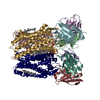
Journal: Nature / Year: 2026 Title: De novo design of miniproteins targeting GPCRs. Authors: Edin Muratspahić / David Feldman / David E Kim / Xiangli Qu / Ana-Maria Bratovianu / Paula Rivera-Sánchez / Jan Hendrik Voss / Emil P T Hertz / Mads Jeppesen / Federica Dimitri / Kensuke ...Authors: Edin Muratspahić / David Feldman / David E Kim / Xiangli Qu / Ana-Maria Bratovianu / Paula Rivera-Sánchez / Jan Hendrik Voss / Emil P T Hertz / Mads Jeppesen / Federica Dimitri / Kensuke Sakamoto / Amrita Nallathambi / Pia Peceli / Jianjun Cao / Brian P Cary / Matthew J Belousoff / Peter Keov / Phuc N H Trinh / Qingchao Chen / Yue Ren / Justyn Fine / Sudha Mishra / Annu Dalal / Shachie Sinha / Ramanuj Banerjee / Manisankar Ganguly / Karthik Varappalayam Karuppusamy / Isaac Sappington / Thomas Schlichthaerle / Jason Z Zhang / Arvind Pillai / Brian Coventry / Ljubica Mihaljević / Magnus S Bauer / Susana Vázquez Torres / Amir Motmaen / Gyu Rie Lee / Long Tran / Xinru Wang / Inna Goreshnik / Dionne K Vafeados / Justin E Svendsen / Parisa Hosseinzadeh / Nicolai Lindegaard / Matthäus Brandt / Yann Waltenspühl / Kristine Deibler / Lukas Deweid / Anja Bennett / Jendrik Schöppe / Tiantang Dong / Xiaoli Yan / Luke Oostdyk / William Cao / Lakshmi Anantharaman / Johan J Weisser / Jesper Frank Bastlund / Christoffer Bundgaard / Ayodeji A Asuni / Justin G English / Lance J Stewart / Lauren Halloran / Jamie B Spangler / André Lieber / Arun K Shukla / Patrick M Sexton / Bryan L Roth / Brian E Krumm / Denise Wootten / Christopher G Tate / Christoffer Norn / David Baker / Abstract: G-protein-coupled receptors (GPCRs) have key roles in physiology and are central targets for drug discovery and development, but the design of protein agonists and antagonists has been challenging as ...G-protein-coupled receptors (GPCRs) have key roles in physiology and are central targets for drug discovery and development, but the design of protein agonists and antagonists has been challenging as GPCRs are integral membrane proteins and conformationally dynamic. Here we describe de novo design methods and a high-throughput receptor-diversion microscopy-based screen for generating GPCR-binding miniproteins with high affinity, potency and selectivity. We design miniprotein agonists that activate receptors involved in itch and pain, as well as antagonists that inhibit receptors implicated in cancer, metabolic disorders such as diabetes and obesity, and migraines. The cryo-electron microscopy (cryo-EM) structures of five receptor-bound designs are close to the computational design models. A designed chemokine receptor antagonist mobilizes haematopoietic stem and progenitor cells in vivo at a level comparable to a clinically used drug, with fewer adverse effects.
In the structure databanks used in Yorodumi, some data are registered as the other names, "COVID-19 virus" and "2019-nCoV". Here are the details of the virus and the list of structure data.
Jan 31, 2019. EMDB accession codes are about to change! (news from PDBe EMDB page)
EMDB accession codes are about to change! (news from PDBe EMDB page)
The allocation of 4 digits for EMDB accession codes will soon come to an end. Whilst these codes will remain in use, new EMDB accession codes will include an additional digit and will expand incrementally as the available range of codes is exhausted. The current 4-digit format prefixed with “EMD-” (i.e. EMD-XXXX) will advance to a 5-digit format (i.e. EMD-XXXXX), and so on. It is currently estimated that the 4-digit codes will be depleted around Spring 2019, at which point the 5-digit format will come into force.
The EM Navigator/Yorodumi systems omit the EMD- prefix.
Related info.:Q: What is EMD? / ID/Accession-code notation in Yorodumi/EM Navigator
Yorodumi is a browser for structure data from EMDB, PDB, SASBDB, etc.
This page is also the successor to EM Navigator detail page, and also detail information page/front-end page for Omokage search.
The word "yorodu" (or yorozu) is an old Japanese word meaning "ten thousand". "mi" (miru) is to see.
Related info.:EMDB / PDB / SASBDB / Comparison of 3 databanks / Yorodumi Search / Aug 31, 2016. New EM Navigator & Yorodumi / Yorodumi Papers / Jmol/JSmol / Function and homology information / Changes in new EM Navigator and Yorodumi
 Movie
Movie Controller

 Yorodumi
 Open data
 Basic information
 Map data
 Sample
 Keywords
 Function and homology information
 Homo sapiens (human) / synthetic construct (others)
 Authors
 India,
  United Kingdom, 3 items
  Citation


 Structure visualization
 Downloads & links
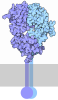
 emd_68747.png
 https://data.pdbj.org/pub/emdb/structures/EMD-68747


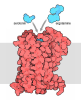
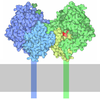
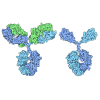
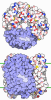
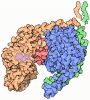
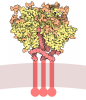
 Z (Sec.)
 Y (Row.)
 X (Col.)


 Sample components
 Escherichia coli (E. coli)
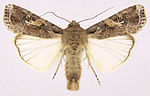 Spodoptera frugiperda (fall armyworm)

 Processing
 Electron microscopy
 FIELD EMISSION GUN