 Movie
Movie Controller

[English] 日本語
 Yorodumi
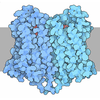
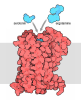
- PDB-22xc: Structure of CXCR4 in complex with a de-novo designed mini-protei... -
+ Open data

- Basic information
| Entry | Database: PDB / ID: 22xc | ||||||||||||||||||||||||
|---|---|---|---|---|---|---|---|---|---|---|---|---|---|---|---|---|---|---|---|---|---|---|---|---|---|
| Title | Structure of CXCR4 in complex with a de-novo designed mini-protein antagonist | ||||||||||||||||||||||||
 Components Components |
| ||||||||||||||||||||||||
 Keywords Keywords | SIGNALING PROTEIN / GPCR / G protein / SIGNALING PROTEIN-IMMUNE SYSTEM complex | ||||||||||||||||||||||||
| Function / homology |  Function and homology information Function and homology informationC-X-C motif chemokine 12 receptor activity / positive regulation of macrophage migration inhibitory factor signaling pathway / CXCL12-activated CXCR4 signaling pathway / myosin light chain binding / Specification of primordial germ cells / myelin maintenance / Developmental Lineage of Multipotent Pancreatic Progenitor Cells / C-X-C chemokine receptor activity / positive regulation of vasculature development / Signaling by ROBO receptors ...C-X-C motif chemokine 12 receptor activity / positive regulation of macrophage migration inhibitory factor signaling pathway / CXCL12-activated CXCR4 signaling pathway / myosin light chain binding / Specification of primordial germ cells / myelin maintenance / Developmental Lineage of Multipotent Pancreatic Progenitor Cells / C-X-C chemokine receptor activity / positive regulation of vasculature development / Signaling by ROBO receptors / Formation of definitive endoderm / C-C chemokine binding / C-C chemokine receptor activity / Chemokine receptors bind chemokines / anchoring junction / dendritic cell chemotaxis / positive regulation of oligodendrocyte differentiation / cellular response to cytokine stimulus / cell leading edge / Binding and entry of HIV virion / regulation of cell adhesion / neurogenesis / coreceptor activity / calcium-mediated signaling / brain development / cell chemotaxis / ubiquitin binding / response to virus / G protein-coupled receptor activity / adenylate cyclase-inhibiting G protein-coupled receptor signaling pathway / late endosome / positive regulation of cold-induced thermogenesis / positive regulation of cytosolic calcium ion concentration / virus receptor activity / actin binding / cytoplasmic vesicle / response to hypoxia / G alpha (i) signalling events / early endosome / lysosome / immune response / positive regulation of cell migration / inflammatory response / G protein-coupled receptor signaling pathway / external side of plasma membrane / ubiquitin protein ligase binding / apoptotic process / cell surface / protein-containing complex / extracellular exosome / plasma membrane / cytoplasm Similarity search - Function | ||||||||||||||||||||||||
| Biological species | synthetic construct (others) Homo sapiens (human) Homo sapiens (human) | ||||||||||||||||||||||||
| Method | ELECTRON MICROSCOPY / single particle reconstruction / cryo EM / Resolution: 3.28 Å | ||||||||||||||||||||||||
 Authors Authors | Banerjee, R. / Ganguly, M. / Banerjee, N. / Tiwari, D. / Muratspahic, E. / Baker, D. / Shukla, A.K. | ||||||||||||||||||||||||
| Funding support |  India, India,  United Kingdom, 3items United Kingdom, 3items
| ||||||||||||||||||||||||
 Citation Citation | Journal: Nature / Year: 2026 Title: De novo design of miniproteins targeting GPCRs. Authors: Edin Muratspahić / David Feldman / David E Kim / Xiangli Qu / Ana-Maria Bratovianu / Paula Rivera-Sánchez / Jan Hendrik Voss / Emil P T Hertz / Mads Jeppesen / Federica Dimitri / Kensuke ...Authors: Edin Muratspahić / David Feldman / David E Kim / Xiangli Qu / Ana-Maria Bratovianu / Paula Rivera-Sánchez / Jan Hendrik Voss / Emil P T Hertz / Mads Jeppesen / Federica Dimitri / Kensuke Sakamoto / Amrita Nallathambi / Pia Peceli / Jianjun Cao / Brian P Cary / Matthew J Belousoff / Peter Keov / Phuc N H Trinh / Qingchao Chen / Yue Ren / Justyn Fine / Sudha Mishra / Annu Dalal / Shachie Sinha / Ramanuj Banerjee / Manisankar Ganguly / Karthik Varappalayam Karuppusamy / Isaac Sappington / Thomas Schlichthaerle / Jason Z Zhang / Arvind Pillai / Brian Coventry / Ljubica Mihaljević / Magnus S Bauer / Susana Vázquez Torres / Amir Motmaen / Gyu Rie Lee / Long Tran / Xinru Wang / Inna Goreshnik / Dionne K Vafeados / Justin E Svendsen / Parisa Hosseinzadeh / Nicolai Lindegaard / Matthäus Brandt / Yann Waltenspühl / Kristine Deibler / Lukas Deweid / Anja Bennett / Jendrik Schöppe / Tiantang Dong / Xiaoli Yan / Luke Oostdyk / William Cao / Lakshmi Anantharaman / Johan J Weisser / Jesper Frank Bastlund / Christoffer Bundgaard / Ayodeji A Asuni / Justin G English / Lance J Stewart / Lauren Halloran / Jamie B Spangler / André Lieber / Arun K Shukla / Patrick M Sexton / Bryan L Roth / Brian E Krumm / Denise Wootten / Christopher G Tate / Christoffer Norn / David Baker /     Abstract: G-protein-coupled receptors (GPCRs) have key roles in physiology and are central targets for drug discovery and development, but the design of protein agonists and antagonists has been challenging as ...G-protein-coupled receptors (GPCRs) have key roles in physiology and are central targets for drug discovery and development, but the design of protein agonists and antagonists has been challenging as GPCRs are integral membrane proteins and conformationally dynamic. Here we describe de novo design methods and a high-throughput receptor-diversion microscopy-based screen for generating GPCR-binding miniproteins with high affinity, potency and selectivity. We design miniprotein agonists that activate receptors involved in itch and pain, as well as antagonists that inhibit receptors implicated in cancer, metabolic disorders such as diabetes and obesity, and migraines. The cryo-electron microscopy (cryo-EM) structures of five receptor-bound designs are close to the computational design models. A designed chemokine receptor antagonist mobilizes haematopoietic stem and progenitor cells in vivo at a level comparable to a clinically used drug, with fewer adverse effects. | ||||||||||||||||||||||||
| History |
|
- Structure visualization
| Structure viewer | Molecule: MolmilJmol/JSmol |
|---|
- Downloads & links
-Download
| PDBx/mmCIF format | 22xc.cif.gz | 209.3 KB | Display | PDBx/mmCIF format |
|---|---|---|---|---|
| PDB format | pdb22xc.ent.gz | 163.7 KB | Display | PDB format |
| PDBx/mmJSON format | 22xc.json.gz | Tree view | PDBx/mmJSON format | |
| Others |  Other downloads Other downloads |
-Validation report
| Arichive directory | https://data.pdbj.org/pub/pdb/validation_reports/2x/22xcftp://data.pdbj.org/pub/pdb/validation_reports/2x/22xc | HTTPS FTP |
|---|
-Related structure data
| Related structure data |  68747MC  9mm5C M: map data used to model this data C: citing same article ( |
|---|---|
| Similar structure data |

-Links
 PDBj
PDBj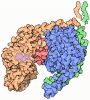
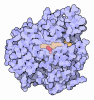
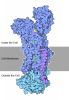
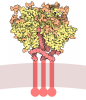
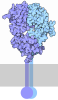
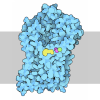
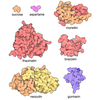
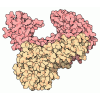
- Assembly
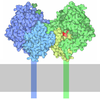
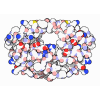
| Deposited unit | 
|
|---|---|
| 1 |
|
-Components
| #1: Protein | Mass: 9994.729 Da / Num. of mol.: 3 Source method: isolated from a genetically manipulated source Source: (gene. exp.) synthetic construct (others) / Production host:   Escherichia coli (E. coli) Escherichia coli (E. coli)#2: Protein | Mass: 45688.859 Da / Num. of mol.: 3 Source method: isolated from a genetically manipulated source Source: (gene. exp.) Homo sapiens (human) / Gene: CXCR4 / Production host:   Spodoptera frugiperda (fall armyworm) / References: UniProt: P61073 Spodoptera frugiperda (fall armyworm) / References: UniProt: P61073#3: Chemical | 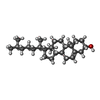 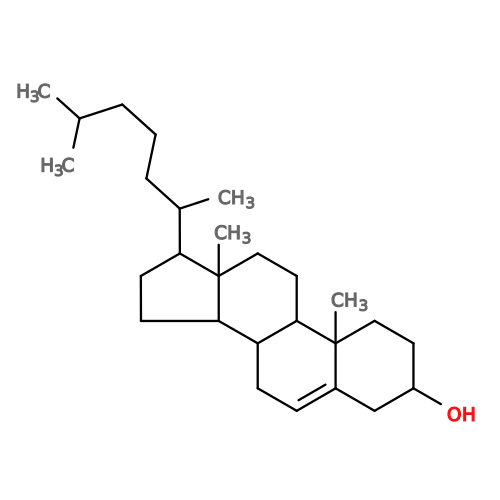 Mass: 386.654 Da / Num. of mol.: 3 / Source method: obtained synthetically / Formula: C27H46O / Feature type: SUBJECT OF INVESTIGATION Mass: 386.654 Da / Num. of mol.: 3 / Source method: obtained synthetically / Formula: C27H46O / Feature type: SUBJECT OF INVESTIGATION#4: Chemical |  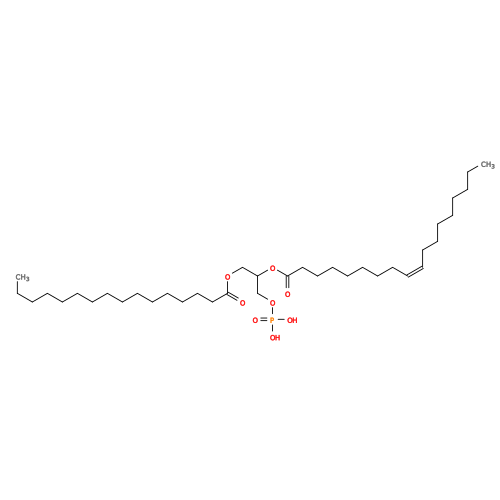 Mass: 674.929 Da / Num. of mol.: 3 / Source method: obtained synthetically / Formula: C37H71O8P / Feature type: SUBJECT OF INVESTIGATION Mass: 674.929 Da / Num. of mol.: 3 / Source method: obtained synthetically / Formula: C37H71O8P / Feature type: SUBJECT OF INVESTIGATIONHas ligand of interest | Y | Has protein modification | Y | |
|---|
-Experimental details
-Experiment
| Experiment | Method: ELECTRON MICROSCOPY |
|---|---|
| EM experiment | Aggregation state: PARTICLE / 3D reconstruction method: single particle reconstruction |
- Sample preparation
| Component |
| ||||||||||||||||||||||||
|---|---|---|---|---|---|---|---|---|---|---|---|---|---|---|---|---|---|---|---|---|---|---|---|---|---|
| Source (natural) |
| ||||||||||||||||||||||||
| Source (recombinant) |
| ||||||||||||||||||||||||
| Buffer solution | pH: 7.4 | ||||||||||||||||||||||||
| Specimen | Embedding applied: NO / Shadowing applied: NO / Staining applied: NO / Vitrification applied: YES | ||||||||||||||||||||||||
| Vitrification | Cryogen name: ETHANE |

 Mus musculus (house mouse)
- Electron microscopy imaging
| Experimental equipment |  Model: Titan Krios / Image courtesy: FEI Company |
|---|---|
| Microscopy | Model: TFS KRIOS |
| Electron gun | Electron source:  FIELD EMISSION GUN / Accelerating voltage: 300 kV / Illumination mode: FLOOD BEAM FIELD EMISSION GUN / Accelerating voltage: 300 kV / Illumination mode: FLOOD BEAM |
| Electron lens | Mode: BRIGHT FIELD / Nominal defocus max: 1800 nm / Nominal defocus min: 800 nm |
| Image recording | Electron dose: 75 e/Å2 / Detector mode: COUNTING / Film or detector model: GATAN K3 (6k x 4k) |
| Image scans | Movie frames/image: 40 |
- Processing
| EM software |
| ||||||||||||||||||||||||
|---|---|---|---|---|---|---|---|---|---|---|---|---|---|---|---|---|---|---|---|---|---|---|---|---|---|
| CTF correction | Type: NONE | ||||||||||||||||||||||||
| Symmetry | Point symmetry: C3 (3 fold cyclic) | ||||||||||||||||||||||||
| 3D reconstruction | Resolution: 3.28 Å / Resolution method: FSC 0.143 CUT-OFF / Num. of particles: 18396 / Symmetry type: POINT | ||||||||||||||||||||||||
| Atomic model building | Protocol: FLEXIBLE FIT / Space: REAL | ||||||||||||||||||||||||
| Refinement | Highest resolution: 3.28 Å Stereochemistry target values: REAL-SPACE (WEIGHTED MAP SUM AT ATOM CENTERS) | ||||||||||||||||||||||||
| Refine LS restraints |
|
