npBAF complex / brahma complex / positive regulation of norepinephrine uptake / positive regulation of telomere maintenance in response to DNA damage / regulation of DNA strand elongation / GBAF complex / cellular response to cytochalasin B / neural retina development / Formation of the embryonic stem cell BAF (esBAF) complex / RSC-type complex ...npBAF complex / brahma complex / positive regulation of norepinephrine uptake / positive regulation of telomere maintenance in response to DNA damage / regulation of DNA strand elongation / GBAF complex / cellular response to cytochalasin B / neural retina development / Formation of the embryonic stem cell BAF (esBAF) complex / RSC-type complex / regulation of transepithelial transport / Formation of the canonical BAF (cBAF) complex / morphogenesis of a polarized epithelium / Formation of annular gap junctions / Formation of the dystrophin-glycoprotein complex (DGC) / Formation of the polybromo-BAF (pBAF) complex / structural constituent of postsynaptic actin cytoskeleton / Gap junction degradation / GBP-mediated host defense / Formation of neuronal progenitor and neuronal BAF (npBAF and nBAF) / protein localization to adherens junction / Formation of the non-canonical BAF (ncBAF) complex / Cell-extracellular matrix interactions / regulation of G0 to G1 transition / dense body / Tat protein binding / Folding of actin by CCT/TriC / postsynaptic actin cytoskeleton / Ino80 complex / Regulation of CDH1 Function / apical protein localization / Adherens junctions interactions / Prefoldin mediated transfer of substrate to CCT/TriC / microtubule nucleation / SWI/SNF complex / RHOF GTPase cycle / regulation of double-strand break repair / adherens junction assembly / Sensory processing of sound by outer hair cells of the cochlea / tight junction / positive regulation of T cell differentiation / regulation of mitotic metaphase/anaphase transition / Sensory processing of sound by inner hair cells of the cochlea / spinal cord development / maintenance of blood-brain barrier / Interaction between L1 and Ankyrins / apical junction complex / regulation of nucleotide-excision repair / positive regulation of stem cell population maintenance / NuA4 histone acetyltransferase complex / regulation of chromosome organization / regulation of norepinephrine uptake / transporter regulator activity / Recycling pathway of L1 / positive regulation of double-strand break repair / cortical cytoskeleton / Regulation of MITF-M-dependent genes involved in pigmentation / establishment or maintenance of cell polarity / negative regulation of cell differentiation / nitric-oxide synthase binding / RUNX1 interacts with co-factors whose precise effect on RUNX1 targets is not known / regulation of DNA replication / brush border / EPH-ephrin mediated repulsion of cells / regulation of synaptic vesicle endocytosis / RHO GTPases Activate WASPs and WAVEs / positive regulation of myoblast differentiation / ATP-dependent activity, acting on DNA / kinesin binding / regulation of protein localization to plasma membrane / RHO GTPases activate IQGAPs / positive regulation of double-strand break repair via homologous recombination / regulation of G1/S transition of mitotic cell cycle / axonogenesis / cytoskeleton organization / EPHB-mediated forward signaling / substantia nigra development / helicase activity / regulation of embryonic development / telomere maintenance / cell motility / calyx of Held / nitric-oxide synthase regulator activity / FCGR3A-mediated phagocytosis / adherens junction / actin filament / positive regulation of cell differentiation / Translocation of SLC2A4 (GLUT4) to the plasma membrane / Regulation of endogenous retroelements by Piwi-interacting RNAs (piRNAs) / RHO GTPases Activate Formins / negative regulation of cell growth / Signaling by high-kinase activity BRAF mutants / MAP2K and MAPK activation / Regulation of actin dynamics for phagocytic cup formation / platelet aggregation / fibrillar center / VEGFA-VEGFR2 Pathway / B-WICH complex positively regulates rRNA expression / tau protein binding / Schaffer collateral - CA1 synapse Similarity search - Function
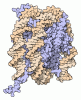
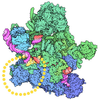
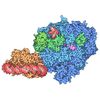
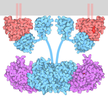
Journal: J Mol Cell Biol / Year: 2026 Title: Structural basis of complex assembly and nucleosome recognition by the chromatin remodeling ncBAF complex. Authors: Wancheng Xu / Shengsheng Ma / Yi Li / Muchun Li / Chihang Li / Yue Yin / Qingrun Li / Jingdong Cheng / Yong Chen / Abstract: BRG1/BRM-associated factor (BAF)-family chromatin remodelers regulate transcription and genome organization by repositioning nucleosomes. The human non-canonical BAF (ncBAF) complex is uniquely ...BRG1/BRM-associated factor (BAF)-family chromatin remodelers regulate transcription and genome organization by repositioning nucleosomes. The human non-canonical BAF (ncBAF) complex is uniquely defined by the presence of BRD9 and GLTSCR1/GLTSCR1L, as well as the absence of the ARID1/2 scaffold and the canonical nucleosome-binding module found in cBAF and PBAF. How ncBAF assembles and engages nucleosomes remains elusive. Here, we present a cryo-EM structure of ncBAF bound to a nucleosome, integrated with biochemical assays and crosslinking mass spectrometry analyses. The ncBAF complex adopts a three-module architecture comprising an ATPase motor module, a repositioned actin-related protein (ARP) module, and a highly flexible Base module. The ncBAF-specific subunits BRD9 and GLTSCR1L are largely dispensable for complex assembly and nucleosome remodeling. Instead, BCL7A directly engages the H2A-H2B acidic patch and the H2A N-terminal tail, providing a structural substitute for SMARCB1 in stimulating remodeling activity. These findings reveal how ncBAF compensates for the loss of the canonical nucleosome-binding module through modular reorganization, providing a structural framework for understanding ncBAF-mediated chromatin regulation and its roles in development and disease.
Protein or peptide: B-cell CLL/lymphoma 7 protein family member A
Protein or peptide: Actin, cytoplasmic 1
Protein or peptide: Actin-like protein 6A
Complex: Nucleosome
Protein or peptide: Histone H3
Protein or peptide: Histone H4
Protein or peptide: Histone H2A
Protein or peptide: Histone H2B
DNA: DNA (167-MER)
DNA: DNA (167-MER)
Ligand: BERYLLIUM TRIFLUORIDE ION
Ligand: MAGNESIUM ION
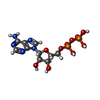
Ligand: ADENOSINE-5'-DIPHOSPHATE
+
Supramolecule #1: The ncBAF-NCP complex
Supramolecule
Name: The ncBAF-NCP complex / type: complex / ID: 1 / Parent: 0 / Macromolecule list: #1-#10 / Details: The ncBAF complex bound to a nucleosome
Source (natural)
Organism: Homo sapiens (human)
Molecular weight
Theoretical: 900 KDa
+
Supramolecule #2: The ncBAF complex
Supramolecule
Name: The ncBAF complex / type: complex / ID: 2 / Parent: 1 / Macromolecule list: #5, #8-#10 Details: Only BCL7A, SMARCA4,ACTB, and ACT6A are observed in density map.
Source (natural)
Organism: Homo sapiens (human)
Molecular weight
Theoretical: 700 KDa
+
Supramolecule #3: Nucleosome
Supramolecule
Name: Nucleosome / type: complex / ID: 3 / Parent: 1 / Macromolecule list: #1-#7 Details: The nucleosome core particle composed of Histones H2A, H2B, H3, H4, and double-stranded DNA. BCL7 finger helix is also included.
Source (natural)
Organism: Homo sapiens (human)
Molecular weight
Theoretical: 200 KDa
+
Supramolecule #4: The ATPase domain of SMARCA4
Supramolecule
Name: The ATPase domain of SMARCA4 / type: complex / ID: 4 / Parent: 2 / Macromolecule list: #8 / Details: It includes ATPase domain of SMARCA4
Source (natural)
Organism: Homo sapiens (human)
Molecular weight
Theoretical: 190 KDa
+
Supramolecule #5: The ARP module
Supramolecule
Name: The ARP module / type: complex / ID: 5 / Parent: 2 / Macromolecule list: #5, #8-#10 Details: The ARP module is composed of ACTB, ACTL6A, ABM of BCL7A,and HSA of SMARCA4
Source (natural)
Organism: Homo sapiens (human)
Molecular weight
Theoretical: 110 KDa
+
Macromolecule #1: Histone H3
Macromolecule
Name: Histone H3 / type: protein_or_peptide / ID: 1 / Number of copies: 2 / Enantiomer: LEVO
Macromolecule #5: B-cell CLL/lymphoma 7 protein family member A
Macromolecule
Name: B-cell CLL/lymphoma 7 protein family member A / type: protein_or_peptide / ID: 5 / Details: BCL7A full length with a C-terminal 6xHis tag / Number of copies: 1 / Enantiomer: LEVO
UniProtKB: B-cell CLL/lymphoma 7 protein family member A
+
Macromolecule #8: SMARCA4 isoform 2
Macromolecule
Name: SMARCA4 isoform 2 / type: protein_or_peptide / ID: 8 Details: SMARCA4 full length with an N-terminal 10aa linker and a C-terminal 3xFlag tag Number of copies: 1 / Enantiomer: LEVO
UniProtKB: SWI/SNF related BAF chromatin remodeling complex subunit ATPase 4
+
Macromolecule #9: Actin, cytoplasmic 1
Macromolecule
Name: Actin, cytoplasmic 1 / type: protein_or_peptide / ID: 9 / Details: ACTB full length with a C-terminal 6xHis tag / Number of copies: 1 / Enantiomer: LEVO EC number: Hydrolases; Acting on acid anhydrides; Acting on acid anhydrides to facilitate cellular and subcellular movement
Name: Actin-like protein 6A / type: protein_or_peptide / ID: 10 / Details: ACTL6A full length with a C-terminal 6xHis tag / Number of copies: 1 / Enantiomer: LEVO
In the structure databanks used in Yorodumi, some data are registered as the other names, "COVID-19 virus" and "2019-nCoV". Here are the details of the virus and the list of structure data.
Jan 31, 2019. EMDB accession codes are about to change! (news from PDBe EMDB page)
EMDB accession codes are about to change! (news from PDBe EMDB page)
The allocation of 4 digits for EMDB accession codes will soon come to an end. Whilst these codes will remain in use, new EMDB accession codes will include an additional digit and will expand incrementally as the available range of codes is exhausted. The current 4-digit format prefixed with “EMD-” (i.e. EMD-XXXX) will advance to a 5-digit format (i.e. EMD-XXXXX), and so on. It is currently estimated that the 4-digit codes will be depleted around Spring 2019, at which point the 5-digit format will come into force.
The EM Navigator/Yorodumi systems omit the EMD- prefix.
Related info.:Q: What is EMD? / ID/Accession-code notation in Yorodumi/EM Navigator
Yorodumi is a browser for structure data from EMDB, PDB, SASBDB, etc.
This page is also the successor to EM Navigator detail page, and also detail information page/front-end page for Omokage search.
The word "yorodu" (or yorozu) is an old Japanese word meaning "ten thousand". "mi" (miru) is to see.
Related info.:EMDB / PDB / SASBDB / Comparison of 3 databanks / Yorodumi Search / Aug 31, 2016. New EM Navigator & Yorodumi / Yorodumi Papers / Jmol/JSmol / Function and homology information / Changes in new EM Navigator and Yorodumi
 Movie
Movie Controller


 Open data
 Basic information
 Map data
 Sample
 Keywords
 Function and homology information
 Homo sapiens (human) /
  Xenopus laevis (African clawed frog)
 Authors
 China, 1 items
  Citation
 Structure visualization
 Downloads & links
 emd_68040.png
 https://data.pdbj.org/pub/emdb/structures/EMD-68040





 Z (Sec.)
 Y (Row.)
 X (Col.)


 Sample components
 Escherichia coli (E. coli)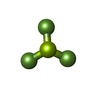
 Processing
 Electron microscopy
 FIELD EMISSION GUN


