[English] 日本語
Yorodumi Papers
- Database of articles cited by EMDB/PDB/SASBDB data -

+
Search query

Keywords
Structure methods
Author
Journal
IF

-
Structure paper

TitleStructural basis of complex assembly and nucleosome recognition by the chromatin remodeling ncBAF complex.
Journal, issue, pagesJ Mol Cell Biol, Year 2026
Publish dateJun 30, 2026
AuthorsWancheng Xu / Shengsheng Ma / Yi Li / Muchun Li / Chihang Li / Yue Yin / Qingrun Li / Jingdong Cheng / Yong Chen /
PubMed AbstractBRG1/BRM-associated factor (BAF)-family chromatin remodelers regulate transcription and genome organization by repositioning nucleosomes. The human non-canonical BAF (ncBAF) complex is uniquely ...BRG1/BRM-associated factor (BAF)-family chromatin remodelers regulate transcription and genome organization by repositioning nucleosomes. The human non-canonical BAF (ncBAF) complex is uniquely defined by the presence of BRD9 and GLTSCR1/GLTSCR1L, as well as the absence of the ARID1/2 scaffold and the canonical nucleosome-binding module found in cBAF and PBAF. How ncBAF assembles and engages nucleosomes remains elusive. Here, we present a cryo-EM structure of ncBAF bound to a nucleosome, integrated with biochemical assays and crosslinking mass spectrometry analyses. The ncBAF complex adopts a three-module architecture comprising an ATPase motor module, a repositioned actin-related protein (ARP) module, and a highly flexible Base module. The ncBAF-specific subunits BRD9 and GLTSCR1L are largely dispensable for complex assembly and nucleosome remodeling. Instead, BCL7A directly engages the H2A-H2B acidic patch and the H2A N-terminal tail, providing a structural substitute for SMARCB1 in stimulating remodeling activity. These findings reveal how ncBAF compensates for the loss of the canonical nucleosome-binding module through modular reorganization, providing a structural framework for understanding ncBAF-mediated chromatin regulation and its roles in development and disease.
External linksJ Mol Cell Biol / PubMed:42377898
MethodsEM (single particle)
Resolution3.7 - 4.7 Å
Structure data

EMDB-68033: CryoEM map of the ATPase domain of SMARCA4 and the finger helix of BCL7A bound to a nucleosome
PDB-21wc: Cryo-EM structure of the ATPase domain of SMARCA4 and the finger helix of BCL7A bound to a nucleosome
Method: EM (single particle) / Resolution: 3.9 Å

EMDB-68034: Cryo-EM map of the ATPase domain of SMARCA4 bound to a nucleosome
PDB-21wa: Cryo-EM structure of the ATPase domain of SMARCA4 bound to a nucleosome
Method: EM (single particle) / Resolution: 3.7 Å

EMDB-68040, PDB-21vv:
Cryo-EM structure of ncBAF bound to the nucleosome
Method: EM (single particle) / Resolution: 4.7 Å

Chemicals

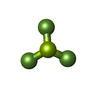
ChemComp-BEF:
BERYLLIUM TRIFLUORIDE ION

ChemComp-MG:
Unknown entry

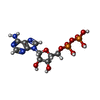
ChemComp-ADP:
ADENOSINE-5'-DIPHOSPHATE / ADP, energy-carrying molecule*YM

Source
  • homo sapiens (human)
  • xenopus laevis (African clawed frog)
  • synthetic construct (others)
KeywordsNUCLEAR PROTEIN/DNA / Chromatin remodeling complex / ncBAF complex / nucleosome / SMARCA4 / BCL7 / ARP / NUCLEAR PROTEIN-DNA complex / ATPase / NUCLEAR PROTEIN / ncBAF

+
About Yorodumi Papers

-
News

-
Feb 9, 2022. New format data for meta-information of EMDB entries

New format data for meta-information of EMDB entries

  • Version 3 of the EMDB header file is now the official format.
  • The previous official version 1.9 will be removed from the archive.

Related info.:EMDB header

External links:wwPDB to switch to version 3 of the EMDB data model

-
Aug 12, 2020. Covid-19 info

Covid-19 info

URL: https://pdbj.org/emnavi/covid19.php

New page: Covid-19 featured information page in EM Navigator.

Related info.:Covid-19 info / Mar 5, 2020. Novel coronavirus structure data

+
Mar 5, 2020. Novel coronavirus structure data

Novel coronavirus structure data

Related info.:Yorodumi Speices / Aug 12, 2020. Covid-19 info

External links:COVID-19 featured content - PDBj / Molecule of the Month (242):Coronavirus Proteases

+
Jan 31, 2019. EMDB accession codes are about to change! (news from PDBe EMDB page)

EMDB accession codes are about to change! (news from PDBe EMDB page)

  • The allocation of 4 digits for EMDB accession codes will soon come to an end. Whilst these codes will remain in use, new EMDB accession codes will include an additional digit and will expand incrementally as the available range of codes is exhausted. The current 4-digit format prefixed with “EMD-” (i.e. EMD-XXXX) will advance to a 5-digit format (i.e. EMD-XXXXX), and so on. It is currently estimated that the 4-digit codes will be depleted around Spring 2019, at which point the 5-digit format will come into force.
  • The EM Navigator/Yorodumi systems omit the EMD- prefix.

Related info.:Q: What is EMD? / ID/Accession-code notation in Yorodumi/EM Navigator

External links:EMDB Accession Codes are Changing Soon! / Contact to PDBj

+
Jul 12, 2017. Major update of PDB

Major update of PDB

  • wwPDB released updated PDB data conforming to the new PDBx/mmCIF dictionary.
  • This is a major update changing the version number from 4 to 5, and with Remediation, in which all the entries are updated.
  • In this update, many items about electron microscopy experimental information are reorganized (e.g. em_software).
  • Now, EM Navigator and Yorodumi are based on the updated data.

External links:wwPDB Remediation / Enriched Model Files Conforming to OneDep Data Standards Now Available in the PDB FTP Archive

-
Yorodumi Papers

Database of articles cited by EMDB/PDB/SASBDB data

  • Database of articles cited by EMDB, PDB, and SASBDB entries
  • Using PubMed data

Related info.:EMDB / PDB / SASBDB / Yorodumi / EMN Papers / Changes in new EM Navigator and Yorodumi

Read more