 Movie
Movie Controller

[English] 日本語
 Yorodumi
- PDB-21wc: Cryo-EM structure of the ATPase domain of SMARCA4 and the finger ... -
+ Open data

- Basic information
| Entry | Database: PDB / ID: 21wc | ||||||
|---|---|---|---|---|---|---|---|
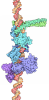
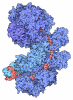
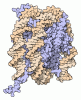
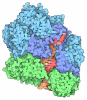
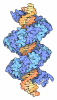
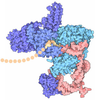
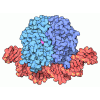
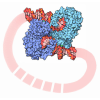
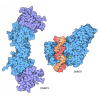
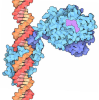
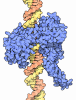
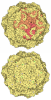
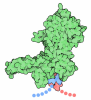
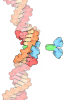
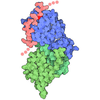
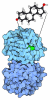
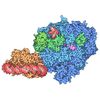
| Title | Cryo-EM structure of the ATPase domain of SMARCA4 and the finger helix of BCL7A bound to a nucleosome | ||||||
 Components Components |
| ||||||
 Keywords Keywords | NUCLEAR PROTEIN/DNA / NUCLEAR PROTEIN / chromatin remodeling complex / ncBAF / SMARCA4 / BCL7 / nucleosome / NUCLEAR PROTEIN-DNA complex | ||||||
| Function / homology |  Function and homology information Function and homology informationFormation of the embryonic stem cell BAF (esBAF) complex / Formation of the canonical BAF (cBAF) complex / Formation of the polybromo-BAF (pBAF) complex / Formation of neuronal progenitor and neuronal BAF (npBAF and nBAF) / Formation of the non-canonical BAF (ncBAF) complex / regulation of G0 to G1 transition / SWI/SNF complex / regulation of mitotic metaphase/anaphase transition / regulation of nucleotide-excision repair / positive regulation of stem cell population maintenance ...Formation of the embryonic stem cell BAF (esBAF) complex / Formation of the canonical BAF (cBAF) complex / Formation of the polybromo-BAF (pBAF) complex / Formation of neuronal progenitor and neuronal BAF (npBAF and nBAF) / Formation of the non-canonical BAF (ncBAF) complex / regulation of G0 to G1 transition / SWI/SNF complex / regulation of mitotic metaphase/anaphase transition / regulation of nucleotide-excision repair / positive regulation of stem cell population maintenance / positive regulation of double-strand break repair / Regulation of MITF-M-dependent genes involved in pigmentation / negative regulation of cell differentiation / ATP-dependent activity, acting on DNA / regulation of G1/S transition of mitotic cell cycle / helicase activity / Regulation of endogenous retroelements by Piwi-interacting RNAs (piRNAs) / negative regulation of cell growth / fibrillar center / nucleosomal DNA binding / innate immune response in mucosa / structural constituent of chromatin / nucleosome / nucleosome assembly / chromatin organization / antimicrobial humoral immune response mediated by antimicrobial peptide / heterochromatin formation / histone binding / antibacterial humoral response / transcription coactivator activity / chromatin remodeling / protein heterodimerization activity / negative regulation of DNA-templated transcription / positive regulation of cell population proliferation / regulation of transcription by RNA polymerase II / nucleolus / chromatin / DNA binding / nucleoplasm / ATP binding / nucleus Similarity search - Function | ||||||
| Biological species |  Xenopus laevis (African clawed frog) Xenopus laevis (African clawed frog) Homo sapiens (human) Homo sapiens (human) | ||||||
| Method | ELECTRON MICROSCOPY / single particle reconstruction / cryo EM / Resolution: 3.9 Å | ||||||
 Authors Authors | Xu, W. / Chen, Y. / Cheng, J. | ||||||
| Funding support |  China, 1items China, 1items
| ||||||
 Citation Citation | Journal: J Mol Cell Biol / Year: 2026 Title: Structural basis of complex assembly and nucleosome recognition by the chromatin remodeling ncBAF complex. Authors: Wancheng Xu / Shengsheng Ma / Yi Li / Muchun Li / Chihang Li / Yue Yin / Qingrun Li / Jingdong Cheng / Yong Chen / Abstract: BRG1/BRM-associated factor (BAF)-family chromatin remodelers regulate transcription and genome organization by repositioning nucleosomes. The human non-canonical BAF (ncBAF) complex is uniquely ...BRG1/BRM-associated factor (BAF)-family chromatin remodelers regulate transcription and genome organization by repositioning nucleosomes. The human non-canonical BAF (ncBAF) complex is uniquely defined by the presence of BRD9 and GLTSCR1/GLTSCR1L, as well as the absence of the ARID1/2 scaffold and the canonical nucleosome-binding module found in cBAF and PBAF. How ncBAF assembles and engages nucleosomes remains elusive. Here, we present a cryo-EM structure of ncBAF bound to a nucleosome, integrated with biochemical assays and crosslinking mass spectrometry analyses. The ncBAF complex adopts a three-module architecture comprising an ATPase motor module, a repositioned actin-related protein (ARP) module, and a highly flexible Base module. The ncBAF-specific subunits BRD9 and GLTSCR1L are largely dispensable for complex assembly and nucleosome remodeling. Instead, BCL7A directly engages the H2A-H2B acidic patch and the H2A N-terminal tail, providing a structural substitute for SMARCB1 in stimulating remodeling activity. These findings reveal how ncBAF compensates for the loss of the canonical nucleosome-binding module through modular reorganization, providing a structural framework for understanding ncBAF-mediated chromatin regulation and its roles in development and disease. | ||||||
| History |
|
- Structure visualization
| Structure viewer | Molecule: MolmilJmol/JSmol |
|---|
- Downloads & links
-Download
| PDBx/mmCIF format | 21wc.cif.gz | 423 KB | Display | PDBx/mmCIF format |
|---|---|---|---|---|
| PDB format | pdb21wc.ent.gz | 307.1 KB | Display | PDB format |
| PDBx/mmJSON format | 21wc.json.gz | Tree view | PDBx/mmJSON format | |
| Others |  Other downloads Other downloads |
-Validation report
| Arichive directory | https://data.pdbj.org/pub/pdb/validation_reports/1w/21wcftp://data.pdbj.org/pub/pdb/validation_reports/1w/21wc | HTTPS FTP |
|---|
-Related structure data
| Related structure data |  68033MC  21vvC  21waC M: map data used to model this data C: citing same article ( |
|---|---|
| Similar structure data |


-Links
 PDBj
PDBj

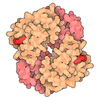
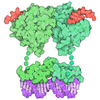
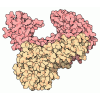
- Assembly
| Deposited unit | 
|
|---|---|
| 1 |
|
-Components
-Protein , 6 types, 10 molecules AEBFCGDHIN
| #1: Protein | Mass: 15303.930 Da / Num. of mol.: 2 Source method: isolated from a genetically manipulated source Source: (gene. exp.) Xenopus laevis (African clawed frog) / Gene: LOC121398065, LOC108703785, LOC121398067 / Production host:   Escherichia coli (E. coli) / References: UniProt: A0A310TTQ1 Escherichia coli (E. coli) / References: UniProt: A0A310TTQ1#2: Protein | Mass: 11263.231 Da / Num. of mol.: 2 Source method: isolated from a genetically manipulated source Source: (gene. exp.) Xenopus laevis (African clawed frog) / Production host: Escherichia coli (E. coli) / References: UniProt: P62799#3: Protein | Mass: 13978.241 Da / Num. of mol.: 2 Source method: isolated from a genetically manipulated source Source: (gene. exp.) Xenopus laevis (African clawed frog) / Gene: LOC494591, h2ac14.L, hist1h2aj, hist1h2aj.L / Production host: Escherichia coli (E. coli) / References: UniProt: Q6AZJ8#4: Protein | Mass: 13848.097 Da / Num. of mol.: 2 Source method: isolated from a genetically manipulated source Source: (gene. exp.) Xenopus laevis (African clawed frog) / Gene: LOC108704303 / Production host: Escherichia coli (E. coli) / References: UniProt: A0A8J0U496#5: Protein | | Mass: 191867.219 Da / Num. of mol.: 1 Source method: isolated from a genetically manipulated source Details: SMARCA4 full length with an N-terminal 10aa linker and a C-terminal 3xFlag tag Source: (gene. exp.) Homo sapiens (human) / Gene: SMARCA4, hCG_29955 / Production host: Homo sapiens (human) / References: UniProt: Q9HBD4#6: Protein | | Mass: 23671.818 Da / Num. of mol.: 1 Source method: isolated from a genetically manipulated source Details: BCL7A full length with a C-terminal 6xHis tag / Source: (gene. exp.) Homo sapiens (human) / Gene: BCL7A / Production host: Homo sapiens (human) / References: UniProt: Q4VC05 |
|---|
-DNA chain , 2 types, 2 molecules XY
| #7: DNA chain | Mass: 51333.703 Da / Num. of mol.: 1 Source method: isolated from a genetically manipulated source Source: (gene. exp.) Homo sapiens (human) / Production host: Homo sapiens (human) |
|---|---|
| #8: DNA chain | Mass: 51773.973 Da / Num. of mol.: 1 Source method: isolated from a genetically manipulated source Source: (gene. exp.) Homo sapiens (human) / Production host: Homo sapiens (human) |
-Non-polymers , 3 types, 3 molecules 
| #9: Chemical | ChemComp-MG / 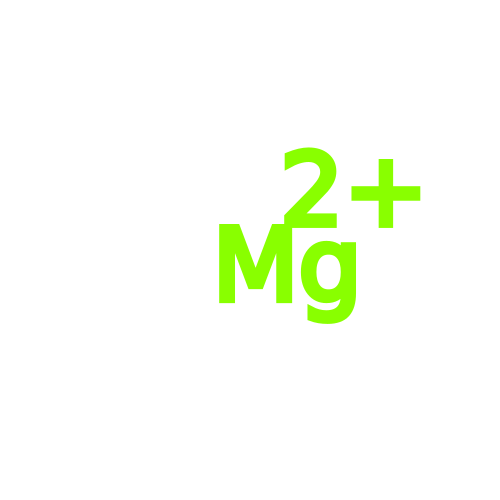 Mass: 24.305 Da / Num. of mol.: 1 / Source method: obtained synthetically / Formula: Mg Mass: 24.305 Da / Num. of mol.: 1 / Source method: obtained synthetically / Formula: Mg |
|---|---|
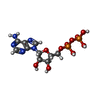
| #10: Chemical | ChemComp-ADP / 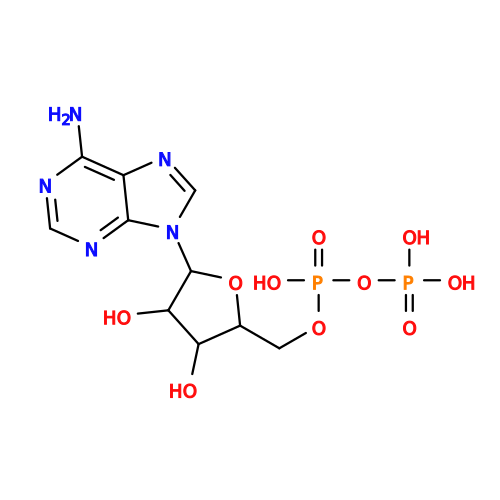 Mass: 427.201 Da / Num. of mol.: 1 / Source method: obtained synthetically / Formula: C10H15N5O10P2 / Comment: ADP, energy-carrying molecule*YM Mass: 427.201 Da / Num. of mol.: 1 / Source method: obtained synthetically / Formula: C10H15N5O10P2 / Comment: ADP, energy-carrying molecule*YM |
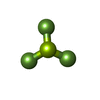
| #11: Chemical | ChemComp-BEF / 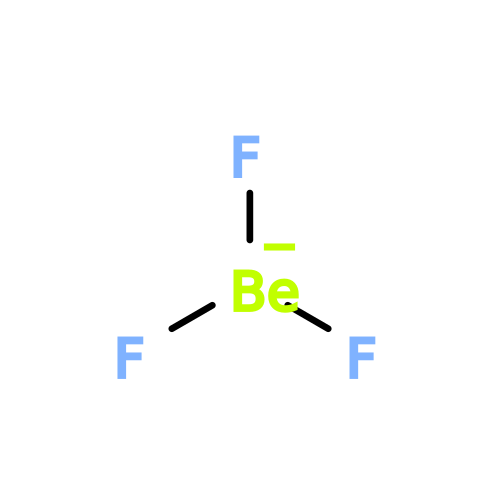 Mass: 66.007 Da / Num. of mol.: 1 / Source method: obtained synthetically / Formula: BeF3 Mass: 66.007 Da / Num. of mol.: 1 / Source method: obtained synthetically / Formula: BeF3 |
-Details
| Has ligand of interest | N |
|---|---|
| Has protein modification | N |
-Experimental details
-Experiment
| Experiment | Method: ELECTRON MICROSCOPY |
|---|---|
| EM experiment | Aggregation state: PARTICLE / 3D reconstruction method: single particle reconstruction |
- Sample preparation
| Component | Name: The ATPase domain of SMARCA4 and the finger helix of BCL7A bound to a nucleosome Type: COMPLEX / Entity ID: #1-#8 / Source: MULTIPLE SOURCES | ||||||||||||||||||||||||||||||||||||||||
|---|---|---|---|---|---|---|---|---|---|---|---|---|---|---|---|---|---|---|---|---|---|---|---|---|---|---|---|---|---|---|---|---|---|---|---|---|---|---|---|---|---|
| Source (natural) | Organism: Homo sapiens (human) | ||||||||||||||||||||||||||||||||||||||||
| Source (recombinant) | Organism: Homo sapiens (human) | ||||||||||||||||||||||||||||||||||||||||
| Buffer solution | pH: 8 Details: 20 mM HEPES pH 8.0, 100 mM KCl, 2 mM MgCl2, 2 mM DTT, 0.5 mM ADP, 8 mM NaF, 1 mM BeSO4. | ||||||||||||||||||||||||||||||||||||||||
| Buffer component |
| ||||||||||||||||||||||||||||||||||||||||
| Specimen | Conc.: 1.5 mg/ml / Embedding applied: NO / Shadowing applied: NO / Staining applied: NO / Vitrification applied: YES | ||||||||||||||||||||||||||||||||||||||||
| Specimen support | Grid material: GOLD / Grid mesh size: 200 divisions/in. / Grid type: Quantifoil R2/1 | ||||||||||||||||||||||||||||||||||||||||
| Vitrification | Instrument: FEI VITROBOT MARK IV / Cryogen name: ETHANE / Humidity: 100 % / Chamber temperature: 277.15 K |
- Electron microscopy imaging
| Experimental equipment |  Model: Titan Krios / Image courtesy: FEI Company |
|---|---|
| Microscopy | Model: TFS KRIOS |
| Electron gun | Electron source:  FIELD EMISSION GUN / Accelerating voltage: 300 kV / Illumination mode: FLOOD BEAM FIELD EMISSION GUN / Accelerating voltage: 300 kV / Illumination mode: FLOOD BEAM |
| Electron lens | Mode: BRIGHT FIELD / Nominal magnification: 64000 X / Nominal defocus max: 1800 nm / Nominal defocus min: 1000 nm |
| Specimen holder | Cryogen: NITROGEN / Specimen holder model: FEI TITAN KRIOS AUTOGRID HOLDER |
| Image recording | Electron dose: 50 e/Å2 / Film or detector model: GATAN K3 (6k x 4k) |
- Processing
| EM software |
| |||||||||||||||||||||||||||||||||||
|---|---|---|---|---|---|---|---|---|---|---|---|---|---|---|---|---|---|---|---|---|---|---|---|---|---|---|---|---|---|---|---|---|---|---|---|---|
| Image processing |
| |||||||||||||||||||||||||||||||||||
| CTF correction |
| |||||||||||||||||||||||||||||||||||
| 3D reconstruction |
| |||||||||||||||||||||||||||||||||||
| Atomic model building | Protocol: FLEXIBLE FIT / Space: REAL | |||||||||||||||||||||||||||||||||||
| Atomic model building | PDB-ID: 7Y8R Accession code: 7Y8R / Source name: PDB / Type: experimental model | |||||||||||||||||||||||||||||||||||
| Refinement | Highest resolution: 3.9 Å Stereochemistry target values: REAL-SPACE (WEIGHTED MAP SUM AT ATOM CENTERS) | |||||||||||||||||||||||||||||||||||
| Refine LS restraints |
|

