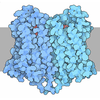
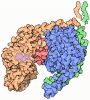
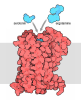
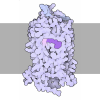
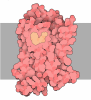
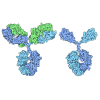
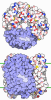
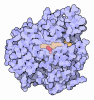
ジャーナル: Cell Res / 年: 2025 タイトル: The molecular basis of μ-opioid receptor signaling plasticity. 著者: Huibing Zhang / Xueting Wang / Kun Xi / Qingya Shen / Jianheng Xue / Yanqing Zhu / Shao-Kun Zang / Tianqiang Yu / Dan-Dan Shen / Jia Guo / Li-Nan Chen / Su-Yu Ji / Jiao Qin / Yingjun Dong / ...著者: Huibing Zhang / Xueting Wang / Kun Xi / Qingya Shen / Jianheng Xue / Yanqing Zhu / Shao-Kun Zang / Tianqiang Yu / Dan-Dan Shen / Jia Guo / Li-Nan Chen / Su-Yu Ji / Jiao Qin / Yingjun Dong / Mingming Zhao / Ming Yang / Haijing Wu / Guoli Yang / Yan Zhang / 要旨: Activation of the μ-opioid receptor (μOR) alleviates pain but also elicits adverse effects through diverse G proteins and β-arrestins. The structural details of μOR complexes with G and β- ...Activation of the μ-opioid receptor (μOR) alleviates pain but also elicits adverse effects through diverse G proteins and β-arrestins. The structural details of μOR complexes with G and β-arrestins have not been determined, impeding a comprehensive understanding of μOR signaling plasticity. Here, we present the cryo-EM structures of the μOR-G and μOR-βarr1 complexes, revealing selective conformational preferences of μOR when engaged with specific downstream signaling transducers. Integrated receptor pharmacology, including high-resolution structural analysis, cell signaling assays, and molecular dynamics simulations, demonstrated that transmembrane helix 1 (TM1) acts as an allosteric regulator of μOR signaling bias through differential stabilization of the G-, G-, and βarr1-bound states. Mechanistically, outward TM1 displacement confers structural flexibility that promotes G protein recruitment, whereas inward TM1 retraction facilitates βarr1 recruitment by stabilizing the intracellular binding pocket through coordinated interactions with TM2, TM7, and helix8. Structural comparisons between the G-, G-, and βarr1-bound complexes identified a TM1-fusion pocket with significant implications for downstream signaling regulation. Overall, we demonstrate that the conformational and thermodynamic heterogeneity of TM1 allosterically drives the downstream signaling specificity and plasticity of μOR, thereby expanding the understanding of μOR signal transduction mechanisms and providing new avenues for the rational design of analgesics.
 ムービー
ムービー コントローラー


 データを開く
 基本情報
基本情報
 マップデータ
 試料
試料 キーワード
キーワード 機能・相同性情報
 Mus musculus (ハツカネズミ) /
  Homo sapiens (ヒト) /
  Bos taurus (ウシ) / synthetic construct (人工物)
 データ登録者
 引用
引用
 構造の表示
構造の表示
 ダウンロードとリンク
 emd_66207.png
 http://ftp.pdbj.org/pub/emdb/structures/EMD-66207


 Z (Sec.)
 Y (Row.)
 X (Col.)


 試料の構成要素
 Spodoptera frugiperda (ツマジロクサヨトウ)
 Escherichia coli (大腸菌)
 解析
解析 電子顕微鏡法
 FIELD EMISSION GUN
