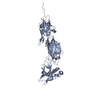
Movie
Movie Controller

[English] 日本語
 Yorodumi
- EMDB-66088: Cryo-EM structure of Clostridium perfringens pili CppA in complex... -
+ Open data

- Basic information
| Entry |  | |||||||||
|---|---|---|---|---|---|---|---|---|---|---|
| Title | Cryo-EM structure of Clostridium perfringens pili CppA in complex with CppB | |||||||||
 Map data Map data | ||||||||||
 Sample Sample |
| |||||||||
 Keywords Keywords | Shaft pilin / Tip pilin / Clostridium perfringens / surface protein / collagen binding protein / PROTEIN FIBRIL | |||||||||
| Function / homology |  Function and homology information Function and homology information | |||||||||
| Biological species |  Clostridium perfringens str. 13 (bacteria) Clostridium perfringens str. 13 (bacteria) | |||||||||
| Method | single particle reconstruction / cryo EM / Resolution: 3.2 Å | |||||||||
 Authors Authors | Nonaka Y / Tamai E / Kamitori S | |||||||||
| Funding support |  Japan, 1 items Japan, 1 items
| |||||||||
 Citation Citation | Journal: FEBS J / Year: 2026 Title: Dynamic motion of bacterial surface pili based on structural analyses of covalently linked complexes formed by tip and shaft pili proteins from Clostridium perfringens. Authors: Yasuhiro Nonaka / Eiji Tamai / Hiroshi Sekiya / Shigehiro Kamitori / Abstract: The pathogenesis and infectivity of Gram-positive bacteria are mediated by many surface proteins covalently attached to the bacterial cell wall. Pili are types of surface appendages that play ...The pathogenesis and infectivity of Gram-positive bacteria are mediated by many surface proteins covalently attached to the bacterial cell wall. Pili are types of surface appendages that play important roles in the initial adhesion of bacterial cells to host tissues and bacterial colonization. The Gram-positive bacterium Clostridium perfringens (C. perfringens), one of the pathogenic clostridial species causing gas gangrene and food poisoning, has sortase-mediated pili composed of shaft/major pilin A (CppA) and tip/minor pilin B (CppB). The pilus shaft is formed by covalent polymerization of CppA, and CppB is covalently attached to the tip of the shaft involved in adhesion to the host cell. The formation of covalent bonds between CppB and CppA, as well as between CppA and CppA, is catalyzed by class C sortase (CpSrtC), a member of the cysteine transpeptidase family. Since pili consistently have CppB at their tip, CpSrtC is the enzyme that preferentially catalyzes the attachment of CppB (tip) to CppA (shaft) rather than polymerization of CppAs by an unknown mechanism. We determined the structures of complexes formed by covalently linking CppB and CppA by X-ray crystallography and cryo-EM analysis. The complexes have an elongated structure in which β-sandwich folded domains are sequentially arranged, and an amide bond between Thr688 of CppB and Lys174 of CppA was clearly identified. The determined structures allowed us to construct a three-dimensional structure model with dynamic motion of C. perfringens pili, and proposed new insights into the mechanism by which CppB is preferentially attached to CppA. | |||||||||
| History |
|
- Structure visualization
| Supplemental images |
|---|

- Downloads & links
-EMDB archive
| Map data | emd_66088.map.gz | 20.8 MB | EMDB map data format | |
|---|---|---|---|---|
| Header (meta data) | emd-66088-v30.xmlemd-66088.xml | 18.2 KB 18.2 KB | Display Display | EMDB header |
| FSC (resolution estimation) | emd_66088_fsc.xml | 7.9 KB | Display | FSC data file |
| Images |  emd_66088.png emd_66088.png | 42.1 KB | ||
| Filedesc metadata | emd-66088.cif.gz | 6.4 KB | ||
| Others | emd_66088_half_map_1.map.gzemd_66088_half_map_2.map.gz | 20.7 MB 20.7 MB | ||
| Archive directory |  https://data.pdbj.org/pub/emdb/structures/EMD-66088ftp://data.pdbj.org/pub/emdb/structures/EMD-66088 https://data.pdbj.org/pub/emdb/structures/EMD-66088ftp://data.pdbj.org/pub/emdb/structures/EMD-66088 | HTTPS FTP |
-Related structure data
| Related structure data |  9wmeMC  9vo4C  9vo5C M: atomic model generated by this map C: citing same article ( |
|---|---|
| Similar structure data |
-Links
| EMDB pages | EMDB (EBI/PDBe) / EMDataResource |
|---|
-Map
| File | Download / File: emd_66088.map.gz / Format: CCP4 / Size: 22.2 MB / Type: IMAGE STORED AS FLOATING POINT NUMBER (4 BYTES) | ||||||||||||||||||||||||||||||||||||
|---|---|---|---|---|---|---|---|---|---|---|---|---|---|---|---|---|---|---|---|---|---|---|---|---|---|---|---|---|---|---|---|---|---|---|---|---|---|
| Projections & slices | Image control
Images are generated by Spider. | ||||||||||||||||||||||||||||||||||||
| Voxel size | X=Y=Z: 1.1 Å | ||||||||||||||||||||||||||||||||||||
| Density |
| ||||||||||||||||||||||||||||||||||||
| Symmetry | Space group: 1 | ||||||||||||||||||||||||||||||||||||
| Details | EMDB XML:
|
 Z (Sec.)
 Y (Row.)
 X (Col.)


-Supplemental data
-Half map: #2
| File | emd_66088_half_map_1.map | ||||||||||||
|---|---|---|---|---|---|---|---|---|---|---|---|---|---|
| Projections & Slices |
| ||||||||||||
| Density Histograms |


-Half map: #1
| File | emd_66088_half_map_2.map | ||||||||||||
|---|---|---|---|---|---|---|---|---|---|---|---|---|---|
| Projections & Slices |
| ||||||||||||
| Density Histograms |


- Sample components
-Entire : Covalent complex of Clostridium perfringens pili proteins CppB an...
| Entire | Name: Covalent complex of Clostridium perfringens pili proteins CppB and CppA |
|---|---|
| Components |
|
-Supramolecule #1: Covalent complex of Clostridium perfringens pili proteins CppB an...
| Supramolecule | Name: Covalent complex of Clostridium perfringens pili proteins CppB and CppA type: organelle_or_cellular_component / ID: 1 / Parent: 0 / Macromolecule list: all |
|---|---|
| Source (natural) | Organism: Clostridium perfringens str. 13 (bacteria) |
-Macromolecule #1: Probable surface protein
| Macromolecule | Name: Probable surface protein / type: protein_or_peptide / ID: 1 / Number of copies: 1 / Enantiomer: LEVO |
|---|---|
| Source (natural) | Organism: Clostridium perfringens str. 13 (bacteria) |
| Molecular weight | Theoretical: 49.98332 KDa |
| Recombinant expression | Organism:  Escherichia coli (E. coli) Escherichia coli (E. coli) |
| Sequence | String: MTPSISKDAP IKGSITISKK GATFTAYKLL DAIKSGDAYE YSVNSDLKDF FNNSNYGSYS QESIQKLNGE QVKEFAINLH KYILENKKS GQELKDGQKN TVDLGYYLVT ETSSDSEGAA VASTPIIVSV PQVSGDSWNY DVTINPKDNT PILEKNIVKE N QRVKTSSE ...String: MTPSISKDAP IKGSITISKK GATFTAYKLL DAIKSGDAYE YSVNSDLKDF FNNSNYGSYS QESIQKLNGE QVKEFAINLH KYILENKKS GQELKDGQKN TVDLGYYLVT ETSSDSEGAA VASTPIIVSV PQVSGDSWNY DVTINPKDNT PILEKNIVKE N QRVKTSSE NIGDVVKYEV KASIPVYQKN AQNIMYKFTD TMSKGLTYDE KTGFKVTSGD KVFAKDTDYT VDVKKQEDGS TV ITINFVY ENIKAYAETG ITLNYQATLN KDAVISNKEN LGNTNNIQLD YTNNPHVKDS YKKLTDKVTT YTFGFGITKV DSE LNSKLL QGAEFSVKDA GGKIVAKYTY DEKGQVVYLS GNGVTNSKGI TTFLGLKEGK YFITEEVAPS GYSLLKNPVE VTIT ANKDE SGNYTGAATI EISNGNKAGQ IINDISEKDG NILFNVQIEN HAHHHHHH UniProtKB: Probable surface protein |
-Macromolecule #2: SpaA-like prealbumin fold domain-containing protein
| Macromolecule | Name: SpaA-like prealbumin fold domain-containing protein / type: protein_or_peptide / ID: 2 / Number of copies: 1 / Enantiomer: LEVO |
|---|---|
| Source (natural) | Organism: Clostridium perfringens str. 13 (bacteria) |
| Molecular weight | Theoretical: 74.482711 KDa |
| Recombinant expression | Organism: Escherichia coli (E. coli) |
| Sequence | String: MEETKSVQND GAVEITSTTF ESNTVAKGIS NNLRIDYKIL NKDKLKDGDK IVISLPDIFK DIEPKCHDQH FKDFDVKDGV VTLTFNENV EKAVTGYMII RFVGNSNIRK GVSYPVSIDL NGKPSTVYIT GEEYSNSSSG AQYPLMYKTA DLPTAATDKE Q GREYYGEI ...String: MEETKSVQND GAVEITSTTF ESNTVAKGIS NNLRIDYKIL NKDKLKDGDK IVISLPDIFK DIEPKCHDQH FKDFDVKDGV VTLTFNENV EKAVTGYMII RFVGNSNIRK GVSYPVSIDL NGKPSTVYIT GEEYSNSSSG AQYPLMYKTA DLPTAATDKE Q GREYYGEI VDRNKPIKYF VEINLGDGVN PNTRSYLSNA DFFDNIPKGM ALDVNSICIK RMGYYDERSS DVTKDFWESN RI KADTKHL EINFGDIRYE RYTVIYETRI TSTESGYLND AKLYYDDKEL PSKHYSKLSK DAGALNVYKY VDKTKVKNNL NDQ KIKYDI KFDSYGYFFK DTLNIIDKLD PRLSDIKITA TDQFITDFDE NTKELVIKNS NGDIDAKKPA YITIEASMKN VGPG EVVKN IAYVNGNPTN EVSTRKNPIV EIIKVSKDDV ESNLLEGAIF KLTTKDGKTV KDVYNKGVKT FTTSSEGSIR FELPN GDYK LEEIKAPNGY KLDQTPIEFT VNDESKIVKV VAKDDPLPTT CNLVINKINE KEIPILGAKF KLFEESNPKK VLKFSS QKN NYELNQNGVG KLTPSGKNAS FKINNLHYGN YILKEVQAPK GYKLSDDIYI TLGFEESFYR VGKQGEKIIL NKNTETN TY NISVENVPRI ILPET UniProtKB: SpaA-like prealbumin fold domain-containing protein |
-Experimental details
-Structure determination
| Method | cryo EM |
|---|---|
 Processing Processing | single particle reconstruction |
| Aggregation state | particle |
-Sample preparation
| Concentration | 0.26 mg/mL |
|---|---|
| Buffer | pH: 7.5 / Details: 20 mM Tris-HCl, 100 mM NaCl |
| Grid | Model: Quantifoil R1.2/1.3 / Material: COPPER / Pretreatment - Type: GLOW DISCHARGE / Pretreatment - Time: 90 sec. |
| Vitrification | Cryogen name: ETHANE / Chamber humidity: 100 % / Chamber temperature: 291 K / Instrument: FEI VITROBOT MARK IV |
- Electron microscopy
| Microscope | FEI TALOS ARCTICA |
|---|---|
| Software | Name: EPU |
| Image recording | Film or detector model: FEI FALCON IV (4k x 4k) / Number real images: 3806 / Average exposure time: 3.88 sec. / Average electron dose: 50.0 e/Å2 |
| Electron beam | Acceleration voltage: 200 kV / Electron source:  FIELD EMISSION GUN FIELD EMISSION GUN |
| Electron optics | Illumination mode: FLOOD BEAM / Imaging mode: BRIGHT FIELD / Nominal defocus max: 2.0 µm / Nominal defocus min: 0.8 µm |
| Experimental equipment | 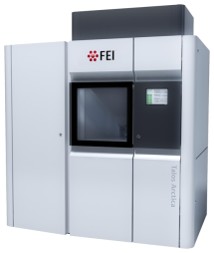 Model: Talos Arctica / Image courtesy: FEI Company |