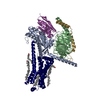
- EMDB-65918: Structure of HCMV UL33 in complex with human Gs protein -
+
Open data
ID or keywords:
Loading...
-
Basic information
Entry
Database: EMDB / ID: EMD-65918
Title
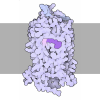
Structure of HCMV UL33 in complex with human Gs protein
Map data
sharpened full map, globally refined map (main map)
Sample
Complex: UL33-Gas-Gb1-Gg2-Nb35
Protein or peptide: Guanine nucleotide-binding protein G(I)/G(S)/G(O) subunit gamma-2
Protein or peptide: Nanobody35
Protein or peptide: Guanine nucleotide-binding protein G(s) subunit alpha isoforms short
Protein or peptide: Guanine nucleotide-binding protein G(I)/G(S)/G(T) subunit beta-1,Guanine nucleotide-binding protein G(I)/G(S)/G(T) subunit beta-1,Guanine nucleotide-binding protein G(I)/G(S)/G(T) subunit beta-1,Guanine nucleotide-binding protein G(I)/G(S)/G(T) subunit beta-1, HiBit fusion
Protein or peptide: G-protein coupled receptor homolog UL33,G-protein coupled receptor homolog UL33,G-protein coupled receptor homolog UL33, LgBit fusion
Keywords
HCMV / viral protein / viral-host interaction / GPCR / MEMBRANE PROTEIN
Function / homology
Function and homology information
adenylate cyclase-activating G protein-coupled bile acid receptor signaling pathway / adenylate cyclase-activating serotonin receptor signaling pathway / regulation of skeletal muscle contraction / developmental growth / hair follicle placode formation / PKA activation in glucagon signalling / renal water homeostasis / intracellular transport / D1 dopamine receptor binding / vascular endothelial cell response to laminar fluid shear stress ...adenylate cyclase-activating G protein-coupled bile acid receptor signaling pathway / adenylate cyclase-activating serotonin receptor signaling pathway / regulation of skeletal muscle contraction / developmental growth / hair follicle placode formation / PKA activation in glucagon signalling / renal water homeostasis / intracellular transport / D1 dopamine receptor binding / vascular endothelial cell response to laminar fluid shear stress / Hedgehog 'off' state / activation of adenylate cyclase activity / adenylate cyclase-activating adrenergic receptor signaling pathway / cellular response to acidic pH / cellular response to glucagon stimulus / intracellular glucose homeostasis / adenylate cyclase activator activity / positive regulation of insulin secretion involved in cellular response to glucose stimulus / trans-Golgi network membrane / positive regulation of insulin secretion / negative regulation of inflammatory response to antigenic stimulus / response to prostaglandin E / bone development / platelet aggregation / cognition / G-protein beta/gamma-subunit complex binding / Olfactory Signaling Pathway / Activation of the phototransduction cascade / G protein-coupled acetylcholine receptor signaling pathway / sensory perception of smell / G beta:gamma signalling through PLC beta / Presynaptic function of Kainate receptors / Thromboxane signalling through TP receptor / Activation of G protein gated Potassium channels / Inhibition of voltage gated Ca2+ channels via Gbeta/gamma subunits / G-protein activation / Glucagon signaling in metabolic regulation / G beta:gamma signalling through CDC42 / Prostacyclin signalling through prostacyclin receptor / Synthesis, secretion, and inactivation of Glucagon-like Peptide-1 (GLP-1) / photoreceptor disc membrane / G beta:gamma signalling through BTK / ADP signalling through P2Y purinoceptor 12 / Sensory perception of sweet, bitter, and umami (glutamate) taste / Glucagon-type ligand receptors / Adrenaline,noradrenaline inhibits insulin secretion / Vasopressin regulates renal water homeostasis via Aquaporins / G alpha (z) signalling events / Glucagon-like Peptide-1 (GLP1) regulates insulin secretion / ADP signalling through P2Y purinoceptor 1 / cellular response to catecholamine stimulus / G beta:gamma signalling through PI3Kgamma / ADORA2B mediated anti-inflammatory cytokines production / adenylate cyclase-activating dopamine receptor signaling pathway / cellular response to prostaglandin E stimulus / Cooperation of PDCL (PhLP1) and TRiC/CCT in G-protein beta folding / positive regulation of cold-induced thermogenesis / GPER1 signaling / heterotrimeric G-protein complex / Inactivation, recovery and regulation of the phototransduction cascade / G alpha (12/13) signalling events / G-protein beta-subunit binding / extracellular vesicle / Thrombin signalling through proteinase activated receptors (PARs) / adenylate cyclase-activating G protein-coupled receptor signaling pathway / signaling receptor complex adaptor activity / GTPase binding / G protein activity / Ca2+ pathway / High laminar flow shear stress activates signaling by PIEZO1 and PECAM1:CDH5:KDR in endothelial cells / G alpha (i) signalling events / G alpha (s) signalling events / G alpha (q) signalling events / Hydrolases; Acting on acid anhydrides; Acting on GTP to facilitate cellular and subcellular movement / Ras protein signal transduction / Extra-nuclear estrogen signaling / G protein-coupled receptor signaling pathway / lysosomal membrane / GTPase activity / synapse / GTP binding / protein-containing complex binding / signal transduction / extracellular exosome / membrane / metal ion binding / plasma membrane / cytosol / cytoplasm Similarity search - Function
G-protein alpha subunit, group S / G protein alpha subunit, helical insertion / G protein alpha subunit / Guanine nucleotide binding protein (G-protein), alpha subunit / G-protein alpha subunit / G-alpha domain profile. / G-protein, gamma subunit / G-protein gamma subunit domain profile. / G-protein gamma-like domain / G-protein gamma-like domain superfamily ...G-protein alpha subunit, group S / G protein alpha subunit, helical insertion / G protein alpha subunit / Guanine nucleotide binding protein (G-protein), alpha subunit / G-protein alpha subunit / G-alpha domain profile. / G-protein, gamma subunit / G-protein gamma subunit domain profile. / G-protein gamma-like domain / G-protein gamma-like domain superfamily / GGL domain / G protein gamma subunit-like motifs / GGL domain / Guanine nucleotide-binding protein, beta subunit / G protein beta WD-40 repeat protein / G-protein, beta subunit / G-protein beta WD-40 repeat / WD40 repeat, conserved site / Trp-Asp (WD) repeats signature. / Trp-Asp (WD) repeats profile. / Trp-Asp (WD) repeats circular profile. / WD40 repeats / WD40 repeat / WD40-repeat-containing domain superfamily / WD40/YVTN repeat-like-containing domain superfamily / P-loop containing nucleoside triphosphate hydrolase Similarity search - Domain/homology
Guanine nucleotide-binding protein G(I)/G(S)/G(O) subunit gamma-2 / Guanine nucleotide-binding protein G(I)/G(S)/G(T) subunit beta-1 / Guanine nucleotide-binding protein G(s) subunit alpha isoforms short Similarity search - Component
Biological species
Homo sapiens (human) / Lama glama (llama) / Human betaherpesvirus 5
Method
single particle reconstruction / cryo EM / Resolution: 3.3 Å
Journal: Commun Biol / Year: 2026 Title: Activation of cytomegalovirus-encoded G protein-coupled receptor UL33 by an innate N-terminal peptide. Authors: Anna K Drzazga / Shota Suzuki / Caroline Wouters / Felix Faas / Kouki Nishikawa / Akiko Kamegawa / Yoshinori Fujiyoshi / Mette M Rosenkilde / Naotaka Tsutsumi / Abstract: Human cytomegalovirus (HCMV) encodes the orphan G protein-coupled receptor (GPCR) UL33, which exhibits constitutive activity that disrupts host G protein signalling, facilitating efficient viral ...Human cytomegalovirus (HCMV) encodes the orphan G protein-coupled receptor (GPCR) UL33, which exhibits constitutive activity that disrupts host G protein signalling, facilitating efficient viral replication and pathogenesis. The cryo-electron microscopy (cryo-EM) structure of UL33 bound to the G subtype of G protein reveals the N-terminal peptide as a tethered ligand reminiscent of the protease-activated receptors and adhesion GPCRs. This self-agonism induces a non-canonical active state that facilitates promiscuous G protein coupling, a plausible viral strategy for fine-tuning host signalling. Structure-guided mutagenesis disrupting key interactions between the N-terminus and its binding pocket abolishes G protein-mediated signalling, confirming the role of the N-terminus as a self-agonist. Our findings elucidate the structural basis for this activation mechanism and highlight the strategies employed by HCMV to hijack host G protein signalling.
Protein or peptide: Guanine nucleotide-binding protein G(I)/G(S)/G(O) subunit gamma-2
Protein or peptide: Nanobody35
Protein or peptide: Guanine nucleotide-binding protein G(s) subunit alpha isoforms short
Protein or peptide: Guanine nucleotide-binding protein G(I)/G(S)/G(T) subunit beta-1,Guanine nucleotide-binding protein G(I)/G(S)/G(T) subunit beta-1,Guanine nucleotide-binding protein G(I)/G(S)/G(T) subunit beta-1,Guanine nucleotide-binding protein G(I)/G(S)/G(T) subunit beta-1, HiBit fusion
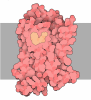
Protein or peptide: G-protein coupled receptor homolog UL33,G-protein coupled receptor homolog UL33,G-protein coupled receptor homolog UL33, LgBit fusion
-
Supramolecule #1: UL33-Gas-Gb1-Gg2-Nb35
Supramolecule
Name: UL33-Gas-Gb1-Gg2-Nb35 / type: complex / ID: 1 / Parent: 0 / Macromolecule list: all Details: Cytomegalovirus GPCR UL33 complexed with heterotrimeric Gs protein with dominant negative mutations via HiBit tethering stabilized by nanobody35
Source (natural)
Organism: Homo sapiens (human)
Molecular weight
Theoretical: 180 KDa
-
Macromolecule #1: Guanine nucleotide-binding protein G(I)/G(S)/G(O) subunit gamma-2
Macromolecule
Name: Guanine nucleotide-binding protein G(I)/G(S)/G(O) subunit gamma-2 type: protein_or_peptide / ID: 1 / Number of copies: 1 / Enantiomer: LEVO
Macromolecule #3: Guanine nucleotide-binding protein G(s) subunit alpha isoforms short
Macromolecule
Name: Guanine nucleotide-binding protein G(s) subunit alpha isoforms short type: protein_or_peptide / ID: 3 / Number of copies: 1 / Enantiomer: LEVO EC number: Hydrolases; Acting on acid anhydrides; Acting on GTP to facilitate cellular and subcellular movement
In the structure databanks used in Yorodumi, some data are registered as the other names, "COVID-19 virus" and "2019-nCoV". Here are the details of the virus and the list of structure data.
Jan 31, 2019. EMDB accession codes are about to change! (news from PDBe EMDB page)
EMDB accession codes are about to change! (news from PDBe EMDB page)
The allocation of 4 digits for EMDB accession codes will soon come to an end. Whilst these codes will remain in use, new EMDB accession codes will include an additional digit and will expand incrementally as the available range of codes is exhausted. The current 4-digit format prefixed with “EMD-” (i.e. EMD-XXXX) will advance to a 5-digit format (i.e. EMD-XXXXX), and so on. It is currently estimated that the 4-digit codes will be depleted around Spring 2019, at which point the 5-digit format will come into force.
The EM Navigator/Yorodumi systems omit the EMD- prefix.
Related info.:Q: What is EMD? / ID/Accession-code notation in Yorodumi/EM Navigator
Yorodumi is a browser for structure data from EMDB, PDB, SASBDB, etc.
This page is also the successor to EM Navigator detail page, and also detail information page/front-end page for Omokage search.
The word "yorodu" (or yorozu) is an old Japanese word meaning "ten thousand". "mi" (miru) is to see.
Related info.:EMDB / PDB / SASBDB / Comparison of 3 databanks / Yorodumi Search / Aug 31, 2016. New EM Navigator & Yorodumi / Yorodumi Papers / Jmol/JSmol / Function and homology information / Changes in new EM Navigator and Yorodumi
 Movie
Movie Controller


 Open data
 Basic information
 Map data
 Sample
 Keywords
 Function and homology information
 Homo sapiens (human) /
 Lama glama (llama) /
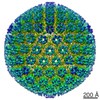 Human betaherpesvirus 5
 Authors
 Japan, 1 items
  Citation
 Structure visualization
 Downloads & links
 emd_65918.png
 https://data.pdbj.org/pub/emdb/structures/EMD-65918

 Z (Sec.)
 Y (Row.)
 X (Col.)


 Sample components
 Escherichia coli (E. coli)
 Processing
 Electron microscopy
 FIELD EMISSION GUN