 Movie
Movie Controller


+ Open data

- Basic information
| Entry |  | ||||||||||||
|---|---|---|---|---|---|---|---|---|---|---|---|---|---|
| Title | Cryo-EM structure of human PLD4 bound to ssDNA (poly(T)) | ||||||||||||
 Map data Map data | |||||||||||||
 Sample Sample |
| ||||||||||||
 Keywords Keywords | Exonuclease / IMMUNE SYSTEM | ||||||||||||
| Function / homology |  Function and homology information Function and homology informationnegative regulation of toll-like receptor 7 signaling pathway / spleen exonuclease / negative regulation of toll-like receptor 9 signaling pathway / Synthesis of PG / single-stranded DNA 5'-3' DNA exonuclease activity / 5'-3' RNA exonuclease activity / 5'-3' DNA exonuclease activity / regulation of cytokine production involved in inflammatory response / acyltransferase activity, transferring groups other than amino-acyl groups / Synthesis of IP3 and IP4 in the cytosol ...negative regulation of toll-like receptor 7 signaling pathway / spleen exonuclease / negative regulation of toll-like receptor 9 signaling pathway / Synthesis of PG / single-stranded DNA 5'-3' DNA exonuclease activity / 5'-3' RNA exonuclease activity / 5'-3' DNA exonuclease activity / regulation of cytokine production involved in inflammatory response / acyltransferase activity, transferring groups other than amino-acyl groups / Synthesis of IP3 and IP4 in the cytosol / phagocytosis / Role of phospholipids in phagocytosis / phagocytic vesicle / lipid metabolic process / Transferases; Acyltransferases; Transferring groups other than aminoacyl groups / endomembrane system / trans-Golgi network membrane / innate immune response / early endosome / inflammatory response / lysosome / endoplasmic reticulum membrane / nucleus Similarity search - Function | ||||||||||||
| Biological species |  Homo sapiens (human) / synthetic construct (others) Homo sapiens (human) / synthetic construct (others) | ||||||||||||
| Method | single particle reconstruction / cryo EM / Resolution: 3.06 Å | ||||||||||||
 Authors Authors | Hirano Y / Ezaki W / Ohto U / Shimizu T | ||||||||||||
| Funding support |  Japan, 3 items Japan, 3 items
| ||||||||||||
 Citation Citation | Journal: Nat Commun / Year: 2025 Title: Mechanistic insights into single-stranded DNA degradation by lysosomal exonucleases PLD3 and PLD4 from structural snapshots. Authors: Yoshinori Hirano / Wakiko Ezaki / Ryota Sato / Umeharu Ohto / Kensuke Miyake / Toshiyuki Shimizu / Abstract: Lysosomal exonuclease phospholipase D (PLD) family PLD3 and PLD4 degrade single-stranded RNA or DNA and regulate TLR7 or TLR9 responses. Polymorphisms of these enzymes are associated with human ...Lysosomal exonuclease phospholipase D (PLD) family PLD3 and PLD4 degrade single-stranded RNA or DNA and regulate TLR7 or TLR9 responses. Polymorphisms of these enzymes are associated with human diseases: PLD4 is associated with inflammatory diseases, and PLD3 is associated with neurodegenerative diseases. Here, we determine the structures of substrate-bound PLD3 and PLD4 by cryo-electron microscopy. Our structures reveal that PLD3 rebuilds a substrate-binding pocket, depending on the substrate, mainly via motion of the Phe335-containing loop. Furthermore, we captured the structure in a metastable state that appears during substrate rearrangement following product release. Together, our findings identify the residues that underlie the distinct activities of PLD3 and PLD4. This study provides a mechanistic basis for the exonuclease activity of PLD3 and PLD4 in single-stranded DNA degradation. | ||||||||||||
| History |
|
- Structure visualization
| Supplemental images |
|---|

- Downloads & links
-EMDB archive
| Map data | emd_64925.map.gz | 51.6 MB | EMDB map data format | |
|---|---|---|---|---|
| Header (meta data) | emd-64925-v30.xmlemd-64925.xml | 20.4 KB 20.4 KB | Display Display | EMDB header |
| Images |  emd_64925.png emd_64925.png | 55.3 KB | ||
| Filedesc metadata | emd-64925.cif.gz | 6.5 KB | ||
| Others | emd_64925_half_map_1.map.gzemd_64925_half_map_2.map.gz | 95.4 MB 95.4 MB | ||
| Archive directory |  https://data.pdbj.org/pub/emdb/structures/EMD-64925ftp://data.pdbj.org/pub/emdb/structures/EMD-64925 https://data.pdbj.org/pub/emdb/structures/EMD-64925ftp://data.pdbj.org/pub/emdb/structures/EMD-64925 | HTTPS FTP |
-Related structure data
| Related structure data |  9vbkMC  9vbgC  9vbhC  9vbiC  9vbjC M: atomic model generated by this map C: citing same article ( |
|---|---|
| Similar structure data |


-Links
| EMDB pages | EMDB (EBI/PDBe) / EMDataResource |
|---|---|
| Related items in Molecule of the Month |
-Map
| File | Download / File: emd_64925.map.gz / Format: CCP4 / Size: 103 MB / Type: IMAGE STORED AS FLOATING POINT NUMBER (4 BYTES) | ||||||||||||||||||||||||||||||||||||
|---|---|---|---|---|---|---|---|---|---|---|---|---|---|---|---|---|---|---|---|---|---|---|---|---|---|---|---|---|---|---|---|---|---|---|---|---|---|
| Projections & slices | Image control
Images are generated by Spider. | ||||||||||||||||||||||||||||||||||||
| Voxel size | X=Y=Z: 0.83 Å | ||||||||||||||||||||||||||||||||||||
| Density |
| ||||||||||||||||||||||||||||||||||||
| Symmetry | Space group: 1 | ||||||||||||||||||||||||||||||||||||
| Details | EMDB XML:
|
 Z (Sec.)
 Y (Row.)
 X (Col.)


-Supplemental data
-Half map: #2
| File | emd_64925_half_map_1.map | ||||||||||||
|---|---|---|---|---|---|---|---|---|---|---|---|---|---|
| Projections & Slices |
| ||||||||||||
| Density Histograms |


-Half map: #1
| File | emd_64925_half_map_2.map | ||||||||||||
|---|---|---|---|---|---|---|---|---|---|---|---|---|---|
| Projections & Slices |
| ||||||||||||
| Density Histograms |


- Sample components
-Entire : Homo-tetramer of PLD4 luminal domain
| Entire | Name: Homo-tetramer of PLD4 luminal domain |
|---|---|
| Components |
|
-Supramolecule #1: Homo-tetramer of PLD4 luminal domain
| Supramolecule | Name: Homo-tetramer of PLD4 luminal domain / type: complex / ID: 1 / Parent: 0 / Macromolecule list: #1-#2 |
|---|
-Supramolecule #2: Homodimer of the luminal domain of PLD3
| Supramolecule | Name: Homodimer of the luminal domain of PLD3 / type: complex / ID: 2 / Parent: 1 / Macromolecule list: #1 |
|---|---|
| Source (natural) | Organism: Homo sapiens (human) |
-Supramolecule #3: ssDNA
| Supramolecule | Name: ssDNA / type: complex / ID: 3 / Parent: 1 / Macromolecule list: #2 |
|---|---|
| Source (natural) | Organism: synthetic construct (others) / Synthetically produced: Yes |
-Macromolecule #1: 5'-3' exonuclease PLD4
| Macromolecule | Name: 5'-3' exonuclease PLD4 / type: protein_or_peptide / ID: 1 / Number of copies: 4 / Enantiomer: LEVO / EC number: spleen exonuclease |
|---|---|
| Source (natural) | Organism: Homo sapiens (human) |
| Molecular weight | Theoretical: 46.287273 KDa |
| Recombinant expression | Organism: Homo sapiens (human) |
| Sequence | String: RDSCQLVLVE SIPQDLPSAA GSPSAQPLGQ AWLQLLDTAQ ESVHVASYYW SLTGPDIGVN DSSSQLGEAL LQKLQQLLGR NISLAVATS SPTLARTSTD LQVLAARGAH VRQVPMGRLT RGVLHSKFWV VDGRHIYMGS ANMDWRSLTQ VKELGAVIYN C SHLAQDLE ...String: RDSCQLVLVE SIPQDLPSAA GSPSAQPLGQ AWLQLLDTAQ ESVHVASYYW SLTGPDIGVN DSSSQLGEAL LQKLQQLLGR NISLAVATS SPTLARTSTD LQVLAARGAH VRQVPMGRLT RGVLHSKFWV VDGRHIYMGS ANMDWRSLTQ VKELGAVIYN C SHLAQDLE KTFQTYWVLG VPKAVLPKTW PQNFSSHFNR FQPFHGLFDG VPTTAYFSAS PPALCPQGRT RDLEALLAVM GS AQEFIYA SVMEYFPTTR FSHPPRYWPV LDNALRAAAF GKGVRVRLLV GCGLNTDPTM FPYLRSLQAL SNPAANVSVD VKV FIVPVG NHSNIPFSRV NHSKFMVTEK AAYIGTSNWS EDYFSSTAGV GLVVTQSPGA QPAGATVQEQ LRQLFERDWS SRYA VGLDG QAPGQDCVWQ GLEVLFQ UniProtKB: 5'-3' exonuclease PLD4 |
-Macromolecule #2: DNA (5'-D(*TP*TP*T)-3')
| Macromolecule | Name: DNA (5'-D(*TP*TP*T)-3') / type: dna / ID: 2 / Number of copies: 2 / Classification: DNA |
|---|---|
| Source (natural) | Organism: synthetic construct (others) |
| Molecular weight | Theoretical: 14.86049 KDa |
| Sequence | String: (DT)(DT)(DT)(DT)(DT)(DT)(DT)(DT)(DT)(DT) (DT)(DT)(DT)(DT)(DT)(DT)(DT)(DT)(DT)(DT) (DT)(DT)(DT)(DT)(DT)(DT)(DT)(DT)(DT) (DT)(DT)(DT)(DT)(DT)(DT)(DT)(DT)(DT)(DT) (DT) (DT)(DT)(DT)(DT)(DT)(DT)(DT)(DT) (DT) |
-Macromolecule #4: 2-acetamido-2-deoxy-beta-D-glucopyranose
| Macromolecule | Name: 2-acetamido-2-deoxy-beta-D-glucopyranose / type: ligand / ID: 4 / Number of copies: 15 / Formula: NAG |
|---|---|
| Molecular weight | Theoretical: 221.208 Da |
| Chemical component information | 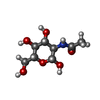 ChemComp-NAG: |
-Macromolecule #5: THYMIDINE-3'-PHOSPHATE
| Macromolecule | Name: THYMIDINE-3'-PHOSPHATE / type: ligand / ID: 5 / Number of copies: 1 / Formula: T3P |
|---|---|
| Molecular weight | Theoretical: 322.208 Da |
| Chemical component information |  ChemComp-ATD: |
-Experimental details
-Structure determination
| Method | cryo EM |
|---|---|
 Processing Processing | single particle reconstruction |
| Aggregation state | particle |
-Sample preparation
| Buffer | pH: 5.5 |
|---|---|
| Grid | Model: Quantifoil R1.2/1.3 / Material: COPPER |
| Vitrification | Cryogen name: ETHANE / Chamber humidity: 100 % / Chamber temperature: 279 K / Instrument: FEI VITROBOT MARK IV |
- Electron microscopy
| Microscope | TFS KRIOS |
|---|---|
| Image recording | Film or detector model: GATAN K3 BIOQUANTUM (6k x 4k) / Average electron dose: 48.0 e/Å2 |
| Electron beam | Acceleration voltage: 300 kV / Electron source:  FIELD EMISSION GUN FIELD EMISSION GUN |
| Electron optics | Illumination mode: OTHER / Imaging mode: BRIGHT FIELD / Nominal defocus max: 2.0 µm / Nominal defocus min: 1.0 µm / Nominal magnification: 105000 |
| Experimental equipment |  Model: Titan Krios / Image courtesy: FEI Company |
