National Natural Science Foundation of China (NSFC)
81773704
中国
引用
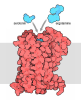
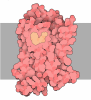
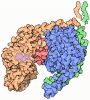
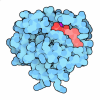
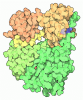
ジャーナル: Cell / 年: 2026 タイトル: Mechanistic insights into fatty acid odor detection mediated by class II olfactory receptors. 著者: Xiang Han / Ming-Hui Zhang / Nai-Kang Rong / Kong-Kai Zhu / Yuan Pei / Xiao-Yan Ge / Qi Liu / Huan Lu / Jing Liu / Li-Jun Zhang / Hong-Qiang Bao / Jia-Hao Pi / Lei Fan / Yu Fu / Xu-Hang Shao ...著者: Xiang Han / Ming-Hui Zhang / Nai-Kang Rong / Kong-Kai Zhu / Yuan Pei / Xiao-Yan Ge / Qi Liu / Huan Lu / Jing Liu / Li-Jun Zhang / Hong-Qiang Bao / Jia-Hao Pi / Lei Fan / Yu Fu / Xu-Hang Shao / Wen-Qi Yan / Xi-He Gao / Ming-Yue Zhang / Lu-Lu Guo / Yan Lu / Shang-Lei Ning / Hua Zhang / Yun-Fei Xu / Xiao-Ya Feng / Jie Cheng / Ming Xia / Qian Li / Xiao Yu / Fan Yang / Jin-Peng Sun / 要旨: Smell is one of the fundamental senses mediated by thousands of odorant receptors (ORs). How hydrophobic and volatile odor molecules are recognized by class II ORs remains elusive. Here, we present ...Smell is one of the fundamental senses mediated by thousands of odorant receptors (ORs). How hydrophobic and volatile odor molecules are recognized by class II ORs remains elusive. Here, we present cryo-electron microscopy (cryo-EM) structures of class II OR Olfr110 complexed with the unsaturated fatty acid metabolite (UFAM) PL45, Gs, and cons-OR5. The structural study revealed an unusually large hydrophobic pocket accommodating PL45 and the endogenous agonist 12(S)-hydroxyeicosapentaenoic acid (12(S)-HEPE). This pocket is decorated with polar residues and aromatic residue arrays, constituting polar networks and π-π interactions with the natural agonist PL45, respectively. Conserved motifs in the type II OR5 subfamily responsible for ligand recognition are characterized. The inward movement of extracellular loop 3 (ECL3) and an unconventional activation mechanism underlie Olfr110 activation. At the G protein interface, Olfr110 displays common and unique interactions. Overall, we revealed the structural basis of odor recognition and the activation mechanism of class II ORs, which may facilitate drug development targeting these receptors.
 ムービー
ムービー コントローラー


 データを開く
 基本情報
基本情報
 マップデータ
 試料
試料 キーワード
キーワード 機能・相同性情報
 Mus musculus (ハツカネズミ) / synthetic construct (人工物) /
  Homo sapiens (ヒト)
 データ登録者
 中国, 1件
  引用
引用 構造の表示
構造の表示
 ダウンロードとリンク
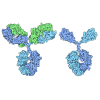
 emd_63174.png
 http://ftp.pdbj.org/pub/emdb/structures/EMD-63174


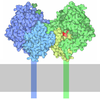
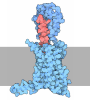
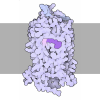
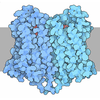

 Z (Sec.)
 Y (Row.)
 X (Col.)


 試料の構成要素
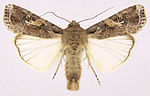 Spodoptera frugiperda (ツマジロクサヨトウ)
 解析
解析 電子顕微鏡法
 FIELD EMISSION GUN