cellular response to cholesterol / cholesterol binding / negative regulation of BMP signaling pathway / positive regulation of TORC1 signaling / cellular response to amino acid starvation / transmembrane transport / cognition / intracellular signal transduction / lysosomal membrane / extracellular exosome 類似検索 - 分子機能
Integral membrane protein GPR155, DEP domain / Membrane transport protein / Membrane transport protein / : / Domain found in Dishevelled, Egl-10, and Pleckstrin (DEP) / DEP domain profile. / Domain found in Dishevelled, Egl-10, and Pleckstrin / DEP domain / Winged helix DNA-binding domain superfamily / Winged helix-like DNA-binding domain superfamily 類似検索 - ドメイン・相同性
Lysosomal cholesterol signaling protein 類似検索 - 構成要素
National Natural Science Foundation of China (NSFC)
32161133022
中国
引用
ジャーナル: Sci Bull (Beijing) / 年: 2025 タイトル: Structural insight into GPR155-mediated cholesterol sensing and signal transduction. 著者: Delin Li / Xiaokang Zhang / Jie Feng / Yufeng Xie / Pu Han / Ming He / Lin Hao / Tianling Guo / Xiaoyi Bai / Kai Yuan / Junqing Sun / Xuefei Pang / Yan Wu / Yingxia Liu / George Fu Gao / Niu ...著者: Delin Li / Xiaokang Zhang / Jie Feng / Yufeng Xie / Pu Han / Ming He / Lin Hao / Tianling Guo / Xiaoyi Bai / Kai Yuan / Junqing Sun / Xuefei Pang / Yan Wu / Yingxia Liu / George Fu Gao / Niu Huang / Haixia Xiao / Feng Gao / 要旨: Cholesterol (CHL) serves as a building block for membrane biogenesis and a precursor to oxysterols, steroid hormones, bile acids, and vitamin D. The lysosome serves as a major sorting station for low- ...Cholesterol (CHL) serves as a building block for membrane biogenesis and a precursor to oxysterols, steroid hormones, bile acids, and vitamin D. The lysosome serves as a major sorting station for low-density lipoproteins (LDLs), which carry dietary CHL, and it is also the cellular site where the master growth regulator, the protein kinase mechanistic Target of Rapamycin Complex 1 (mTORC1), is activated. Recently, the lysosomal transmembrane protein GPR155 was reported to signals CHL sufficiency to mTORC1 through sequestration of the GTPase-activating protein towards the Rags 1 (GATOR1). Although the recently reported structures of GPR155 have revealed the CHL binding site, how the signal is transduced from the CHL binding site to the soluble parts of GPR155 and GATOR1 remains unknown. Here, with our three cryo-EM structures of GPR155 captured in different conformations in complex with CHL, complemented by long-time scale molecular dynamics simulations, the dynamic rearrangement of different domains was observed. CHL binding induces a widening of the crevice between the transporter and GPCR domains. The extending helix preceding transmembrane helix (TM) 16, which was unresolved in other structures, acts as a linkage lever that transmits the rotation of the GPCR domain to the soluble parts of GPR155 in response to CHL binding. This work not only answers the question of how CHL is sensed by GPR155, but also addresses a more profound question: how the signal perceived by the TMs regions is transduced to the LED and DEP domains.
 ムービー
ムービー コントローラー


 データを開く
 基本情報
基本情報
 マップデータ
 試料
試料 キーワード
キーワード 機能・相同性情報
 Homo sapiens (ヒト)
 データ登録者
 中国, 2件
  引用
引用 構造の表示
構造の表示
 ダウンロードとリンク
 emd_63104.png
 http://ftp.pdbj.org/pub/emdb/structures/EMD-63104



 Z (Sec.)
 Y (Row.)
 X (Col.)


 試料の構成要素
 Schizosaccharomyces pombe (分裂酵母)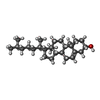
 解析
解析 電子顕微鏡法
 FIELD EMISSION GUN
