 Movie
Movie Controller

[English] 日本語
 Yorodumi
- PDB-9lhv: Cryo-EM structure of GPR155 contracted dimer in complex with chol... -
+ Open data

- Basic information
| Entry | Database: PDB / ID: 9lhv | |||||||||
|---|---|---|---|---|---|---|---|---|---|---|
| Title | Cryo-EM structure of GPR155 contracted dimer in complex with cholesterol | |||||||||
 Components Components | Lysosomal cholesterol signaling protein | |||||||||
 Keywords Keywords | MEMBRANE PROTEIN / cholesterol / mTORC1 regulation / GPCR / transceptor | |||||||||
| Function / homology |  Function and homology information Function and homology informationcellular response to cholesterol / negative regulation of BMP signaling pathway / cholesterol binding / positive regulation of TORC1 signaling / cellular response to amino acid starvation / transmembrane transport / cognition / intracellular signal transduction / lysosomal membrane / extracellular exosome Similarity search - Function | |||||||||
| Biological species |  Homo sapiens (human) Homo sapiens (human) | |||||||||
| Method | ELECTRON MICROSCOPY / single particle reconstruction / cryo EM / Resolution: 2.79 Å | |||||||||
 Authors Authors | Gao, F. / Zhang, X. / Li, D. / Han, P. | |||||||||
| Funding support |  China, 2items China, 2items
| |||||||||
 Citation Citation | Journal: Sci Bull (Beijing) / Year: 2025 Title: Structural insight into GPR155-mediated cholesterol sensing and signal transduction. Authors: Delin Li / Xiaokang Zhang / Jie Feng / Yufeng Xie / Pu Han / Ming He / Lin Hao / Tianling Guo / Xiaoyi Bai / Kai Yuan / Junqing Sun / Xuefei Pang / Yan Wu / Yingxia Liu / George Fu Gao / Niu ...Authors: Delin Li / Xiaokang Zhang / Jie Feng / Yufeng Xie / Pu Han / Ming He / Lin Hao / Tianling Guo / Xiaoyi Bai / Kai Yuan / Junqing Sun / Xuefei Pang / Yan Wu / Yingxia Liu / George Fu Gao / Niu Huang / Haixia Xiao / Feng Gao / Abstract: Cholesterol (CHL) serves as a building block for membrane biogenesis and a precursor to oxysterols, steroid hormones, bile acids, and vitamin D. The lysosome serves as a major sorting station for low- ...Cholesterol (CHL) serves as a building block for membrane biogenesis and a precursor to oxysterols, steroid hormones, bile acids, and vitamin D. The lysosome serves as a major sorting station for low-density lipoproteins (LDLs), which carry dietary CHL, and it is also the cellular site where the master growth regulator, the protein kinase mechanistic Target of Rapamycin Complex 1 (mTORC1), is activated. Recently, the lysosomal transmembrane protein GPR155 was reported to signals CHL sufficiency to mTORC1 through sequestration of the GTPase-activating protein towards the Rags 1 (GATOR1). Although the recently reported structures of GPR155 have revealed the CHL binding site, how the signal is transduced from the CHL binding site to the soluble parts of GPR155 and GATOR1 remains unknown. Here, with our three cryo-EM structures of GPR155 captured in different conformations in complex with CHL, complemented by long-time scale molecular dynamics simulations, the dynamic rearrangement of different domains was observed. CHL binding induces a widening of the crevice between the transporter and GPCR domains. The extending helix preceding transmembrane helix (TM) 16, which was unresolved in other structures, acts as a linkage lever that transmits the rotation of the GPCR domain to the soluble parts of GPR155 in response to CHL binding. This work not only answers the question of how CHL is sensed by GPR155, but also addresses a more profound question: how the signal perceived by the TMs regions is transduced to the LED and DEP domains. | |||||||||
| History |
|
- Structure visualization
| Structure viewer | Molecule: MolmilJmol/JSmol |
|---|
- Downloads & links
-Download
| PDBx/mmCIF format | 9lhv.cif.gz | 253.5 KB | Display | PDBx/mmCIF format |
|---|---|---|---|---|
| PDB format | pdb9lhv.ent.gz | 194.6 KB | Display | PDB format |
| PDBx/mmJSON format | 9lhv.json.gz | Tree view | PDBx/mmJSON format | |
| Others |  Other downloads Other downloads |
-Validation report
| Arichive directory | https://data.pdbj.org/pub/pdb/validation_reports/lh/9lhvftp://data.pdbj.org/pub/pdb/validation_reports/lh/9lhv | HTTPS FTP |
|---|
-Related structure data
| Related structure data |  63106MC  9lhqC  9lhxC M: map data used to model this data C: citing same article ( |
|---|---|
| Similar structure data |


-Links
 PDBj
PDBj
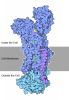
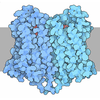
- Assembly
| Deposited unit | 
|
|---|---|
| 1 |
|
-Components
| #1: Protein | Mass: 101046.047 Da / Num. of mol.: 2 Source method: isolated from a genetically manipulated source Source: (gene. exp.) Homo sapiens (human) / Gene: GPR155, PGR22 / Production host:   Schizosaccharomyces pombe (fission yeast) / References: UniProt: Q7Z3F1 Schizosaccharomyces pombe (fission yeast) / References: UniProt: Q7Z3F1#2: Chemical | 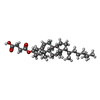 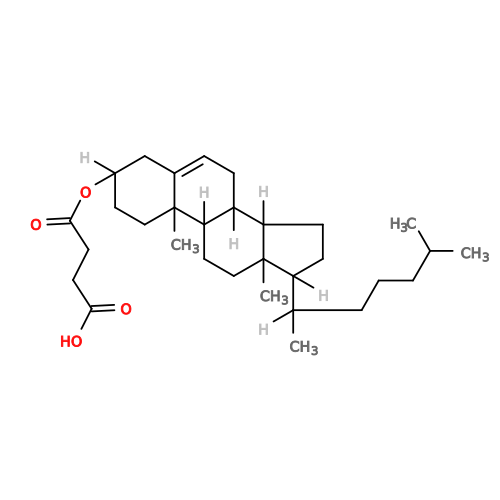 Mass: 486.726 Da / Num. of mol.: 2 / Source method: obtained synthetically / Formula: C31H50O4 / Feature type: SUBJECT OF INVESTIGATION Mass: 486.726 Da / Num. of mol.: 2 / Source method: obtained synthetically / Formula: C31H50O4 / Feature type: SUBJECT OF INVESTIGATION#3: Chemical | 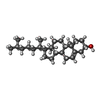 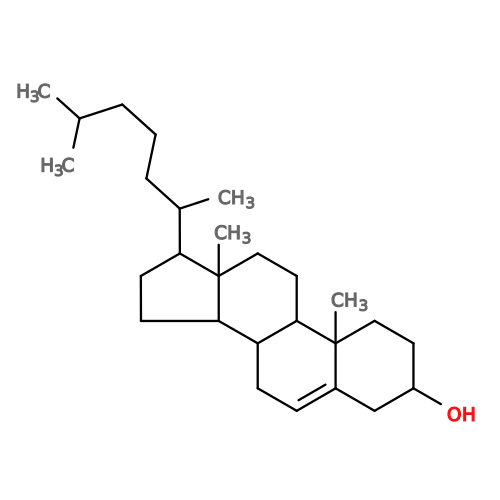 Mass: 386.654 Da / Num. of mol.: 2 / Source method: obtained synthetically / Formula: C27H46O / Feature type: SUBJECT OF INVESTIGATION Mass: 386.654 Da / Num. of mol.: 2 / Source method: obtained synthetically / Formula: C27H46O / Feature type: SUBJECT OF INVESTIGATIONHas ligand of interest | Y | Has protein modification | N | |
|---|
-Experimental details
-Experiment
| Experiment | Method: ELECTRON MICROSCOPY |
|---|---|
| EM experiment | Aggregation state: PARTICLE / 3D reconstruction method: single particle reconstruction |
- Sample preparation
| Component | Name: GPR155 in complex in complex with cholesterol / Type: COMPLEX / Entity ID: #1 / Source: RECOMBINANT |
|---|---|
| Molecular weight | Experimental value: NO |
| Source (natural) | Organism: Homo sapiens (human) |
| Source (recombinant) | Organism: Schizosaccharomyces pombe (fission yeast) |
| Buffer solution | pH: 8 |
| Specimen | Embedding applied: NO / Shadowing applied: NO / Staining applied: NO / Vitrification applied: YES |
| Vitrification | Cryogen name: ETHANE |
- Electron microscopy imaging
| Experimental equipment |  Model: Titan Krios / Image courtesy: FEI Company |
|---|---|
| Microscopy | Model: TFS KRIOS |
| Electron gun | Electron source:  FIELD EMISSION GUN / Accelerating voltage: 300 kV / Illumination mode: FLOOD BEAM FIELD EMISSION GUN / Accelerating voltage: 300 kV / Illumination mode: FLOOD BEAM |
| Electron lens | Mode: BRIGHT FIELD / Nominal defocus max: -2000 nm / Nominal defocus min: -1000 nm |
| Image recording | Electron dose: 50 e/Å2 / Film or detector model: GATAN K3 (6k x 4k) |
- Processing
| CTF correction | Type: PHASE FLIPPING AND AMPLITUDE CORRECTION | ||||||||||||||||||||||||
|---|---|---|---|---|---|---|---|---|---|---|---|---|---|---|---|---|---|---|---|---|---|---|---|---|---|
| 3D reconstruction | Resolution: 2.79 Å / Resolution method: FSC 0.143 CUT-OFF / Num. of particles: 751281 / Symmetry type: POINT | ||||||||||||||||||||||||
| Refinement | Cross valid method: NONE Stereochemistry target values: GeoStd + Monomer Library + CDL v1.2 | ||||||||||||||||||||||||
| Displacement parameters | Biso mean: 25.6 Å2 | ||||||||||||||||||||||||
| Refine LS restraints |
|
