 Movie
Movie Controller

[English] 日本語
 Yorodumi
- EMDB-63106: Cryo-EM structure of GPR155 contracted dimer in complex with chol... -
+ Open data

- Basic information
| Entry |  | |||||||||
|---|---|---|---|---|---|---|---|---|---|---|
| Title | Cryo-EM structure of GPR155 contracted dimer in complex with cholesterol | |||||||||
 Map data Map data | EM map of GPR155 | |||||||||
 Sample Sample |
| |||||||||
 Keywords Keywords | cholesterol / mTORC1 regulation / GPCR / transceptor / MEMBRANE PROTEIN | |||||||||
| Function / homology |  Function and homology information Function and homology informationcellular response to cholesterol / negative regulation of BMP signaling pathway / cholesterol binding / positive regulation of TORC1 signaling / cellular response to amino acid starvation / transmembrane transport / cognition / intracellular signal transduction / lysosomal membrane / extracellular exosome Similarity search - Function | |||||||||
| Biological species |  Homo sapiens (human) Homo sapiens (human) | |||||||||
| Method | single particle reconstruction / cryo EM / Resolution: 2.79 Å | |||||||||
 Authors Authors | Gao F / Zhang X / Li D / Han P | |||||||||
| Funding support |  China, 2 items China, 2 items
| |||||||||
 Citation Citation | Journal: Sci Bull (Beijing) / Year: 2025 Title: Structural insight into GPR155-mediated cholesterol sensing and signal transduction. Authors: Delin Li / Xiaokang Zhang / Jie Feng / Yufeng Xie / Pu Han / Ming He / Lin Hao / Tianling Guo / Xiaoyi Bai / Kai Yuan / Junqing Sun / Xuefei Pang / Yan Wu / Yingxia Liu / George Fu Gao / Niu ...Authors: Delin Li / Xiaokang Zhang / Jie Feng / Yufeng Xie / Pu Han / Ming He / Lin Hao / Tianling Guo / Xiaoyi Bai / Kai Yuan / Junqing Sun / Xuefei Pang / Yan Wu / Yingxia Liu / George Fu Gao / Niu Huang / Haixia Xiao / Feng Gao / Abstract: Cholesterol (CHL) serves as a building block for membrane biogenesis and a precursor to oxysterols, steroid hormones, bile acids, and vitamin D. The lysosome serves as a major sorting station for low- ...Cholesterol (CHL) serves as a building block for membrane biogenesis and a precursor to oxysterols, steroid hormones, bile acids, and vitamin D. The lysosome serves as a major sorting station for low-density lipoproteins (LDLs), which carry dietary CHL, and it is also the cellular site where the master growth regulator, the protein kinase mechanistic Target of Rapamycin Complex 1 (mTORC1), is activated. Recently, the lysosomal transmembrane protein GPR155 was reported to signals CHL sufficiency to mTORC1 through sequestration of the GTPase-activating protein towards the Rags 1 (GATOR1). Although the recently reported structures of GPR155 have revealed the CHL binding site, how the signal is transduced from the CHL binding site to the soluble parts of GPR155 and GATOR1 remains unknown. Here, with our three cryo-EM structures of GPR155 captured in different conformations in complex with CHL, complemented by long-time scale molecular dynamics simulations, the dynamic rearrangement of different domains was observed. CHL binding induces a widening of the crevice between the transporter and GPCR domains. The extending helix preceding transmembrane helix (TM) 16, which was unresolved in other structures, acts as a linkage lever that transmits the rotation of the GPCR domain to the soluble parts of GPR155 in response to CHL binding. This work not only answers the question of how CHL is sensed by GPR155, but also addresses a more profound question: how the signal perceived by the TMs regions is transduced to the LED and DEP domains. | |||||||||
| History |
|
- Structure visualization
| Supplemental images |
|---|

- Downloads & links
-EMDB archive
| Map data | emd_63106.map.gz | 229.9 MB | EMDB map data format | |
|---|---|---|---|---|
| Header (meta data) | emd-63106-v30.xmlemd-63106.xml | 16.3 KB 16.3 KB | Display Display | EMDB header |
| Images |  emd_63106.png emd_63106.png | 93.5 KB | ||
| Filedesc metadata | emd-63106.cif.gz | 6 KB | ||
| Others | emd_63106_half_map_1.map.gzemd_63106_half_map_2.map.gz | 226.5 MB 226.5 MB | ||
| Archive directory |  https://data.pdbj.org/pub/emdb/structures/EMD-63106ftp://data.pdbj.org/pub/emdb/structures/EMD-63106 https://data.pdbj.org/pub/emdb/structures/EMD-63106ftp://data.pdbj.org/pub/emdb/structures/EMD-63106 | HTTPS FTP |
-Related structure data
| Related structure data |  9lhvMC  9lhqC  9lhxC M: atomic model generated by this map C: citing same article ( |
|---|---|
| Similar structure data |


-Links
| EMDB pages | EMDB (EBI/PDBe) / EMDataResource |
|---|---|
| Related items in Molecule of the Month |

-Map
| File | Download / File: emd_63106.map.gz / Format: CCP4 / Size: 244.1 MB / Type: IMAGE STORED AS FLOATING POINT NUMBER (4 BYTES) | ||||||||||||||||||||||||||||||||||||
|---|---|---|---|---|---|---|---|---|---|---|---|---|---|---|---|---|---|---|---|---|---|---|---|---|---|---|---|---|---|---|---|---|---|---|---|---|---|
| Annotation | EM map of GPR155 | ||||||||||||||||||||||||||||||||||||
| Projections & slices | Image control
Images are generated by Spider. | ||||||||||||||||||||||||||||||||||||
| Voxel size | X=Y=Z: 0.85 Å | ||||||||||||||||||||||||||||||||||||
| Density |
| ||||||||||||||||||||||||||||||||||||
| Symmetry | Space group: 1 | ||||||||||||||||||||||||||||||||||||
| Details | EMDB XML:
|
 Z (Sec.)
 Y (Row.)
 X (Col.)


-Supplemental data
-Half map: EM halp map A of GPR155
| File | emd_63106_half_map_1.map | ||||||||||||
|---|---|---|---|---|---|---|---|---|---|---|---|---|---|
| Annotation | EM halp map A of GPR155 | ||||||||||||
| Projections & Slices |
| ||||||||||||
| Density Histograms |


-Half map: EM half map B of GPR155
| File | emd_63106_half_map_2.map | ||||||||||||
|---|---|---|---|---|---|---|---|---|---|---|---|---|---|
| Annotation | EM half map B of GPR155 | ||||||||||||
| Projections & Slices |
| ||||||||||||
| Density Histograms |


- Sample components
-Entire : GPR155 in complex in complex with cholesterol
| Entire | Name: GPR155 in complex in complex with cholesterol |
|---|---|
| Components |
|
-Supramolecule #1: GPR155 in complex in complex with cholesterol
| Supramolecule | Name: GPR155 in complex in complex with cholesterol / type: complex / ID: 1 / Parent: 0 / Macromolecule list: #1 |
|---|---|
| Source (natural) | Organism: Homo sapiens (human) |
-Macromolecule #1: Lysosomal cholesterol signaling protein
| Macromolecule | Name: Lysosomal cholesterol signaling protein / type: protein_or_peptide / ID: 1 / Number of copies: 2 / Enantiomer: LEVO |
|---|---|
| Source (natural) | Organism: Homo sapiens (human) |
| Molecular weight | Theoretical: 101.046047 KDa |
| Recombinant expression | Organism:   Schizosaccharomyces pombe (fission yeast) Schizosaccharomyces pombe (fission yeast) |
| Sequence | String: MNSNLPAENL TIAVNMTKTL PTAVTHGFNS TNDPPSMSIT RLFPALLECF GIVLCGYIAG RANVITSTQA KGLGNFVSRF ALPALLFKN MVVLNFSNVD WSFLYSILIA KASVFFIVCV LTLLVASPDS RFSKAGLFPI FATQSNDFAL GYPIVEALYQ T TYPEYLQY ...String: MNSNLPAENL TIAVNMTKTL PTAVTHGFNS TNDPPSMSIT RLFPALLECF GIVLCGYIAG RANVITSTQA KGLGNFVSRF ALPALLFKN MVVLNFSNVD WSFLYSILIA KASVFFIVCV LTLLVASPDS RFSKAGLFPI FATQSNDFAL GYPIVEALYQ T TYPEYLQY IYLVAPISLM MLNPIGFIFC EIQKWKDTQN ASQNKIKIVG LGLLRVLQNP IVFMVFIGIA FNFILDRKVP VY VENFLDG LGNSFSGSAL FYLGLTMVGK IKRLKKSAFV VLILLITAKL LVLPLLCREM VELLDKGDSV VNHTSLSNYA FLY GVFPVA PGVAIFATQF NMEVEIITSG MVISTFVSAP IMYVSAWLLT FPTMDPKPLA YAIQNVSFDI SIVSLISLIW SLAI LLLSK KYKQLPHMLT TNLLIAQSIV CAGMMIWNFV KEKNFVGQIL VFVLLYSSLY STYLWTGLLA ISLFLLKKRE RVQIP VGII IISGWGIPAL LVGVLLITGK HNGDSIDSAF FYGKEQMITT AVTLFCSILI AGISLMCMNQ TAQAGSYEGF DQSQSH KVV EPGNTAFEES PAPVNEPELF TSSIPETSCC SCSMGNGELH CPSIEPIANT STSEPVIPSF EKNNHCVSRC NSQSCIL AQ EEEQYLQSGD QQLTRHVLLC LLLIIGLFAN LSSCLWWLFN QEPGRLYVEL QFFCAVFNFG QGFISFGIFG LDKHLIIL P FKRRLEFLWN NKDTAENRDS PVSEEIKMTC QQFIHYHRDL CIRNIVKERR CGAKTSAGTF CGCDLVSWLI EVGLASDRG EAVIYGDRLV QGGVIQHITN EYEFRDEYLF YRFLQKSPEQ SPPAINANTL QQERYKEIEH SSPPSHSPKT AAAENLYFQG LWSHPQFEK GGGSGGGSGG SAWSHPQFEK UniProtKB: Lysosomal cholesterol signaling protein |
-Macromolecule #2: CHOLESTEROL HEMISUCCINATE
| Macromolecule | Name: CHOLESTEROL HEMISUCCINATE / type: ligand / ID: 2 / Number of copies: 2 / Formula: Y01 |
|---|---|
| Molecular weight | Theoretical: 486.726 Da |
| Chemical component information | 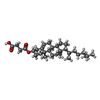 ChemComp-Y01: |
-Macromolecule #3: CHOLESTEROL
| Macromolecule | Name: CHOLESTEROL / type: ligand / ID: 3 / Number of copies: 2 / Formula: CLR |
|---|---|
| Molecular weight | Theoretical: 386.654 Da |
| Chemical component information | 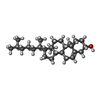 ChemComp-CLR: |
-Experimental details
-Structure determination
| Method | cryo EM |
|---|---|
 Processing Processing | single particle reconstruction |
| Aggregation state | particle |
-Sample preparation
| Buffer | pH: 8 |
|---|---|
| Vitrification | Cryogen name: ETHANE |
- Electron microscopy
| Microscope | TFS KRIOS |
|---|---|
| Image recording | Film or detector model: GATAN K3 (6k x 4k) / Average electron dose: 50.0 e/Å2 |
| Electron beam | Acceleration voltage: 300 kV / Electron source:  FIELD EMISSION GUN FIELD EMISSION GUN |
| Electron optics | Illumination mode: FLOOD BEAM / Imaging mode: BRIGHT FIELD / Nominal defocus max: -2.0 µm / Nominal defocus min: -1.0 µm |
| Experimental equipment |  Model: Titan Krios / Image courtesy: FEI Company |
