National Natural Science Foundation of China (NSFC)
中国
National Key Research and Development Program
2021YFC2302500
中国
R&D Program of Guangzhou Laboratory
SRPG22-003
中国
引用
ジャーナル: Nat Commun / 年: 2025 タイトル: Orphan broadly RBD-binding antibodies annotate three remaining conserved RBD epitopes along SARS-CoV-2 evolution. 著者: Minxiang Xie / Yinong Qiu / Xiaoyu Zhao / Jialu Shi / Yuanchen Liu / Qingsong Zhang / Jiaying He / Jiayan Li / Luotian Liu / Siyuan Sun / Yuzhen Zhu / Qiyu Mao / Yiming Long / Thiago Y ...著者: Minxiang Xie / Yinong Qiu / Xiaoyu Zhao / Jialu Shi / Yuanchen Liu / Qingsong Zhang / Jiaying He / Jiayan Li / Luotian Liu / Siyuan Sun / Yuzhen Zhu / Qiyu Mao / Yiming Long / Thiago Y Oliveira / Zijun Wang / Yunjiao Zhou / Yan Yan / Anqi Xia / Wenjing Zai / Christian T Mayer / Youhua Xie / Shibo Jiang / Lu Lu / Rong Xia / Fan Wu / Lei Sun / Pengfei Wang / Hin Chu / Qiao Wang / 要旨: The receptor-binding domain (RBD) of the SARS-CoV-2 spike (S) protein continues to evolve, facilitating antibody evasion. It remains unclear whether any conserved RBD epitopes persist across SARS-CoV- ...The receptor-binding domain (RBD) of the SARS-CoV-2 spike (S) protein continues to evolve, facilitating antibody evasion. It remains unclear whether any conserved RBD epitopes persist across SARS-CoV-2 variants and whether vaccination and/or breakthrough infection (BTI) can elicit antibodies capable of targeting these conserved regions to counter future variants. Here, using a heterogeneous double-bait single B-cell sorting strategy, we identify a subset of antibodies with broad-spectrum RBD binding, including recognition of SARS-CoV-1 and emerging variants such as EG.5.1, BA.2.86, JN.1, and KP.2/3. These broadly binding antibodies (bbAbs) exhibit elevated levels of somatic hypermutation but are infrequently derived from clonally expanded B lymphocytes. Passive transfer of representative bbAbs reduces viral infection in a male hamster model. Structural analyses reveals that these bbAbs primarily target three distinct, highly conserved RBD epitopes, suggesting potential regions of future mutational pressure and highlighting the presence of conserved and immunogenic RBD conformations that may serve as a foundation for the development of broadly protective vaccines.
 ムービー
ムービー コントローラー


 データを開く
 基本情報
基本情報
 マップデータ
 試料
試料 キーワード
キーワード
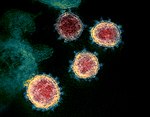 Severe acute respiratory syndrome coronavirus 2 (ウイルス) /
  Homo sapiens (ヒト)
 データ登録者
 中国, 3件
  引用
引用
 構造の表示
構造の表示
 ダウンロードとリンク
 EMDBマップデータ形式
 emd_62733.png
 http://ftp.pdbj.org/pub/emdb/structures/EMD-62733


 Z (Sec.)
 Y (Row.)
 X (Col.)


 試料の構成要素
 解析
解析 電子顕微鏡法
 FIELD EMISSION GUN
