[English] 日本語
Yorodumi
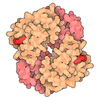
- EMDB-61715: CryoEM structure of mouse RAG SEC-PHD -

+
Open data


ID or keywords:

Loading...

-
Basic information

Entry
Database: EMDB / ID: EMD-61715
TitleCryoEM structure of mouse RAG SEC-PHD
Map data
Sample
  • Complex: mouse RAG SEC
    • Protein or peptide: V(D)J recombination-activating protein 1
    • Protein or peptide: V(D)J recombination-activating protein 2
    • DNA: DNA (5'-D(P*GP*GP*CP*TP*GP*TP*AP*TP*CP*AP*CP*TP*GP*TP*G)-3')
    • DNA: DNA (5'-D(P*TP*TP*TP*GP*CP*AP*TP*CP*AP*CP*TP*GP*TP*G)-3')
    • DNA: DNA (5'-D(*CP*AP*CP*AP*GP*TP*GP*AP*TP*AP*CP*AP*GP*CP*C)-3')
    • DNA: DNA (5'-D(*CP*AP*CP*AP*GP*TP*GP*AP*TP*GP*CP*AP*AP*A)-3')
  • Ligand: CALCIUM ION
  • Ligand: ZINC ION
  • Ligand: water
KeywordsV(D)J recombination / RAG / PHD / Transposition / DNA BINDING PROTEIN / DNA BINDING PROTEIN-DNA complex
Function / homology
Function and homology information


mature B cell differentiation involved in immune response / DNA recombinase complex / B cell homeostatic proliferation / endodeoxyribonuclease complex / negative regulation of T cell differentiation in thymus / pre-B cell allelic exclusion / positive regulation of organ growth / V(D)J recombination / negative regulation of T cell apoptotic process / regulation of behavioral fear response ...mature B cell differentiation involved in immune response / DNA recombinase complex / B cell homeostatic proliferation / endodeoxyribonuclease complex / negative regulation of T cell differentiation in thymus / pre-B cell allelic exclusion / positive regulation of organ growth / V(D)J recombination / negative regulation of T cell apoptotic process / regulation of behavioral fear response / phosphatidylinositol-3,4-bisphosphate binding / negative regulation of thymocyte apoptotic process / phosphatidylinositol-3,5-bisphosphate binding / histone H3K4me3 reader activity / regulation of T cell differentiation / positive regulation of T cell differentiation / T cell lineage commitment / B cell lineage commitment / phosphatidylinositol-3,4,5-trisphosphate binding / T cell homeostasis / T cell differentiation / protein autoubiquitination / phosphatidylinositol-4,5-bisphosphate binding / phosphatidylinositol binding / B cell differentiation / thymus development / RING-type E3 ubiquitin transferase / visual learning / ubiquitin-protein transferase activity / ubiquitin protein ligase activity / T cell differentiation in thymus / chromatin organization / endonuclease activity / DNA recombination / histone binding / sequence-specific DNA binding / Hydrolases; Acting on ester bonds / adaptive immune response / defense response to bacterium / hydrolase activity / chromatin binding / protein homodimerization activity / zinc ion binding / nucleoplasm / metal ion binding / identical protein binding / nucleus
Similarity search - Function
Recombination-activating protein 1 zinc-finger domain / V(D)J recombination-activating protein 1, Zinc finger / : / NBD domain profile. / Zinc finger RAG1-type profile. / RAG nonamer-binding domain / V(D)J recombination-activating protein 1 / RAG1 importin-binding / : / : ...Recombination-activating protein 1 zinc-finger domain / V(D)J recombination-activating protein 1, Zinc finger / : / NBD domain profile. / Zinc finger RAG1-type profile. / RAG nonamer-binding domain / V(D)J recombination-activating protein 1 / RAG1 importin-binding / : / : / : / : / : / : / RAG1 importin binding / Recombination-activation protein 1 (RAG1) nonamer-binding domain / Recombination-activation protein 1 (RAG1) DNA-binding domain / Recombination-activation protein 1 (RAG1) pre-RNase H domain / Recombination-activation protein 1 (RAG1) RNase H domain / Recombination-activation protein 1 (RAG1) ZnC2 domain / Recombination-activation protein 1 (RAG1) ZnH2 domain / Recombination-activation protein 1 (RAG1) C-terminal domain / Recombination activating protein 2 / RAG2 PHD domain / V-D-J recombination activating protein 2 / Recombination activating protein 2, PHD domain / Galactose oxidase/kelch, beta-propeller / Kelch-type beta propeller / Zinc finger, C3HC4 RING-type / Zinc finger, C3HC4 type (RING finger) / Zinc finger, RING-type, conserved site / Zinc finger RING-type signature. / Zinc finger C2H2 superfamily / Ring finger / Zinc finger, FYVE/PHD-type / Zinc finger RING-type profile. / Zinc finger, RING-type / Zinc finger, RING/FYVE/PHD-type
Similarity search - Domain/homology
V(D)J recombination-activating protein 1 / V(D)J recombination-activating protein 2
Similarity search - Component
Biological speciesMus musculus (house mouse) / Escherichia coli (E. coli)
Methodsingle particle reconstruction / cryo EM / Resolution: 3.25 Å
AuthorsChen X / Yao L / Yang W / Gellert M
Funding support United States, China, 2 items
OrganizationGrant numberCountry
National Institutes of Health/National Institute of Diabetes and Digestive and Kidney Disease (NIH/NIDDK) United States
National Natural Science Foundation of China (NSFC) China
CitationJournal: Proc Natl Acad Sci U S A / Year: 2025
Title: How RAG1/2 evolved from ancestral transposases to initiate V(D)J recombination without transposition.
Authors: Xuemin Chen / Liangrui Yao / Wenwen Li / Shanshan Ma / Xingyun Yuan / Yang Yang / Yuan Yuan / Yumei Liu / Lan Liu / Huaibin Wang / Martin Gellert / Wei Yang /
Abstract: The recombination activating genes 1 and 2 (RAG1/2) recombinase, which initiates V(D)J recombination in jawed vertebrates, evolved from RNaseH-like transposases such as Transib and ProtoRAG. However, ...The recombination activating genes 1 and 2 (RAG1/2) recombinase, which initiates V(D)J recombination in jawed vertebrates, evolved from RNaseH-like transposases such as Transib and ProtoRAG. However, its postcleavage transposase activity is strictly suppressed. Previous structural studies have focused only on the conserved core domains of RAG1/2, leaving the regulatory mechanisms of the noncore regions unclear. To investigate how RAG1/2 suppresses transposition and regulates DNA cleavage, we determined cryo-electron microscopy (cryo-EM) structures of nearly full-length RAG1/2 complexed with cleaved recombination signal sequences (RSS) in a signal-end complex (SEC) at resolutions up to 2.95 Å. Two key structures, SEC-0 and SEC-Plant Homeodomain (PHD), reveal distinct regulatory roles of RAG2, which is absent in Transib transposase. SEC-0 displays a closed conformation, revealing that the core RAG2 facilitates sequential DNA cleavage by stabilizing the RSS-cleaved states in a "spring-loaded" mechanism. SEC-PHD reveals how RAG2's noncore PHD and Acidic Hinge (AH), which are absent in ProtoRAG, inhibit target DNA binding in transposition. Histone H3K4me3, which recruits RAG1/2 to RSS sites, does not influence RAG1/2 binding to V, D, or J gene segments bordered by RSS. In contrast, the suppressed transposition can be activated by H3K4me3 peptides that dislodge the inhibitory PHD. To achieve this derepression in vivo, however, would require an unlikely close placement of two nucleosomes flanking a target DNA bent by nearly 180°. Our structural and biochemical results elucidate how RAG1 has acquired RAG2 and utilizes its core and noncore domains to enhance V(D)J recombination and suppress transposition.
History
DepositionSep 26, 2024-
Header (metadata) releaseJul 23, 2025-
Map releaseJul 23, 2025-
UpdateFeb 4, 2026-
Current statusFeb 4, 2026Processing site: PDBj / Status: Released

-
Structure visualization

Supplemental images

Downloads & links

-
Map

FileDownload / File: emd_61715.map.gz / Format: CCP4 / Size: 70.2 MB / Type: IMAGE STORED AS FLOATING POINT NUMBER (4 BYTES)
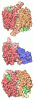
Projections & slices

Image control

Size
Brightness
Contrast
Others
AxesZ (Sec.)Y (Row.)X (Col.)
1.06 Å/pix.
x 264 pix.
= 279.84 Å
1.06 Å/pix.
x 264 pix.
= 279.84 Å
1.06 Å/pix.
x 264 pix.
= 279.84 Å

Surface

Projections

Slices (1/3)

Slices (1/2)

Slices (2/3)

Images are generated by Spider.

Voxel sizeX=Y=Z: 1.06 Å
Density
Contour LevelBy AUTHOR: 0.1
Minimum - Maximum-0.32465112 - 0.6282071
Average (Standard dev.)-0.0007021466 (±0.024054378)
SymmetrySpace group: 1
Details

EMDB XML:

Map geometry
Axis orderXYZ
Origin000
Dimensions264264264
Spacing264264264
CellA=B=C: 279.84 Å
α=β=γ: 90.0 °

-
Supplemental data

-
Half map: #2

Fileemd_61715_half_map_1.map
Projections & Slices
AxesZYX

Projections

Slices (1/2)
Density Histograms

-
Half map: #1

Fileemd_61715_half_map_2.map
Projections & Slices
AxesZYX

Projections

Slices (1/2)
Density Histograms

-
Sample components

+
Entire : mouse RAG SEC

EntireName: mouse RAG SEC
Components
  • Complex: mouse RAG SEC
    • Protein or peptide: V(D)J recombination-activating protein 1
    • Protein or peptide: V(D)J recombination-activating protein 2
    • DNA: DNA (5'-D(P*GP*GP*CP*TP*GP*TP*AP*TP*CP*AP*CP*TP*GP*TP*G)-3')
    • DNA: DNA (5'-D(P*TP*TP*TP*GP*CP*AP*TP*CP*AP*CP*TP*GP*TP*G)-3')
    • DNA: DNA (5'-D(*CP*AP*CP*AP*GP*TP*GP*AP*TP*AP*CP*AP*GP*CP*C)-3')
    • DNA: DNA (5'-D(*CP*AP*CP*AP*GP*TP*GP*AP*TP*GP*CP*AP*AP*A)-3')
  • Ligand: CALCIUM ION
  • Ligand: ZINC ION
  • Ligand: water

+
Supramolecule #1: mouse RAG SEC

SupramoleculeName: mouse RAG SEC / type: complex / ID: 1 / Parent: 0 / Macromolecule list: #1-#6
Source (natural)Organism: Mus musculus (house mouse)

+
Macromolecule #1: V(D)J recombination-activating protein 1

MacromoleculeName: V(D)J recombination-activating protein 1 / type: protein_or_peptide / ID: 1 / Number of copies: 2 / Enantiomer: LEVO / EC number: Hydrolases; Acting on ester bonds
Source (natural)Organism: Mus musculus (house mouse)
Molecular weightTheoretical: 119.389352 KDa
Recombinant expressionOrganism: Homo sapiens (human)
SequenceString: MAASLPSTLS FSSAPDEIQH PQIKFSEWKF KLFRVRSFEK APEEAQKEKD SSEGKPYLEQ SPVVPEKPGG QNSILTQRAL KLHPKFSKK FHADGKSSDK AVHQARLRHF CRICGNRFKS DGHSRRYPVH GPVDAKTQSL FRKKEKRVTS WPDLIARIFR I DVKADVDS ...String:
MAASLPSTLS FSSAPDEIQH PQIKFSEWKF KLFRVRSFEK APEEAQKEKD SSEGKPYLEQ SPVVPEKPGG QNSILTQRAL KLHPKFSKK FHADGKSSDK AVHQARLRHF CRICGNRFKS DGHSRRYPVH GPVDAKTQSL FRKKEKRVTS WPDLIARIFR I DVKADVDS IHPTEFCHDC WSIMHRKFSS SHSQVYFPRK VTVEWHPHTP SCDICFTAHR GLKRKRHQPN VQLSKKLKTV LN HARRDRR KRTQARVSSK EVLKKISNCS KIHLSTKLLA VDFPAHFVKS ISCQICEHIL ADPVETSCKH LFCRICILRC LKV MGSYCP SCRYPCFPTD LESPVKSFLN ILNSLMVKCP AQDCNEEVSL EKYNHHVSSH KESKETLVHI NKGGRPRQHL LSLT RRAQK HRLRELKIQV KEFADKEEGG DVKAVCLTLF LLALRARNEH RQADELEAIM QGRGSGLQPA VCLAIRVNTF LSCSQ YHKM YRTVKAITGR QIFQPLHALR NAEKVLLPGY HPFEWQPPLK NVSSRTDVGI IDGLSGLASS VDEYPVDTIA KRFRYD SAL VSALMDMEED ILEGMRSQDL DDYLNGPFTV VVKESCDGMG DVSEKHGSGP AVPEKAVRFS FTVMRITIEH GSQNVKV FE EPKPNSELCC KPLCLMLADE SDHETLTAIL SPLIAEREAM KSSELTLEMG GIPRTFKFIF RGTGYDEKLV REVEGLEA S GSVYICTLCD TTRLEASQNL VFHSITRSHA ENLQRYEVWR SNPYHESVEE LRDRVKGVSA KPFIETVPSI DALHCDIGN AAEFYKIFQL EIGEVYKHPN ASKEERKRWQ ATLDKHLRKR MNLKPIMRMN GNFARKLMTQ ETVDAVCELI PSEERHEALR ELMDLYLKM KPVWRSSCPA KECPESLCQY SFNSQRFAEL LSTKFKYRYE GKITNYFHKT LAHVPEIIER DGSIGAWASE G NESGNKLF RRFRKMNARQ SKCYEMEDVL KHHWLYTSKY LQKFMNAHNA LKSSGFTMNS KETLGDPLGI EDSLESQDSM EF

UniProtKB: V(D)J recombination-activating protein 1

+
Macromolecule #2: V(D)J recombination-activating protein 2

MacromoleculeName: V(D)J recombination-activating protein 2 / type: protein_or_peptide / ID: 2 / Number of copies: 3 / Enantiomer: LEVO
Source (natural)Organism: Mus musculus (house mouse)
Molecular weightTheoretical: 59.13841 KDa
Recombinant expressionOrganism: Homo sapiens (human)
SequenceString: MSLQMVTVGH NIALIQPGFS LMNFDGQVFF FGQKGWPKRS CPTGVFHFDI KQNHLKLKPA IFSKDSCYLP PLRYPATCSY KGSIDSDKH QYIIHGGKTP NNELSDKIYI MSVACKNNKK VTFRCTEKDL VGDVPEPRYG HSIDVVYSRG KSMGVLFGGR S YMPSTQRT ...String:
MSLQMVTVGH NIALIQPGFS LMNFDGQVFF FGQKGWPKRS CPTGVFHFDI KQNHLKLKPA IFSKDSCYLP PLRYPATCSY KGSIDSDKH QYIIHGGKTP NNELSDKIYI MSVACKNNKK VTFRCTEKDL VGDVPEPRYG HSIDVVYSRG KSMGVLFGGR S YMPSTQRT TEKWNSVADC LPHVFLIDFE FGCATSYILP ELQDGLSFHV SIARNDTVYI LGGHSLASNI RPANLYRIRV DL PLGTPAV NCTVLPGGIS VSSAILTQTN NDEFVIVGGY QLENQKRMVC SLVSLGDNTI EISEMETPDW TSDIKHSKIW FGS NMGNGT IFLGIPGDNK QAMSEAFYFY TLRCSEEDLS EDQKIVSNSQ TSTEDPGDST PFEDSEEFCF SAEATSFDGD DEFD TYNED DEDDESVTGY WITCCPTCDV DINTWVPFYS TELNKPAMIY CSHGDGHWVH AQCMDLEERT LIHLSEGSNK YYCNE HVQI ARALQTPKRN PPLQKPPMKS LHKKGSGKVL TPAKKSFLRR LFD

UniProtKB: V(D)J recombination-activating protein 2

+
Macromolecule #3: DNA (5'-D(P*GP*GP*CP*TP*GP*TP*AP*TP*CP*AP*CP*TP*GP*TP*G)-3')

MacromoleculeName: DNA (5'-D(P*GP*GP*CP*TP*GP*TP*AP*TP*CP*AP*CP*TP*GP*TP*G)-3')
type: dna / ID: 3 / Number of copies: 1 / Classification: DNA
Source (natural)Organism: Escherichia coli (E. coli)
Molecular weightTheoretical: 4.615995 KDa
SequenceString:
(DG)(DG)(DC)(DT)(DG)(DT)(DA)(DT)(DC)(DA) (DC)(DT)(DG)(DT)(DG)

+
Macromolecule #4: DNA (5'-D(P*TP*TP*TP*GP*CP*AP*TP*CP*AP*CP*TP*GP*TP*G)-3')

MacromoleculeName: DNA (5'-D(P*TP*TP*TP*GP*CP*AP*TP*CP*AP*CP*TP*GP*TP*G)-3')
type: dna / ID: 4 / Number of copies: 1 / Classification: DNA
Source (natural)Organism: Escherichia coli (E. coli)
Molecular weightTheoretical: 4.261775 KDa
SequenceString:
(DT)(DT)(DT)(DG)(DC)(DA)(DT)(DC)(DA)(DC) (DT)(DG)(DT)(DG)

+
Macromolecule #5: DNA (5'-D(*CP*AP*CP*AP*GP*TP*GP*AP*TP*AP*CP*AP*GP*CP*C)-3')

MacromoleculeName: DNA (5'-D(*CP*AP*CP*AP*GP*TP*GP*AP*TP*AP*CP*AP*GP*CP*C)-3')
type: dna / ID: 5 / Number of copies: 1 / Classification: DNA
Source (natural)Organism: Escherichia coli (E. coli)
Molecular weightTheoretical: 4.562988 KDa
SequenceString:
(DC)(DA)(DC)(DA)(DG)(DT)(DG)(DA)(DT)(DA) (DC)(DA)(DG)(DC)(DC)

+
Macromolecule #6: DNA (5'-D(*CP*AP*CP*AP*GP*TP*GP*AP*TP*GP*CP*AP*AP*A)-3')

MacromoleculeName: DNA (5'-D(*CP*AP*CP*AP*GP*TP*GP*AP*TP*GP*CP*AP*AP*A)-3')
type: dna / ID: 6 / Number of copies: 1 / Classification: DNA
Source (natural)Organism: Escherichia coli (E. coli)
Molecular weightTheoretical: 4.297832 KDa
SequenceString:
(DC)(DA)(DC)(DA)(DG)(DT)(DG)(DA)(DT)(DG) (DC)(DA)(DA)(DA)

+
Macromolecule #7: CALCIUM ION

MacromoleculeName: CALCIUM ION / type: ligand / ID: 7 / Number of copies: 2 / Formula: CA
Molecular weightTheoretical: 40.078 Da

+
Macromolecule #8: ZINC ION

MacromoleculeName: ZINC ION / type: ligand / ID: 8 / Number of copies: 4 / Formula: ZN
Molecular weightTheoretical: 65.409 Da

+
Macromolecule #9: water

MacromoleculeName: water / type: ligand / ID: 9 / Number of copies: 2 / Formula: HOH
Molecular weightTheoretical: 18.015 Da
Chemical component information

ChemComp-HOH:
WATER

-
Experimental details

-
Structure determination

Methodcryo EM
Processingsingle particle reconstruction
Aggregation stateparticle

-
Sample preparation

BufferpH: 7.4
VitrificationCryogen name: ETHANE

-
Electron microscopy

MicroscopeTFS KRIOS
Image recordingFilm or detector model: GATAN K2 SUMMIT (4k x 4k) / Average electron dose: 70.0 e/Å2
Electron beamAcceleration voltage: 300 kV / Electron source: FIELD EMISSION GUN
Electron opticsIllumination mode: FLOOD BEAM / Imaging mode: BRIGHT FIELD / Nominal defocus max: 3.0 µm / Nominal defocus min: 0.8 µm
Experimental equipment
Model: Titan Krios / Image courtesy: FEI Company

+
Image processing

CTF correctionDetails: cryoSPARC / Type: PHASE FLIPPING AND AMPLITUDE CORRECTION
Startup modelType of model: NONE
Final reconstructionResolution.type: BY AUTHOR / Resolution: 3.25 Å / Resolution method: FSC 0.143 CUT-OFF / Number images used: 57418
Initial angle assignmentType: NOT APPLICABLE / Details: cryoSPARC
Final angle assignmentType: COMMON LINE

+
About Yorodumi

-
News

-
Feb 9, 2022. New format data for meta-information of EMDB entries

New format data for meta-information of EMDB entries

  • Version 3 of the EMDB header file is now the official format.
  • The previous official version 1.9 will be removed from the archive.

Related info.:EMDB header

External links:wwPDB to switch to version 3 of the EMDB data model

-
Aug 12, 2020. Covid-19 info

Covid-19 info

URL: https://pdbj.org/emnavi/covid19.php

New page: Covid-19 featured information page in EM Navigator.

Related info.:Covid-19 info / Mar 5, 2020. Novel coronavirus structure data

+
Mar 5, 2020. Novel coronavirus structure data

Novel coronavirus structure data

Related info.:Yorodumi Speices / Aug 12, 2020. Covid-19 info

External links:COVID-19 featured content - PDBj / Molecule of the Month (242):Coronavirus Proteases

+
Jan 31, 2019. EMDB accession codes are about to change! (news from PDBe EMDB page)

EMDB accession codes are about to change! (news from PDBe EMDB page)

  • The allocation of 4 digits for EMDB accession codes will soon come to an end. Whilst these codes will remain in use, new EMDB accession codes will include an additional digit and will expand incrementally as the available range of codes is exhausted. The current 4-digit format prefixed with “EMD-” (i.e. EMD-XXXX) will advance to a 5-digit format (i.e. EMD-XXXXX), and so on. It is currently estimated that the 4-digit codes will be depleted around Spring 2019, at which point the 5-digit format will come into force.
  • The EM Navigator/Yorodumi systems omit the EMD- prefix.

Related info.:Q: What is EMD? / ID/Accession-code notation in Yorodumi/EM Navigator

External links:EMDB Accession Codes are Changing Soon! / Contact to PDBj

+
Jul 12, 2017. Major update of PDB

Major update of PDB

  • wwPDB released updated PDB data conforming to the new PDBx/mmCIF dictionary.
  • This is a major update changing the version number from 4 to 5, and with Remediation, in which all the entries are updated.
  • In this update, many items about electron microscopy experimental information are reorganized (e.g. em_software).
  • Now, EM Navigator and Yorodumi are based on the updated data.

External links:wwPDB Remediation / Enriched Model Files Conforming to OneDep Data Standards Now Available in the PDB FTP Archive

-
Yorodumi

Thousand views of thousand structures

  • Yorodumi is a browser for structure data from EMDB, PDB, SASBDB, etc.
  • This page is also the successor to EM Navigator detail page, and also detail information page/front-end page for Omokage search.
  • The word "yorodu" (or yorozu) is an old Japanese word meaning "ten thousand". "mi" (miru) is to see.

Related info.:EMDB / PDB / SASBDB / Comparison of 3 databanks / Yorodumi Search / Aug 31, 2016. New EM Navigator & Yorodumi / Yorodumi Papers / Jmol/JSmol / Function and homology information / Changes in new EM Navigator and Yorodumi

Read more