Journal: PLoS Pathog / Year: 2025 Title: Engineering a multivalent antibody nanoparticle to overcome SARS-CoV-2 Omicron immune evasion. Authors: Hui Sun / Yanan Jiang / Miaolin Lan / Ming Zhou / Gangshun Yi / Juan Shen / Tingting Deng / Liqin Liu / Yang Huang / Yu Li / Jinfu Su / Yanling Lin / Zhenqin Chen / Lizhi Zhou / Tingting Li ...Authors: Hui Sun / Yanan Jiang / Miaolin Lan / Ming Zhou / Gangshun Yi / Juan Shen / Tingting Deng / Liqin Liu / Yang Huang / Yu Li / Jinfu Su / Yanling Lin / Zhenqin Chen / Lizhi Zhou / Tingting Li / Hai Yu / Tong Cheng / Yali Zhang / Lunzhi Yuan / Shaowei Li / Ying Gu / Peijun Zhang / Ningshao Xia / Qingbing Zheng / Abstract: The rapid evolution of SARS-CoV-2 and the subsequent emergence of Omicron subvariants pose significant challenges to the efficacy of existing vaccines and therapeutics, including those previously ...The rapid evolution of SARS-CoV-2 and the subsequent emergence of Omicron subvariants pose significant challenges to the efficacy of existing vaccines and therapeutics, including those previously reported most broad neutralizing antibodies (bnAbs). Here, we investigated the molecular basis of the altered neutralization profile of a bnAb, 1C4, against recent variants. 1C4 is effective against early variants from Alpha to Omicron BQ.1, but is circumvented by BQ.1.1, XBB and thereafter variants, primarily due to an additional R346T mutation that diminishes its binding affinity. Cryo-electron microscopy analysis revealed that despite the loss of neutralizing potency, 1C4 retained residual binding to the spike protein of immune-evasive variants such as XBB, which harbor altered receptor-binding domain (RBD). Furthermore, 1C4 exhibited a diminished capacity to inhibit ACE2 engagement with Omicron variants, amplifying the intricacies of viral immune evasion tactics. To address this, we employed the mi3-SpyCatcher-based nanoparticle to polymerize 1C4 (mi3-1C4), which reestablished the neutralization potency against recent variants by enhancing avidity via multivalent binding. Such multivalent binding can promote efficient spike aggregation as well as viral cross-linking, thereby providing enhanced protection against both the infection of Beta and XBB variants in a hamster model. Together, our findings delineate the molecular landscape of immune evasion by neutralizing antibodies and provide strategic insight for the adaptation of antibody engineering to keep pace with viral evolution.
In the structure databanks used in Yorodumi, some data are registered as the other names, "COVID-19 virus" and "2019-nCoV". Here are the details of the virus and the list of structure data.
Jan 31, 2019. EMDB accession codes are about to change! (news from PDBe EMDB page)
EMDB accession codes are about to change! (news from PDBe EMDB page)
The allocation of 4 digits for EMDB accession codes will soon come to an end. Whilst these codes will remain in use, new EMDB accession codes will include an additional digit and will expand incrementally as the available range of codes is exhausted. The current 4-digit format prefixed with “EMD-” (i.e. EMD-XXXX) will advance to a 5-digit format (i.e. EMD-XXXXX), and so on. It is currently estimated that the 4-digit codes will be depleted around Spring 2019, at which point the 5-digit format will come into force.
The EM Navigator/Yorodumi systems omit the EMD- prefix.
Related info.:Q: What is EMD? / ID/Accession-code notation in Yorodumi/EM Navigator
Yorodumi is a browser for structure data from EMDB, PDB, SASBDB, etc.
This page is also the successor to EM Navigator detail page, and also detail information page/front-end page for Omokage search.
The word "yorodu" (or yorozu) is an old Japanese word meaning "ten thousand". "mi" (miru) is to see.
Related info.:EMDB / PDB / SASBDB / Comparison of 3 databanks / Yorodumi Search / Aug 31, 2016. New EM Navigator & Yorodumi / Yorodumi Papers / Jmol/JSmol / Function and homology information / Changes in new EM Navigator and Yorodumi
 Movie
Movie Controller

 Yorodumi
 Open data
 Basic information
 Map data
 Sample
 Keywords
 Mus musculus (house mouse) /
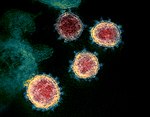 Severe acute respiratory syndrome coronavirus 2
 Authors
 Citation

 Structure visualization
 Downloads & links
 EMDB map data format
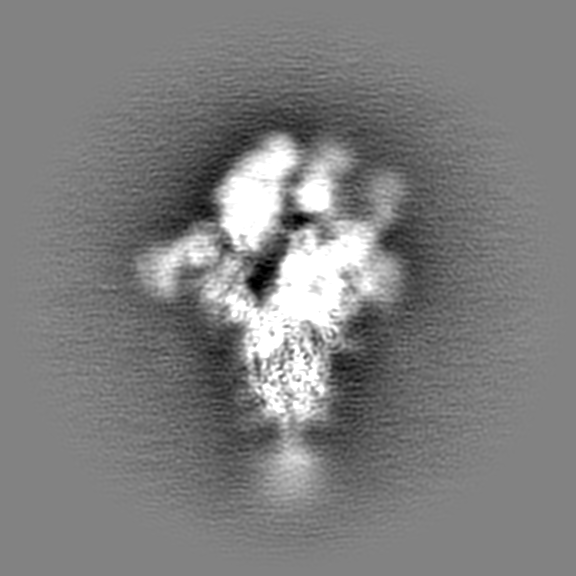
 emd_60863.png
 http://ftp.pdbj.org/pub/emdb/structures/EMD-60863


 Z (Sec.)
 Y (Row.)
 X (Col.)




 Sample components
 Processing
 Electron microscopy
 FIELD EMISSION GUN