 Movie
Movie Controller

[English] 日本語
 Yorodumi
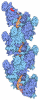
- EMDB-56645: Cryo-EM structure of UBA6-UbDha-UBE2Z trapped ternary complex (do... -
+ Open data

- Basic information
| Entry |  | |||||||||
|---|---|---|---|---|---|---|---|---|---|---|
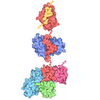
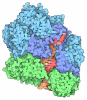
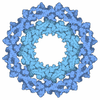
| Title | Cryo-EM structure of UBA6-UbDha-UBE2Z trapped ternary complex (doubly loaded) | |||||||||
 Map data Map data | ||||||||||
 Sample Sample |
| |||||||||
 Keywords Keywords | Ubiquitin-activating enzyme / ubiquitin / adenylation / signalling cascade / SIGNALING PROTEIN | |||||||||
| Function / homology |  Function and homology information Function and homology informationFAT10 activating enzyme activity / E1 ubiquitin-activating enzyme / ubiquitin activating enzyme activity / mitochondrion transport along microtubule / positive regulation of protein monoubiquitination / E2 ubiquitin-conjugating enzyme / ubiquitin conjugating enzyme activity / positive regulation of intrinsic apoptotic signaling pathway by p53 class mediator / Dengue Virus Attachment and Entry / Maturation of protein E ...FAT10 activating enzyme activity / E1 ubiquitin-activating enzyme / ubiquitin activating enzyme activity / mitochondrion transport along microtubule / positive regulation of protein monoubiquitination / E2 ubiquitin-conjugating enzyme / ubiquitin conjugating enzyme activity / positive regulation of intrinsic apoptotic signaling pathway by p53 class mediator / Dengue Virus Attachment and Entry / Maturation of protein E / Maturation of protein E / neuron projection morphogenesis / ER Quality Control Compartment (ERQC) / regulation of neuron apoptotic process / Myoclonic epilepsy of Lafora / FLT3 signaling by CBL mutants / IRAK2 mediated activation of TAK1 complex / Alpha-protein kinase 1 signaling pathway / Glycogen synthesis / regulation of mitochondrial membrane potential / IRAK1 recruits IKK complex / IRAK1 recruits IKK complex upon TLR7/8 or 9 stimulation / Prevention of phagosomal-lysosomal fusion / Endosomal Sorting Complex Required For Transport (ESCRT) / Membrane binding and targetting of GAG proteins / Regulation of TBK1, IKKε (IKBKE)-mediated activation of IRF3, IRF7 / Negative regulation of FLT3 / Regulation of TBK1, IKKε-mediated activation of IRF3, IRF7 upon TLR3 ligation / IRAK2 mediated activation of TAK1 complex upon TLR7/8 or 9 stimulation / Constitutive Signaling by NOTCH1 HD Domain Mutants / NOTCH2 Activation and Transmission of Signal to the Nucleus / TICAM1,TRAF6-dependent induction of TAK1 complex / PTK6 Regulates RTKs and Their Effectors AKT1 and DOK1 / TICAM1-dependent activation of IRF3/IRF7 / APC/C:Cdc20 mediated degradation of Cyclin B / Downregulation of ERBB4 signaling / APC-Cdc20 mediated degradation of Nek2A / Regulation of FZD by ubiquitination / p75NTR recruits signalling complexes / positive regulation of protein ubiquitination / InlA-mediated entry of Listeria monocytogenes into host cells / TRAF6 mediated IRF7 activation in TLR7/8 or 9 signaling / regulation of proteasomal protein catabolic process / NF-kB is activated and signals survival / TRAF6-mediated induction of TAK1 complex within TLR4 complex / Regulation of pyruvate metabolism / Pexophagy / PD-L1(CD274) glycosylation and translocation to plasma membrane / NRIF signals cell death from the nucleus / Downregulation of ERBB2:ERBB3 signaling / Regulation of PTEN localization / Regulation of innate immune responses to cytosolic DNA / VLDLR internalisation and degradation / Activated NOTCH1 Transmits Signal to the Nucleus / Translesion synthesis by REV1 / TICAM1, RIP1-mediated IKK complex recruitment / ZNF598 and the Ribosome-associated Quality Trigger (RQT) complex dissociate a ribosome stalled on a no-go mRNA / Synthesis of active ubiquitin: roles of E1 and E2 enzymes / Translesion synthesis by POLK / Regulation of BACH1 activity / InlB-mediated entry of Listeria monocytogenes into host cell / JNK (c-Jun kinases) phosphorylation and activation mediated by activated human TAK1 / Activation of IRF3, IRF7 mediated by TBK1, IKKε (IKBKE) / MAP3K8 (TPL2)-dependent MAPK1/3 activation / Translesion synthesis by POLI / Downregulation of TGF-beta receptor signaling / Josephin domain DUBs / Gap-filling DNA repair synthesis and ligation in GG-NER / IKK complex recruitment mediated by RIP1 / PINK1-PRKN Mediated Mitophagy / TGF-beta receptor signaling in EMT (epithelial to mesenchymal transition) / TNFR1-induced NF-kappa-B signaling pathway / Regulation of activated PAK-2p34 by proteasome mediated degradation / TCF dependent signaling in response to WNT / activated TAK1 mediates p38 MAPK activation / Regulation of NF-kappa B signaling / Maturation of DENV proteins / Autodegradation of Cdh1 by Cdh1:APC/C / APC/C:Cdc20 mediated degradation of Securin / NOTCH3 Activation and Transmission of Signal to the Nucleus / N-glycan trimming in the ER and Calnexin/Calreticulin cycle / Regulation of signaling by CBL / Negative regulators of DDX58/IFIH1 signaling / Asymmetric localization of PCP proteins / Negative regulation of FGFR3 signaling / Ubiquitin-dependent degradation of Cyclin D / Peroxisomal protein import / Fanconi Anemia Pathway / SCF-beta-TrCP mediated degradation of Emi1 / AUF1 (hnRNP D0) binds and destabilizes mRNA / NIK-->noncanonical NF-kB signaling / Stabilization of p53 / TNFR2 non-canonical NF-kB pathway / Negative regulation of FGFR2 signaling / Negative regulation of FGFR4 signaling / Enterobacterial factors antagonize host defense / Negative regulation of FGFR1 signaling / Downregulation of SMAD2/3:SMAD4 transcriptional activity / Termination of translesion DNA synthesis / Assembly of the pre-replicative complex Similarity search - Function | |||||||||
| Biological species |  Homo sapiens (human) Homo sapiens (human) | |||||||||
| Method | single particle reconstruction / cryo EM / Resolution: 3.12 Å | |||||||||
 Authors Authors | Ellison CJ / Riechmann C / Elliott PR | |||||||||
| Funding support |  United Kingdom, 2 items United Kingdom, 2 items
| |||||||||
 Citation Citation | Journal: Nat Commun / Year: 2026 Title: Structural determinants for FAT10 activation and transfer from UBA6 to E2 enzymes. Authors: Cara J Ellison / Carlos Riechmann / Evmorfia V Dalietou / Michael D R Simmons / Emma C Dodd / Paul R Elliott / Abstract: Attachment of the ubiquitin-like protein (UBL) FAT10 onto substrates targets them for proteasomal degradation. Like ubiquitin, FAT10 is activated by the E1 enzyme UBA6 then transferred to E2 enzymes, ...Attachment of the ubiquitin-like protein (UBL) FAT10 onto substrates targets them for proteasomal degradation. Like ubiquitin, FAT10 is activated by the E1 enzyme UBA6 then transferred to E2 enzymes, but mechanisms controlling ubiquitin versus FAT10 activation by UBA6 and FAT10 transfer onto E2s remain unclear. Using cryo-EM, we visualise all stages of FAT10 E1-E2 handover: adenylation, thiolation and transthiolation. We find that FAT10 monopolises UBA6 by out-competing ubiquitin for thiolation and blocking the adenylation domain, preventing further UBL recruitment and promoting FAT10 signalling. We profiled UBA6-compatible E2 enzymes and found FAT10 transfer is restricted to a select subset associated with specific cellular pathways. UBE2Z (USE1) showed highest activity followed by UBE2D2, UBE2J2 and UBE2S. Capturing FAT10 or ubiquitin transfer from UBA6 to UBE2Z reveals UBE2Z is highly specialised for FAT10 transfer. It simultaneously engages both FAT10 domains (UBL1 and UBL2) and co-ordinates the metabolite inositol hexakisphosphate (InsP) bound within the UBA6 catalytic domain. This InsP co-ordination extends to other FAT10 compatible E2s. Together, our structural and biochemical analyses reveal regulatory mechanisms underpinning FAT10 activation and transfer. We define principles governing selective FAT10 transfer, highlighting favourable interactions with FAT10 C-terminal domain (UBL2) and stable UBA6 binding, ensuring controlled conjugation onto substrates. | |||||||||
| History |
|
- Structure visualization
| Supplemental images |
|---|

- Downloads & links
-EMDB archive
| Map data | emd_56645.map.gz | 71.1 MB | EMDB map data format | |
|---|---|---|---|---|
| Header (meta data) | emd-56645-v30.xmlemd-56645.xml | 18.9 KB 18.9 KB | Display Display | EMDB header |
| Images |  emd_56645.png emd_56645.png | 55.5 KB | ||
| Filedesc metadata | emd-56645.cif.gz | 6.8 KB | ||
| Others | emd_56645_half_map_1.map.gzemd_56645_half_map_2.map.gz | 132.1 MB 132.1 MB | ||
| Archive directory |  https://data.pdbj.org/pub/emdb/structures/EMD-56645ftp://data.pdbj.org/pub/emdb/structures/EMD-56645 https://data.pdbj.org/pub/emdb/structures/EMD-56645ftp://data.pdbj.org/pub/emdb/structures/EMD-56645 | HTTPS FTP |
-Related structure data
| Related structure data |  28mpMC  28mjC  28mkC  28moC  28mqC M: atomic model generated by this map C: citing same article ( |
|---|---|
| Similar structure data |


-Links
| EMDB pages | EMDB (EBI/PDBe) / EMDataResource |
|---|---|
| Related items in Molecule of the Month |



-Map
| File | Download / File: emd_56645.map.gz / Format: CCP4 / Size: 142.1 MB / Type: IMAGE STORED AS FLOATING POINT NUMBER (4 BYTES) | ||||||||||||||||||||||||||||||||||||
|---|---|---|---|---|---|---|---|---|---|---|---|---|---|---|---|---|---|---|---|---|---|---|---|---|---|---|---|---|---|---|---|---|---|---|---|---|---|
| Projections & slices | Image control
Images are generated by Spider. | ||||||||||||||||||||||||||||||||||||
| Voxel size | X=Y=Z: 0.85 Å | ||||||||||||||||||||||||||||||||||||
| Density |
| ||||||||||||||||||||||||||||||||||||
| Symmetry | Space group: 1 | ||||||||||||||||||||||||||||||||||||
| Details | EMDB XML:
|
 Z (Sec.)
 Y (Row.)
 X (Col.)


-Supplemental data
-Half map: Half map A
| File | emd_56645_half_map_1.map | ||||||||||||
|---|---|---|---|---|---|---|---|---|---|---|---|---|---|
| Annotation | Half map A | ||||||||||||
| Projections & Slices |
| ||||||||||||
| Density Histograms |


-Half map: Half map B
| File | emd_56645_half_map_2.map | ||||||||||||
|---|---|---|---|---|---|---|---|---|---|---|---|---|---|
| Annotation | Half map B | ||||||||||||
| Projections & Slices |
| ||||||||||||
| Density Histograms |


- Sample components
-Entire : UBA6-UbDha-UBE2Z trapped ternary complex (doubly loaded)
| Entire | Name: UBA6-UbDha-UBE2Z trapped ternary complex (doubly loaded) |
|---|---|
| Components |
|
-Supramolecule #1: UBA6-UbDha-UBE2Z trapped ternary complex (doubly loaded)
| Supramolecule | Name: UBA6-UbDha-UBE2Z trapped ternary complex (doubly loaded) type: complex / ID: 1 / Parent: 0 / Macromolecule list: #1-#3 |
|---|---|
| Source (natural) | Organism: Homo sapiens (human) |
-Macromolecule #1: Ubiquitin-conjugating enzyme E2 Z
| Macromolecule | Name: Ubiquitin-conjugating enzyme E2 Z / type: protein_or_peptide / ID: 1 / Number of copies: 1 / Enantiomer: LEVO / EC number: E2 ubiquitin-conjugating enzyme |
|---|---|
| Source (natural) | Organism: Homo sapiens (human) |
| Molecular weight | Theoretical: 38.40325 KDa |
| Recombinant expression | Organism:   Escherichia coli (E. coli) Escherichia coli (E. coli) |
| Sequence | String: GPMAESPTEE AATAGAGAAG PGASSVAGVV GVSGSGGGFG PPFLPDVWAA AAAAGGAGGP GSGLAPLPGL PPSAAAHGAA LLSHWDPTL SSDWDGERTA PQCLLRIKRD IMSIYKEPPP GMFVVPDTVD MTKIHALITG PFDTPYEGGF FLFVFRCPPD Y PIHPPRVK ...String: GPMAESPTEE AATAGAGAAG PGASSVAGVV GVSGSGGGFG PPFLPDVWAA AAAAGGAGGP GSGLAPLPGL PPSAAAHGAA LLSHWDPTL SSDWDGERTA PQCLLRIKRD IMSIYKEPPP GMFVVPDTVD MTKIHALITG PFDTPYEGGF FLFVFRCPPD Y PIHPPRVK LMTTGNNTVR FNPNFYRNGK VCLSILGTWT GPAWSPAQSI SSVLISIQSL MTENPYHNEP GFEQERHPGD SK NYNECIR HETIRVAVCD MMEGKCPCPE PLRGVMEKSF LEYYDFYEVA CKDRLHLQGQ TMQDPFGEKR GHFDYQSLLM RLG LIRQKV LERLHNENAE MDSDSSSSGT ETDLHGSLRV UniProtKB: Ubiquitin-conjugating enzyme E2 Z |
-Macromolecule #2: Ubiquitin-like modifier-activating enzyme 6
| Macromolecule | Name: Ubiquitin-like modifier-activating enzyme 6 / type: protein_or_peptide / ID: 2 / Number of copies: 1 / Enantiomer: LEVO / EC number: E1 ubiquitin-activating enzyme |
|---|---|
| Source (natural) | Organism: Homo sapiens (human) |
| Molecular weight | Theoretical: 118.25082 KDa |
| Recombinant expression | Organism:  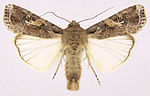 Spodoptera frugiperda (fall armyworm) Spodoptera frugiperda (fall armyworm) |
| Sequence | String: GPMEGSEPVA AHQGEEASCS SWGTGSTNKN LPIMSTASVE IDDALYSRQR YVLGDTAMQK MAKSHVFLSG MGGLGLEIAK NLVLAGIKA VTIHDTEKCQ AWDLGTNFFL SEDDVVNKRN RAEAVLKHIA ELNPYVHVTS SSVPFNETTD LSFLDKYQCV V LTEMKLPL ...String: GPMEGSEPVA AHQGEEASCS SWGTGSTNKN LPIMSTASVE IDDALYSRQR YVLGDTAMQK MAKSHVFLSG MGGLGLEIAK NLVLAGIKA VTIHDTEKCQ AWDLGTNFFL SEDDVVNKRN RAEAVLKHIA ELNPYVHVTS SSVPFNETTD LSFLDKYQCV V LTEMKLPL QKKINDFCRS QCPPIKFISA DVHGIWSRLF CDFGDEFEVL DTTGEEPKEI FISNITQANP GIVTCLENHP HK LETGQFL TFREINGMTG LNGSIQQITV ISPFSFSIGD TTELEPYLHG GIAVQVKTPK TVFFESLERQ LKHPKCLIVD FSN PEAPLE IHTAMLALDQ FQEKYSRKPN VGCQQDSEEL LKLATSISET LEEKPDVNAD IVHWLSWTAQ GFLSPLAAAV GGVA SQEVL KAVTGKFSPL CQWLYLEAAD IVESLGKPEC EEFLPRGDRY DALRACIGDT LCQKLQNLNI FLVGCGAIGC EMLKN FALL GVGTSKEKGM ITVTDPDLIE KSNLNRQFLF RPHHIQKPKS YTAADATLKI NSQIKIDAHL NKVCPTTETI YNDEFY TKQ DVIITALDNV EARRYVDSRC LANLRPLLDS GTMGTKGHTE VIVPHLTESY NSHRDPPEEE IPFSTLKSFP AAIEHTI QW ARDKFESSFS HKPSLFNKFW QTYSSAEEVL QKIQSGHSLE GCFQVIKLLS RRPRNWSQCV ELARLKFEKY FNHKALQL L HCFPLDIRLK DGSLFWQSPK RPPSPIKFDL NEPLHLSFLQ NAAKLYATVY CIPFAEEDLS ADALLNILSE VKIQEFKPS NKVVQTDETA RKPDHVPISS EDERNAIFQL EKAILSNEAT KSDLQMAVLS FEKDDDHNGH IDFITAASNL RAKMYSIEPA DRFKTKRIA GKIIPAIATT TATVSGLVAL EMIKVTGGYP FEAYKNCFLN LAIPIVVFTE TTEVRKTKIR NGISFTIWDR W TVHGKEDF TLLDFINAVK EKYGIEPTMV VQGVKMLYVP VMPGHAKRLK LTMHKLVKPT TEKKYVDLTV SFAPDIDGDE DL PGPPVRY YFSHDTD UniProtKB: Ubiquitin-like modifier-activating enzyme 6 |
-Macromolecule #3: Polyubiquitin-B
| Macromolecule | Name: Polyubiquitin-B / type: protein_or_peptide / ID: 3 / Number of copies: 2 / Enantiomer: LEVO |
|---|---|
| Source (natural) | Organism: Homo sapiens (human) |
| Molecular weight | Theoretical: 8.590856 KDa |
| Recombinant expression | Organism: Escherichia coli (E. coli) |
| Sequence | String: MQIFVKTLTG KTITLEVEPS DTIENVKAKI QDKEGIPPDQ QRLIFAGKQL EDGRTLSDYN IQKESTLHLV LRLRGA UniProtKB: Polyubiquitin-B |
-Macromolecule #4: INOSITOL HEXAKISPHOSPHATE
| Macromolecule | Name: INOSITOL HEXAKISPHOSPHATE / type: ligand / ID: 4 / Number of copies: 1 / Formula: IHP |
|---|---|
| Molecular weight | Theoretical: 660.035 Da |
| Chemical component information | 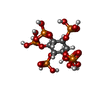 ChemComp-IHP: |
-Macromolecule #5: ADENOSINE-5'-TRIPHOSPHATE
| Macromolecule | Name: ADENOSINE-5'-TRIPHOSPHATE / type: ligand / ID: 5 / Number of copies: 1 / Formula: ATP |
|---|---|
| Molecular weight | Theoretical: 507.181 Da |
| Chemical component information | 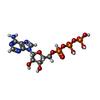 ChemComp-ATP: |
-Experimental details
-Structure determination
| Method | cryo EM |
|---|---|
 Processing Processing | single particle reconstruction |
| Aggregation state | particle |
-Sample preparation
| Buffer | pH: 7.5 |
|---|---|
| Vitrification | Cryogen name: ETHANE |
- Electron microscopy
| Microscope | TFS KRIOS |
|---|---|
| Image recording | Film or detector model: GATAN K3 BIOQUANTUM (6k x 4k) / Average electron dose: 40.1 e/Å2 |
| Electron beam | Acceleration voltage: 300 kV / Electron source:  FIELD EMISSION GUN FIELD EMISSION GUN |
| Electron optics | Illumination mode: FLOOD BEAM / Imaging mode: BRIGHT FIELD / Nominal defocus max: 2.5 µm / Nominal defocus min: 0.5 µm |
| Experimental equipment |  Model: Titan Krios / Image courtesy: FEI Company |

