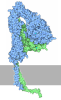
- EMDB-56052: Structure of human prothrombinase with prothrombin -
+
Open data
ID or keywords:
Loading...
-
Basic information
Entry
Database: EMDB / ID: EMD-56052
Title
Structure of human prothrombinase with prothrombin
Map data
Sample
Complex: Human prothrombinase in complex with prothrombin
Protein or peptide: Activated factor Xa heavy chain
Protein or peptide: Coagulation factor X
Protein or peptide: Coagulation factor V heavy chain
Protein or peptide: Coagulation factor V light chain
Protein or peptide: Prothrombin
Ligand: CALCIUM ION
Ligand: SODIUM ION
Keywords
prothrombinase / factor Va / factor Xa / prothrombin / BLOOD CLOTTING
Function / homology
Function and homology information
Defective cleavage of FV variant at a.a.534 / Defective cleavage of FV variant at R334 / response to vitamin K / coagulation factor Xa / platelet alpha granule / Amplification and propagation of coagulation cascade / Cargo concentration in the ER / Initiation of coagulation cascade / : / COPII-coated ER to Golgi transport vesicle ...Defective cleavage of FV variant at a.a.534 / Defective cleavage of FV variant at R334 / response to vitamin K / coagulation factor Xa / platelet alpha granule / Amplification and propagation of coagulation cascade / Cargo concentration in the ER / Initiation of coagulation cascade / : / COPII-coated ER to Golgi transport vesicle / Defective factor IX causes thrombophilia / Defective cofactor function of FVIIIa variant / Defective F9 variant does not activate FX / COPII-mediated vesicle transport / Regulation of clotting cascade / blood circulation / : / negative regulation of astrocyte differentiation / thrombospondin receptor activity / thrombin / thrombin-activated receptor signaling pathway / Defective factor XII causes hereditary angioedema / regulation of blood coagulation / neutrophil-mediated killing of gram-negative bacterium / positive regulation of phospholipase C-activating G protein-coupled receptor signaling pathway / Platelet Aggregation (Plug Formation) / Defective F8 cleavage by thrombin / : / positive regulation of collagen biosynthetic process / negative regulation of platelet activation / negative regulation of blood coagulation / negative regulation of fibrinolysis / positive regulation of blood coagulation / negative regulation of proteolysis / : / positive regulation of TOR signaling / Transport of gamma-carboxylated protein precursors from the endoplasmic reticulum to the Golgi apparatus / fibrinolysis / Gamma-carboxylation of protein precursors / Removal of aminoterminal propeptides from gamma-carboxylated proteins / regulation of cytosolic calcium ion concentration / acute-phase response / negative regulation of cytokine production involved in inflammatory response / endoplasmic reticulum-Golgi intermediate compartment membrane / platelet alpha granule lumen / Regulation of Complement cascade / positive regulation of release of sequestered calcium ion into cytosol / positive regulation of receptor signaling pathway via JAK-STAT / Cell surface interactions at the vascular wall / growth factor activity / Peptide ligand-binding receptors / Post-translational protein phosphorylation / response to wounding / lipopolysaccharide binding / platelet activation / positive regulation of protein localization to nucleus / phospholipid binding / Golgi lumen / blood coagulation / Regulation of Insulin-like Growth Factor (IGF) transport and uptake by Insulin-like Growth Factor Binding Proteins (IGFBPs) / positive regulation of reactive oxygen species metabolic process / heparin binding / Platelet degranulation / extracellular vesicle / Thrombin signalling through proteinase activated receptors (PARs) / Dengue Virus-Host Interactions / antimicrobial humoral immune response mediated by antimicrobial peptide / blood microparticle / extracellular matrix / G alpha (q) signalling events / cell surface receptor signaling pathway / positive regulation of cell migration / receptor ligand activity / endoplasmic reticulum lumen / copper ion binding / serine-type endopeptidase activity / external side of plasma membrane / signaling receptor binding / calcium ion binding / : / proteolysis / extracellular exosome / extracellular region / membrane / plasma membrane Similarity search - Function
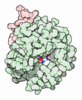
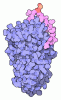
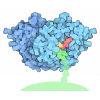
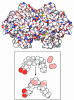
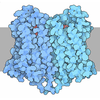
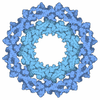
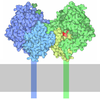
Journal: EMBO J / Year: 2026 Title: Prothrombinase processivity is conferred by substrate allostery. Authors: Fatma Işık Üstok / Alexandre Faille / Alan J Warren / James A Huntington / Abstract: The prothrombinase complex, comprised of factor (f) Xa and fVa, converts prothrombin to thrombin through sequential cleavage at two sites in a rapid and processive manner. The molecular basis of ...The prothrombinase complex, comprised of factor (f) Xa and fVa, converts prothrombin to thrombin through sequential cleavage at two sites in a rapid and processive manner. The molecular basis of prothrombin processing is an enzymatical mystery that to solve requires structural insight into how the substrate and intermediate bind to prothrombinase. Here we present two 3.1 Å cryo-EM structures of prothrombinase bound to prothrombin and to meizothrombin. The prothrombin complex revealed a surprising interaction between the end of the heavy chain of fVa with exosite I of prothrombin, accounting for 70% of the contact interface. Triggering of the zymogen-to-protease conformational change following cleavage at Arg320 alters all domain-domain and fVa interactions observed for prothrombin, and results in a large-scale rearrangement of meizothrombin that presents the second cleavage site (Arg271) for processing. Together, these structures reveal a remarkable enzymatic mechanism that requires the active participation of the substrate itself, and introduces a new paradigm of 'substrate allostery'.
In the structure databanks used in Yorodumi, some data are registered as the other names, "COVID-19 virus" and "2019-nCoV". Here are the details of the virus and the list of structure data.
Jan 31, 2019. EMDB accession codes are about to change! (news from PDBe EMDB page)
EMDB accession codes are about to change! (news from PDBe EMDB page)
The allocation of 4 digits for EMDB accession codes will soon come to an end. Whilst these codes will remain in use, new EMDB accession codes will include an additional digit and will expand incrementally as the available range of codes is exhausted. The current 4-digit format prefixed with “EMD-” (i.e. EMD-XXXX) will advance to a 5-digit format (i.e. EMD-XXXXX), and so on. It is currently estimated that the 4-digit codes will be depleted around Spring 2019, at which point the 5-digit format will come into force.
The EM Navigator/Yorodumi systems omit the EMD- prefix.
Related info.:Q: What is EMD? / ID/Accession-code notation in Yorodumi/EM Navigator
Yorodumi is a browser for structure data from EMDB, PDB, SASBDB, etc.
This page is also the successor to EM Navigator detail page, and also detail information page/front-end page for Omokage search.
The word "yorodu" (or yorozu) is an old Japanese word meaning "ten thousand". "mi" (miru) is to see.
Related info.:EMDB / PDB / SASBDB / Comparison of 3 databanks / Yorodumi Search / Aug 31, 2016. New EM Navigator & Yorodumi / Yorodumi Papers / Jmol/JSmol / Function and homology information / Changes in new EM Navigator and Yorodumi
 Movie
Movie Controller


 Open data
 Basic information
 Map data
 Sample
 Keywords
 Function and homology information
 Homo sapiens (human)
 Authors
 United Kingdom, 3 items
  Citation
 Structure visualization
 Downloads & links
 emd_56052.png
 https://data.pdbj.org/pub/emdb/structures/EMD-56052


 X (Sec.)
 Y (Row.)
 Z (Col.)


 Sample components
 Escherichia coli (E. coli)
 Processing
 Electron microscopy
 FIELD EMISSION GUN


