Movie
Movie Controller


+ Open data

- Basic information
| Entry |  | |||||||||
|---|---|---|---|---|---|---|---|---|---|---|
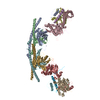
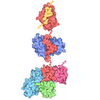
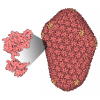
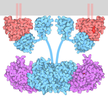
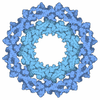
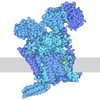
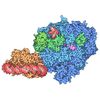
| Title | BRCA1-A complex bound to K63-oligoUbATA - closed form StateC* | |||||||||
 Map data Map data | ||||||||||
 Sample Sample |
| |||||||||
 Keywords Keywords | Deubiquitinase / DNA repair / Metalloprotein / Ubiquitin chains / METAL BINDING PROTEIN | |||||||||
| Function / homology |  Function and homology information Function and homology informationperoxisome signal sequence receptor activity / BRISC complex / Hydrolases; Acting on peptide bonds (peptidases); Omega peptidases / response to vitamin B6 / BRCA1-A complex / attachment of spindle microtubules to kinetochore / ubiquitin-modified histone reader activity / nuclear ubiquitin ligase complex / tumor necrosis factor receptor binding / mitotic G2/M transition checkpoint ...peroxisome signal sequence receptor activity / BRISC complex / Hydrolases; Acting on peptide bonds (peptidases); Omega peptidases / response to vitamin B6 / BRCA1-A complex / attachment of spindle microtubules to kinetochore / ubiquitin-modified histone reader activity / nuclear ubiquitin ligase complex / tumor necrosis factor receptor binding / mitotic G2/M transition checkpoint / response to X-ray / K63-linked polyubiquitin modification-dependent protein binding / metal-dependent deubiquitinase activity / response to ionizing radiation / regulation of DNA damage checkpoint / protein K63-linked deubiquitination / K63-linked deubiquitinase activity / mitotic G2 DNA damage checkpoint signaling / polyubiquitin modification-dependent protein binding / DNA repair-dependent chromatin remodeling / mitotic spindle assembly / positive regulation of NLRP3 inflammasome complex assembly / protein deubiquitination / enzyme regulator activity / ubiquitin ligase complex / Maturation of protein E / regulation of DNA repair / Maturation of protein E / ER Quality Control Compartment (ERQC) / Myoclonic epilepsy of Lafora / FLT3 signaling by CBL mutants / IRAK2 mediated activation of TAK1 complex / Alpha-protein kinase 1 signaling pathway / Glycogen synthesis / IRAK1 recruits IKK complex / IRAK1 recruits IKK complex upon TLR7/8 or 9 stimulation / Prevention of phagosomal-lysosomal fusion / Endosomal Sorting Complex Required For Transport (ESCRT) / Membrane binding and targetting of GAG proteins / Regulation of TBK1, IKKε (IKBKE)-mediated activation of IRF3, IRF7 / Negative regulation of FLT3 / Regulation of TBK1, IKKε-mediated activation of IRF3, IRF7 upon TLR3 ligation / IRAK2 mediated activation of TAK1 complex upon TLR7/8 or 9 stimulation / Constitutive Signaling by NOTCH1 HD Domain Mutants / NOTCH2 Activation and Transmission of Signal to the Nucleus / TICAM1,TRAF6-dependent induction of TAK1 complex / PTK6 Regulates RTKs and Their Effectors AKT1 and DOK1 / positive regulation of DNA repair / TICAM1-dependent activation of IRF3/IRF7 / APC/C:Cdc20 mediated degradation of Cyclin B / Downregulation of ERBB4 signaling / APC-Cdc20 mediated degradation of Nek2A / Regulation of FZD by ubiquitination / p75NTR recruits signalling complexes / InlA-mediated entry of Listeria monocytogenes into host cells / TRAF6 mediated IRF7 activation in TLR7/8 or 9 signaling / NF-kB is activated and signals survival / TRAF6-mediated induction of TAK1 complex within TLR4 complex / Regulation of pyruvate metabolism / Pexophagy / PD-L1(CD274) glycosylation and translocation to plasma membrane / NRIF signals cell death from the nucleus / Downregulation of ERBB2:ERBB3 signaling / Regulation of PTEN localization / Regulation of innate immune responses to cytosolic DNA / cellular response to ionizing radiation / VLDLR internalisation and degradation / Activated NOTCH1 Transmits Signal to the Nucleus / Translesion synthesis by REV1 / TICAM1, RIP1-mediated IKK complex recruitment / Synthesis of active ubiquitin: roles of E1 and E2 enzymes / ZNF598 and the Ribosome-associated Quality Trigger (RQT) complex dissociate a ribosome stalled on a no-go mRNA / Translesion synthesis by POLK / Regulation of BACH1 activity / InlB-mediated entry of Listeria monocytogenes into host cell / JNK (c-Jun kinases) phosphorylation and activation mediated by activated human TAK1 / Activation of IRF3, IRF7 mediated by TBK1, IKKε (IKBKE) / MAP3K8 (TPL2)-dependent MAPK1/3 activation / Translesion synthesis by POLI / Downregulation of TGF-beta receptor signaling / Josephin domain DUBs / Gap-filling DNA repair synthesis and ligation in GG-NER / IKK complex recruitment mediated by RIP1 / PINK1-PRKN Mediated Mitophagy / TGF-beta receptor signaling in EMT (epithelial to mesenchymal transition) / TNFR1-induced NF-kappa-B signaling pathway / Regulation of activated PAK-2p34 by proteasome mediated degradation / TCF dependent signaling in response to WNT / activated TAK1 mediates p38 MAPK activation / Regulation of NF-kappa B signaling / Maturation of DENV proteins / Autodegradation of Cdh1 by Cdh1:APC/C / SRC activates STAT3 in a quantitative manner, through Cadherin-11 (CDH11), RAC1 and gp130 (IL6ST) / APC/C:Cdc20 mediated degradation of Securin / NOTCH3 Activation and Transmission of Signal to the Nucleus / N-glycan trimming in the ER and Calnexin/Calreticulin cycle / Regulation of signaling by CBL / Negative regulators of DDX58/IFIH1 signaling / Asymmetric localization of PCP proteins / Negative regulation of FGFR3 signaling Similarity search - Function | |||||||||
| Biological species |  Homo sapiens (human) Homo sapiens (human) | |||||||||
| Method | single particle reconstruction / cryo EM / Resolution: 3.4 Å | |||||||||
 Authors Authors | Murachelli AG / Sixma TK | |||||||||
| Funding support |  Netherlands, 2 items Netherlands, 2 items
| |||||||||
 Citation Citation | Journal: Nat Commun / Year: 2026 Title: A ubiquitin chain-feeding mechanism for BRCA1-A. Authors: Andrea G Murachelli / Farid El Oualid / Titia K Sixma / Abstract: The BRCA1-A complex is a multi-subunit, metallo-deubiquitinating enzyme (metallo-DUB) involved in genome maintenance. BRCA1-A displays strict specificity for K63-linked ubiquitin, with a strong ...The BRCA1-A complex is a multi-subunit, metallo-deubiquitinating enzyme (metallo-DUB) involved in genome maintenance. BRCA1-A displays strict specificity for K63-linked ubiquitin, with a strong preference for long chains, but the mechanistic basis for this selectivity has remained unclear. To address this, we have developed an activity-based probe that is specific for metallo-DUBs and mimics di- or polyubiquitin chains of any linkage (di- and poly-ubiquitin). We have solved cryoEM structures of BRCA1-A bound to K63-linked probe chains of various length, capturing multiple conformational and catalytic states. The structures reveal how allosteric regulation of catalysis occurs within the complex and how BRCA1-A uses auxiliary ubiquitin-binding sites to engage substrate by avidity and to trigger processive cleavage. Crucially, avidity and processivity can only apply to long polyubiquitin chains, explaining BRCA1-A's substrate preference. Together, these results establish BRCA1-A as a chain-shortening DUB specialised for trimming extended K63-linked polyubiquitin chains. #1: Journal: Biorxiv / Year: 2026Title: A ubiquitin chain-feeding mechanism for BRCA1-A Authors: Murachelli AG / El Oualid F / Sixma TK | |||||||||
| History |
|
- Structure visualization
| Supplemental images |
|---|

- Downloads & links
-EMDB archive
| Map data | emd_55053.map.gz | 195.4 MB | EMDB map data format | |
|---|---|---|---|---|
| Header (meta data) | emd-55053-v30.xmlemd-55053.xml | 35 KB 35 KB | Display Display | EMDB header |
| FSC (resolution estimation) | emd_55053_fsc.xml | 12.7 KB | Display | FSC data file |
| Images |  emd_55053.png emd_55053.png | 65.2 KB | ||
| Masks | emd_55053_msk_1.map | 216 MB | Mask map | |
| Filedesc metadata | emd-55053.cif.gz | 9 KB | ||
| Others | emd_55053_half_map_1.map.gzemd_55053_half_map_2.map.gz | 191.2 MB 191.2 MB | ||
| Archive directory |  https://data.pdbj.org/pub/emdb/structures/EMD-55053ftp://data.pdbj.org/pub/emdb/structures/EMD-55053 https://data.pdbj.org/pub/emdb/structures/EMD-55053ftp://data.pdbj.org/pub/emdb/structures/EMD-55053 | HTTPS FTP |
-Related structure data
| Related structure data |  9so9MC  9smnC  9smpC  9smrC  9smsC  9snaC M: atomic model generated by this map C: citing same article ( |
|---|---|
| Similar structure data |


-Links
| EMDB pages | EMDB (EBI/PDBe) / EMDataResource |
|---|---|
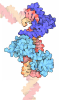
| Related items in Molecule of the Month |


-Map
| File | Download / File: emd_55053.map.gz / Format: CCP4 / Size: 216 MB / Type: IMAGE STORED AS FLOATING POINT NUMBER (4 BYTES) | ||||||||||||||||||||||||||||||||||||
|---|---|---|---|---|---|---|---|---|---|---|---|---|---|---|---|---|---|---|---|---|---|---|---|---|---|---|---|---|---|---|---|---|---|---|---|---|---|
| Projections & slices | Image control
Images are generated by Spider. | ||||||||||||||||||||||||||||||||||||
| Voxel size | X=Y=Z: 1.1362 Å | ||||||||||||||||||||||||||||||||||||
| Density |
| ||||||||||||||||||||||||||||||||||||
| Symmetry | Space group: 1 | ||||||||||||||||||||||||||||||||||||
| Details | EMDB XML:
|
 Z (Sec.)
 Y (Row.)
 X (Col.)


-Supplemental data
-Mask #1
| File | emd_55053_msk_1.map | ||||||||||||
|---|---|---|---|---|---|---|---|---|---|---|---|---|---|
| Projections & Slices |
| ||||||||||||
| Density Histograms |


-Half map: #2
| File | emd_55053_half_map_1.map | ||||||||||||
|---|---|---|---|---|---|---|---|---|---|---|---|---|---|
| Projections & Slices |
| ||||||||||||
| Density Histograms |


-Half map: #1
| File | emd_55053_half_map_2.map | ||||||||||||
|---|---|---|---|---|---|---|---|---|---|---|---|---|---|
| Projections & Slices |
| ||||||||||||
| Density Histograms |


- Sample components
+Entire : BRCA1-A complex bound to Lys-63 linked polyubiquitin chains
+Supramolecule #1: BRCA1-A complex bound to Lys-63 linked polyubiquitin chains
+Supramolecule #2: BRCA1-A complex
+Supramolecule #3: Lys-63 Polyubiquitin chain analog
+Macromolecule #1: BRCA1-A complex subunit Abraxas 1

 Spodoptera frugiperda (fall armyworm)
+Macromolecule #2: Lys-63-specific deubiquitinase BRCC36
+Macromolecule #3: BRISC and BRCA1-A complex member 2
+Macromolecule #4: BRISC and BRCA1-A complex member 1
+Macromolecule #5: BRCA1-A complex subunit RAP80
+Macromolecule #6: Ubiquitin
+Macromolecule #7: Polyubiquitin-C
+Macromolecule #8: Polyubiquitin-C
+Macromolecule #9: ZINC ION
-Experimental details
-Structure determination
| Method | cryo EM |
|---|---|
 Processing Processing | single particle reconstruction |
| Aggregation state | particle |
-Sample preparation
| Concentration | 0.33 mg/mL | |||||||||||||||
|---|---|---|---|---|---|---|---|---|---|---|---|---|---|---|---|---|
| Buffer | pH: 8 Component:
Details: 0.5% octyl-glucoside, 150 mM NaCl, 20 mM HEPES, pH 8.0 buffer was added as 10x to protein in 150 mM NaCl, 20 mM HEPES pH 8.0 prior to grid freezing. | |||||||||||||||
| Grid | Model: Quantifoil R2/2 / Material: COPPER / Mesh: 300 / Support film - Material: CARBON / Support film - topology: HOLEY ARRAY / Pretreatment - Type: GLOW DISCHARGE / Pretreatment - Time: 30 sec. / Pretreatment - Atmosphere: AIR / Pretreatment - Pressure: 0.02 kPa / Details: 30 mA | |||||||||||||||
| Vitrification | Cryogen name: ETHANE / Chamber humidity: 100 % / Chamber temperature: 277 K / Instrument: FEI VITROBOT MARK IV / Details: Blot time: 5 s Blot Force: 0. | |||||||||||||||
| Details | 3.3 mg/ml of BRCA1-A complex were mixed with 1 ul of probe chains (concentration > 10 uM - see paper), and incubated at 37C for 15 minutes; Octyl glucoside was added at 10X concentration prior to freezing. |
- Electron microscopy
| Microscope | TFS KRIOS |
|---|---|
| Image recording | Film or detector model: GATAN K3 (6k x 4k) / Number grids imaged: 1 / Number real images: 11785 / Average exposure time: 2.28 sec. / Average electron dose: 50.0 e/Å2 Details: 8017 images collected without tilt, 5 shots / hole at rim of hole (no particles at center due to lensing); 3768 images tilted 30 degrees, collected from same grid, different session, same ...Details: 8017 images collected without tilt, 5 shots / hole at rim of hole (no particles at center due to lensing); 3768 images tilted 30 degrees, collected from same grid, different session, same imaging conditions, 4 shots / hole. Tilted and straight combined directly in data processing. |
| Electron beam | Acceleration voltage: 300 kV / Electron source:  FIELD EMISSION GUN FIELD EMISSION GUN |
| Electron optics | C2 aperture diameter: 50.0 µm / Illumination mode: FLOOD BEAM / Imaging mode: BRIGHT FIELD / Cs: 2.7 mm / Nominal defocus max: 2.0 µm / Nominal defocus min: 1.25 µm / Nominal magnification: 105000 |
| Sample stage | Specimen holder model: FEI TITAN KRIOS AUTOGRID HOLDER / Cooling holder cryogen: NITROGEN |
| Experimental equipment |  Model: Titan Krios / Image courtesy: FEI Company |
+Image processing

-Atomic model buiding 1
| Initial model |
| |||||||||
|---|---|---|---|---|---|---|---|---|---|---|
| Refinement | Space: REAL / Protocol: FLEXIBLE FIT | |||||||||
| Output model | PDB-9so9: |