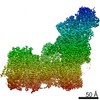
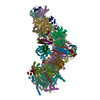
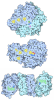
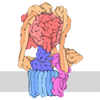
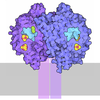
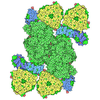
Journal: Nat Commun / Year: 2026 Title: Post-catalysis structures of mitochondrial complex I with ubiquinol-10 bound in the active site. Authors: Injae Chung / Caroline S Pereira / John J Wright / Guilherme M Arantes / Judy Hirst / Abstract: Respiratory complex I is a multi-subunit energy-transducing membrane enzyme essential for mitochondrial and cellular energy metabolism. It couples NADH oxidation and ubiquinone-10 (Q) reduction to ...Respiratory complex I is a multi-subunit energy-transducing membrane enzyme essential for mitochondrial and cellular energy metabolism. It couples NADH oxidation and ubiquinone-10 (Q) reduction to the concomitant pumping of four protons to generate the proton-motive force that powers oxidative phosphorylation. Despite recent advances in structural knowledge of complex I, many mechanistic aspects including the reactive binding poses of Q, how Q reduction initiates the proton transfer cascade, and how protons move through the membrane domain, remain unclear. Here, we use electron cryomicroscopy to determine structures of mammalian complex I, reconstituted into phospholipid nanodiscs containing exogenous Q and reduced by NADH, to global resolutions of 2.0 to 2.6 Å. Two conformations of a reduced QH molecule are observed, fully inserted into the Q-binding channel in the turnover-relevant closed state. By comparing the quinone species bound in oxidised and reduced complex I structures, paired with molecular dynamics simulations to investigate the charge states of key surrounding residues, we propose a series of substrate binding poses that Q transits through for reduction. Our highly hydrated structures exhibit near-continuous proton-transfer connections along the length of the membrane domain, enabling comparisons between them to assist in identifying the proton-transfer control points that are essential to catalysis.
UniProtKB: NADH dehydrogenase [ubiquinone] iron-sulfur protein 3, mitochondrial
+
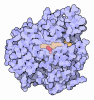
Macromolecule #4: NADH dehydrogenase [ubiquinone] iron-sulfur protein 2, mitochondrial
Macromolecule
Name: NADH dehydrogenase [ubiquinone] iron-sulfur protein 2, mitochondrial type: protein_or_peptide / ID: 4 Details: Harbours a naturally occurring mutation Q129R (Q162R) in the Cambridge UK population Number of copies: 1 / Enantiomer: LEVO / EC number: NADH:ubiquinone reductase (H+-translocating)
Model: UltrAuFoil / Material: GOLD / Pretreatment - Type: GLOW DISCHARGE / Pretreatment - Time: 90 sec. Details: Following glow discharge for 90 s at 20 mA, the grid was treated for 48 hours in an anaerobic glovebox in ethanol containing 5 mM 11-mercaptoundecyl hexaethyleneglycol, washed three times in ...Details: Following glow discharge for 90 s at 20 mA, the grid was treated for 48 hours in an anaerobic glovebox in ethanol containing 5 mM 11-mercaptoundecyl hexaethyleneglycol, washed three times in ethanol and dried prior to blotting
Vitrification
Cryogen name: ETHANE / Chamber humidity: 100 % / Chamber temperature: 277 K / Instrument: FEI VITROBOT MARK IV Details: Mix with NADH, then blot for 10 seconds before plunging.
-
Electron microscopy
Microscope
TFS KRIOS
Specialist optics
Energy filter - Slit width: 20 eV
Details
AutoStigmate and AutoComa on EPU, no AutoCTF
Image recording
Film or detector model: GATAN K3 BIOQUANTUM (6k x 4k) / Number grids imaged: 1 / Number real images: 13056 / Average exposure time: 2.14 sec. / Average electron dose: 40.29 e/Å2
Electron beam
Acceleration voltage: 300 kV / Electron source: FIELD EMISSION GUN
In the structure databanks used in Yorodumi, some data are registered as the other names, "COVID-19 virus" and "2019-nCoV". Here are the details of the virus and the list of structure data.
Jan 31, 2019. EMDB accession codes are about to change! (news from PDBe EMDB page)
EMDB accession codes are about to change! (news from PDBe EMDB page)
The allocation of 4 digits for EMDB accession codes will soon come to an end. Whilst these codes will remain in use, new EMDB accession codes will include an additional digit and will expand incrementally as the available range of codes is exhausted. The current 4-digit format prefixed with “EMD-” (i.e. EMD-XXXX) will advance to a 5-digit format (i.e. EMD-XXXXX), and so on. It is currently estimated that the 4-digit codes will be depleted around Spring 2019, at which point the 5-digit format will come into force.
The EM Navigator/Yorodumi systems omit the EMD- prefix.
Related info.:Q: What is EMD? / ID/Accession-code notation in Yorodumi/EM Navigator
Yorodumi is a browser for structure data from EMDB, PDB, SASBDB, etc.
This page is also the successor to EM Navigator detail page, and also detail information page/front-end page for Omokage search.
The word "yorodu" (or yorozu) is an old Japanese word meaning "ten thousand". "mi" (miru) is to see.
Related info.:EMDB / PDB / SASBDB / Comparison of 3 databanks / Yorodumi Search / Aug 31, 2016. New EM Navigator & Yorodumi / Yorodumi Papers / Jmol/JSmol / Function and homology information / Changes in new EM Navigator and Yorodumi
 Movie
Movie Controller


 Open data
 Basic information
 Map data
 Sample
 Keywords
 Function and homology information
 Bos taurus (domestic cattle)
 Authors
 United Kingdom, 3 items
  Citation

 Structure visualization
 Downloads & links
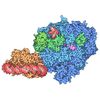
 emd_55033.png
 http://ftp.pdbj.org/pub/emdb/structures/EMD-55033


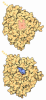
 X (Sec.)
 Y (Row.)
 Z (Col.)


 Sample components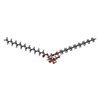
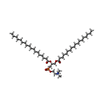
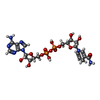
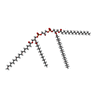
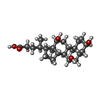
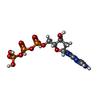
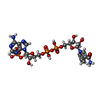
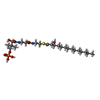
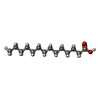

 Processing
 Electron microscopy
 FIELD EMISSION GUN