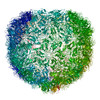
Journal: Proc Natl Acad Sci U S A / Year: 2026 Title: Particles of echovirus 18 open to release their genomes in vivo. Authors: Liya Mukhamedova / David Buchta / Zuzana Trebichalská / Yevgen Levdansky / Jana Moravcová / David Potěšil / Zbyněk Zdráhal / Dominik Hrebík / Lucie Nepovímová / Torleif Tollefsrud ...Authors: Liya Mukhamedova / David Buchta / Zuzana Trebichalská / Yevgen Levdansky / Jana Moravcová / David Potěšil / Zbyněk Zdráhal / Dominik Hrebík / Lucie Nepovímová / Torleif Tollefsrud Gjølberg / Jan Terje Andersen / Jiří Nováček / Tibor Füzik / Pavel Plevka / Abstract: Enteroviruses cause a broad spectrum of human diseases, ranging from mild respiratory or gastrointestinal infections to severe neurological disorders such as aseptic meningitis and encephalitis. ...Enteroviruses cause a broad spectrum of human diseases, ranging from mild respiratory or gastrointestinal infections to severe neurological disorders such as aseptic meningitis and encephalitis. Enterovirus cell entry involves receptor-mediated endocytosis followed by destabilizing rearrangements of the virus capsid that enable genome release. However, the mechanism of enterovirus genome release has not been visualized in infected cells. Here, we used cryoelectron tomography and microscopy to image echovirus 18 (E18) entry into host cells and its interaction with the neonatal Fc receptor (FcRn). 30 min postinfection, endosomes and cytoplasm contained empty capsids missing one or several pentamers of capsid proteins, providing evidence that in vivo E18 releases its genome through capsid opening. In vitro, FcRn binding induced the expulsion of pocket factors from hydrophobic pockets in VP1, priming the virus for uncoating. The cryoelectron microscopy reconstruction of genome-containing particles of E18 inside infected cells did not reveal pocket factors, indicating that receptor binding triggers the same priming process during infection. We did not detect activated particles in infected cells, suggesting that these intermediates are short-lived and rapidly release their genomes in vivo. Our results identify capsid opening as the in vivo mechanism of echovirus 18 genome release, providing structural evidence for a process previously only inferred from in vitro experiments.
Name: Echovirus E18 / type: virus / ID: 1 / Parent: 0 / NCBI-ID: 47506 / Sci species name: Echovirus E18 / Virus type: VIRION / Virus isolate: OTHER / Virus enveloped: No / Virus empty: No
Host (natural)
Organism: Homo sapiens (human)
Molecular weight
Theoretical: 7.9 MDa
Virus shell
Shell ID: 1 / Diameter: 330.0 Å
-
Experimental details
-
Structure determination
Method
cryo EM
Processing
single particle reconstruction
Aggregation state
cell
-
Sample preparation
Concentration
2 mg/mL
Buffer
pH: 7.4
Grid
Model: Quantifoil R2/1 / Material: GOLD / Mesh: 200 / Support film - Material: CARBON / Support film - topology: HOLEY / Pretreatment - Type: GLOW DISCHARGE
Vitrification
Cryogen name: ETHANE / Instrument: FEI VITROBOT MARK III
-
Electron microscopy
Microscope
TFS KRIOS
Specialist optics
Phase plate: OTHER
Image recording
Film or detector model: FEI FALCON III (4k x 4k) / Detector mode: COUNTING / Number grids imaged: 1 / Number real images: 1290 / Average exposure time: 8.0 sec. / Average electron dose: 34.0 e/Å2
Electron beam
Acceleration voltage: 300 kV / Electron source: FIELD EMISSION GUN
In the structure databanks used in Yorodumi, some data are registered as the other names, "COVID-19 virus" and "2019-nCoV". Here are the details of the virus and the list of structure data.
Jan 31, 2019. EMDB accession codes are about to change! (news from PDBe EMDB page)
EMDB accession codes are about to change! (news from PDBe EMDB page)
The allocation of 4 digits for EMDB accession codes will soon come to an end. Whilst these codes will remain in use, new EMDB accession codes will include an additional digit and will expand incrementally as the available range of codes is exhausted. The current 4-digit format prefixed with “EMD-” (i.e. EMD-XXXX) will advance to a 5-digit format (i.e. EMD-XXXXX), and so on. It is currently estimated that the 4-digit codes will be depleted around Spring 2019, at which point the 5-digit format will come into force.
The EM Navigator/Yorodumi systems omit the EMD- prefix.
Related info.:Q: What is EMD? / ID/Accession-code notation in Yorodumi/EM Navigator
Yorodumi is a browser for structure data from EMDB, PDB, SASBDB, etc.
This page is also the successor to EM Navigator detail page, and also detail information page/front-end page for Omokage search.
The word "yorodu" (or yorozu) is an old Japanese word meaning "ten thousand". "mi" (miru) is to see.
Related info.:EMDB / PDB / SASBDB / Comparison of 3 databanks / Yorodumi Search / Aug 31, 2016. New EM Navigator & Yorodumi / Yorodumi Papers / Jmol/JSmol / Function and homology information / Changes in new EM Navigator and Yorodumi
 Movie
Movie Controller


 Open data
 Basic information
 Map data
 Sample
 Keywords
 Echovirus E18
 Authors
 Citation

 Structure visualization
 Downloads & links
 EMDB map data format
 emd_54484.png
 https://data.pdbj.org/pub/emdb/structures/EMD-54484


 Z (Sec.)
 Y (Row.)
 X (Col.)


 Sample components
 Homo sapiens (human)
 Processing
 Electron microscopy
 FIELD EMISSION GUN