 Movie
Movie Controller


+ Open data

- Basic information
| Entry |  | |||||||||
|---|---|---|---|---|---|---|---|---|---|---|
| Title | Non-uniform refine map MiDAC complex | |||||||||
 Map data Map data | Non-uniform refine map | |||||||||
 Sample Sample |
| |||||||||
 Keywords Keywords | HDAC1 DNTTIP1 MIDEAS histone deacetylase complex / GENE REGULATION | |||||||||
| Biological species |  Homo sapiens (human) Homo sapiens (human) | |||||||||
| Method | single particle reconstruction / cryo EM / Resolution: 2.92 Å | |||||||||
 Authors Authors | Fairall L / Schwabe JWR | |||||||||
| Funding support |  United Kingdom, 1 items United Kingdom, 1 items
| |||||||||
 Citation Citation | Journal: Nat Commun / Year: 2025 Title: A de novo missense variant in MIDEAS results in increased deacetylase activity of the MiDAC HDAC complex causing a neurodevelopmental syndrome. Authors: Louise Fairall / Kristupas Sirvydis / Robert E Turnbull / Suzan Jg Knottnerus / Oksana Gonchar / Frederick W Muskett / Rebekah Jukes-Jones / Lonneke van Brussel / Ellen van de Geer / Koen ...Authors: Louise Fairall / Kristupas Sirvydis / Robert E Turnbull / Suzan Jg Knottnerus / Oksana Gonchar / Frederick W Muskett / Rebekah Jukes-Jones / Lonneke van Brussel / Ellen van de Geer / Koen van Gassen / Paul Badenhorst / Diana Johnson / Paulien A Terhal / Peter M van Hasselt / Richard H van Jaarsveld / John Wr Schwabe /  Abstract: MIDEAS is a scaffold protein that, together with DNTTIP1, mediates assembly of the MiDAC histone deacetylase complex. Mice lacking MiDAC die before birth suggesting a key developmental function. ...MIDEAS is a scaffold protein that, together with DNTTIP1, mediates assembly of the MiDAC histone deacetylase complex. Mice lacking MiDAC die before birth suggesting a key developmental function. Here, we report two unrelated individuals, with a multisystem disorder characterised by delayed speech development, joint contractures, dysmorphic features and dysmotility of the gut. Both individuals have the same de novo heterozygous missense variant in MIDEAS (p.Tyr654Ser). A cryoEM structure of the MiDAC complex reveals that this amino acid is located in a conserved auto-inhibitory loop that covers the active site of the deacetylase enzyme. We suggest that the variant results in loop displacement leading to elevated deacetylase activity. In support, we observe reciprocal gene expression changes in patient fibroblasts compared with a cell line following rapid MiDAC degradation. Our results establish MIDEAS as a dominant monogenic disease gene and that hyperactivity of the MiDAC complex results in a characteristic multisystem disorder. | |||||||||
| History |
|
- Structure visualization
| Supplemental images |
|---|

- Downloads & links
-EMDB archive
| Map data | emd_53563.map.gz | 41.4 MB |  EMDB map data format EMDB map data format | |
|---|---|---|---|---|
| Header (meta data) | emd-53563-v30.xmlemd-53563.xml | 20 KB 20 KB | Display Display | EMDB header |
| FSC (resolution estimation) | emd_53563_fsc.xml | 9.1 KB | Display | FSC data file |
| Images |  emd_53563.png emd_53563.png | 58.8 KB | ||
| Filedesc metadata | emd-53563.cif.gz | 5.2 KB | ||
| Others | emd_53563_half_map_1.map.gzemd_53563_half_map_2.map.gz | 76.1 MB 76.1 MB | ||
| Archive directory |  https://data.pdbj.org/pub/emdb/structures/EMD-53563ftp://data.pdbj.org/pub/emdb/structures/EMD-53563 https://data.pdbj.org/pub/emdb/structures/EMD-53563ftp://data.pdbj.org/pub/emdb/structures/EMD-53563 | HTTPS FTP |
-Related structure data


-Links
| EMDB pages | EMDB (EBI/PDBe) / EMDataResource |
|---|
-Map
| File | Download / File: emd_53563.map.gz / Format: CCP4 / Size: 82 MB / Type: IMAGE STORED AS FLOATING POINT NUMBER (4 BYTES) | ||||||||||||||||||||||||||||||||||||
|---|---|---|---|---|---|---|---|---|---|---|---|---|---|---|---|---|---|---|---|---|---|---|---|---|---|---|---|---|---|---|---|---|---|---|---|---|---|
| Annotation | Non-uniform refine map | ||||||||||||||||||||||||||||||||||||
| Projections & slices | Image control
Images are generated by Spider. | ||||||||||||||||||||||||||||||||||||
| Voxel size | X=Y=Z: 1.201 Å | ||||||||||||||||||||||||||||||||||||
| Density |
| ||||||||||||||||||||||||||||||||||||
| Symmetry | Space group: 1 | ||||||||||||||||||||||||||||||||||||
| Details | EMDB XML:
|
 Z (Sec.)
 Y (Row.)
 X (Col.)


-Supplemental data
-Half map: #1
| File | emd_53563_half_map_1.map | ||||||||||||
|---|---|---|---|---|---|---|---|---|---|---|---|---|---|
| Projections & Slices |
| ||||||||||||
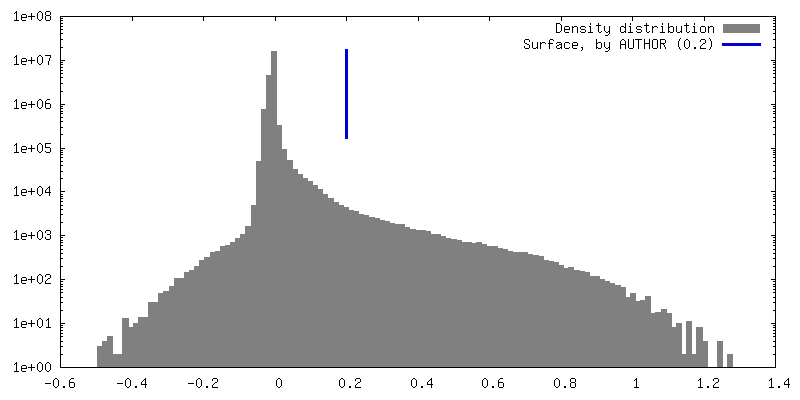
| Density Histograms |


-Half map: #2
| File | emd_53563_half_map_2.map | ||||||||||||
|---|---|---|---|---|---|---|---|---|---|---|---|---|---|
| Projections & Slices |
| ||||||||||||
| Density Histograms |


- Sample components
-Entire : Dimeric complex of HDAC1:MIDEAS:DNTTIP1
| Entire | Name: Dimeric complex of HDAC1:MIDEAS:DNTTIP1 |
|---|---|
| Components |
|
-Supramolecule #1: Dimeric complex of HDAC1:MIDEAS:DNTTIP1
| Supramolecule | Name: Dimeric complex of HDAC1:MIDEAS:DNTTIP1 / type: complex / ID: 1 / Parent: 0 / Macromolecule list: #1-#4 |
|---|---|
| Source (natural) | Organism: Homo sapiens (human) |
| Molecular weight | Theoretical: 225 KDa |
-Experimental details
-Structure determination
| Method | cryo EM |
|---|---|
 Processing Processing | single particle reconstruction |
| Aggregation state | particle |
-Sample preparation
| Concentration | 0.2 mg/mL | ||||||||||||
|---|---|---|---|---|---|---|---|---|---|---|---|---|---|
| Buffer | pH: 7.5 Component:
Details: 10 mM HEPES, 25 mM KCl, 1 micromolar Inositol Hexaphosphate | ||||||||||||
| Grid | Model: Quantifoil R1.2/1.3 / Material: GOLD / Mesh: 300 / Support film - Material: CARBON / Support film - topology: HOLEY / Pretreatment - Type: GLOW DISCHARGE | ||||||||||||
| Vitrification | Cryogen name: ETHANE / Chamber humidity: 100 % / Chamber temperature: 277 K / Instrument: FEI VITROBOT MARK IV | ||||||||||||
| Details | Crosslinked with 0.1% formaldehyde and 0.0625% glutaraldehyde |
- Electron microscopy
| Microscope | TFS KRIOS |
|---|---|
| Temperature | Min: 77.0 K / Max: 100.0 K |
| Image recording | Film or detector model: GATAN K3 BIOQUANTUM (6k x 4k) / Digitization - Dimensions - Width: 5760 pixel / Digitization - Dimensions - Height: 4092 pixel / Number grids imaged: 1 / Number real images: 10709 / Average exposure time: 2.0 sec. / Average electron dose: 46.7 e/Å2 |
| Electron beam | Acceleration voltage: 300 kV / Electron source:  FIELD EMISSION GUN FIELD EMISSION GUN |
| Electron optics | C2 aperture diameter: 50.0 µm / Illumination mode: FLOOD BEAM / Imaging mode: BRIGHT FIELD / Cs: 2.7 mm / Nominal defocus max: 2.4 µm / Nominal defocus min: 1.2 µm / Nominal magnification: 105000 |
| Sample stage | Specimen holder model: FEI TITAN KRIOS AUTOGRID HOLDER / Cooling holder cryogen: NITROGEN |
| Experimental equipment |  Model: Titan Krios / Image courtesy: FEI Company |
+Image processing

-Atomic model buiding 1
| Initial model | PDB ID: Chain - Source name: PDB / Chain - Initial model type: experimental model |
|---|---|
| Details | Initial model was built using Modelangelo and compared with PDB entry 6Z2J |
| Refinement | Space: REAL / Protocol: AB INITIO MODEL / Overall B value: 100.7 |

