- EMDB-53264: Ternary complex of the human 20S proteasome in complex with Impor... -
+
Open data
ID or keywords:
Loading...
-
Basic information
Entry
Database: EMDB / ID: EMD-53264
Title
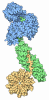
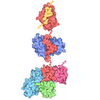
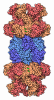
Ternary complex of the human 20S proteasome in complex with Importin-9 and two homodimers of Akirin-2 - focussed refinement on the alpha subunits, Ipo-9 and Ak2
Map data
Sample
Complex: Ternary complex of the human 20S proteasome in complex with two dimers of Akirin-2 and Importin-9
Protein or peptide: Akirin-2
Protein or peptide: Proteasome subunit alpha type-3
Protein or peptide: Proteasome subunit alpha type-6
Protein or peptide: Proteasome subunit alpha type-2
Protein or peptide: Proteasome subunit alpha type-4
Protein or peptide: Proteasome subunit alpha type-7
Protein or peptide: Proteasome subunit alpha type-5
Protein or peptide: Proteasome subunit alpha type-1
proteasome localization / regulation of muscle cell differentiation / positive regulation of B cell activation / nuclear protein quality control by the ubiquitin-proteasome system / histone chaperone activity / positive regulation of adaptive immune response / embryo development ending in birth or egg hatching / positive regulation of innate immune response / purine ribonucleoside triphosphate binding / CD8-positive, alpha-beta T cell differentiation ...proteasome localization / regulation of muscle cell differentiation / positive regulation of B cell activation / nuclear protein quality control by the ubiquitin-proteasome system / histone chaperone activity / positive regulation of adaptive immune response / embryo development ending in birth or egg hatching / positive regulation of innate immune response / purine ribonucleoside triphosphate binding / CD8-positive, alpha-beta T cell differentiation / CD8-positive, alpha-beta T cell homeostasis / thymic T cell selection / Antigen processing: Ub, ATP-independent proteasomal degradation / structural constituent of proteasome / spermatoproteasome complex / nuclear import signal receptor activity / negative regulation of regulatory T cell differentiation / T-helper 1 cell differentiation / Regulation of ornithine decarboxylase (ODC) / proteasome core complex / Proteasome assembly / cellular response to type I interferon / T-helper 17 cell differentiation / Cross-presentation of soluble exogenous antigens (endosomes) / Somitogenesis / flagellated sperm motility / sperm end piece / immune system process / myofibril / proteasomal ubiquitin-independent protein catabolic process / ciliary tip / NF-kappaB binding / proteasome core complex, alpha-subunit complex / regulation of G1/S transition of mitotic cell cycle / positive regulation of interleukin-2 production / transcription repressor complex / proteasome storage granule / response to type II interferon / proteasome complex / protein import into nucleus / regulation of proteasomal protein catabolic process / meiotic cell cycle / sarcomere / Regulation of activated PAK-2p34 by proteasome mediated degradation / negative regulation of inflammatory response to antigenic stimulus / proteasomal protein catabolic process / Autodegradation of Cdh1 by Cdh1:APC/C / APC/C:Cdc20 mediated degradation of Securin / lipopolysaccharide binding / Asymmetric localization of PCP proteins / Ubiquitin-dependent degradation of Cyclin D / positive regulation of type II interferon production / SCF-beta-TrCP mediated degradation of Emi1 / AUF1 (hnRNP D0) binds and destabilizes mRNA / NIK-->noncanonical NF-kB signaling / P-body / TNFR2 non-canonical NF-kB pathway / protein catabolic process / cerebral cortex development / Assembly of the pre-replicative complex / Vpu mediated degradation of CD4 / Cdc20:Phospho-APC/C mediated degradation of Cyclin A / Dectin-1 mediated noncanonical NF-kB signaling / Degradation of DVL / Degradation of AXIN / Degradation of CRY and PER proteins / Hh mutants are degraded by ERAD / Activation of NF-kappaB in B cells / G2/M Checkpoints / positive regulation of interleukin-6 production / Degradation of GLI1 by the proteasome / Hedgehog ligand biogenesis / Regulation of RUNX3 expression and activity / Autodegradation of the E3 ubiquitin ligase COP1 / Defective CFTR causes cystic fibrosis / GSK3B and BTRC:CUL1-mediated-degradation of NFE2L2 / response to virus / Negative regulation of NOTCH4 signaling / AMPK-induced ERAD and lysosome mediated degradation of PD-L1(CD274) / Hedgehog 'on' state / APC/C:Cdh1 mediated degradation of Cdc20 and other APC/C:Cdh1 targeted proteins in late mitosis/early G1 / Vif-mediated degradation of APOBEC3G / FBXL7 down-regulates AURKA during mitotic entry and in early mitosis / Degradation of GLI2 by the proteasome / GLI3 is processed to GLI3R by the proteasome / MAPK6/MAPK4 signaling / GSK3B-mediated proteasomal degradation of PD-L1(CD274) / Degradation of CDH1 / Degradation of beta-catenin by the destruction complex / Oxygen-dependent proline hydroxylation of Hypoxia-inducible Factor Alpha / adaptive immune response / CDK-mediated phosphorylation and removal of Cdc6 / small GTPase binding / ABC-family protein mediated transport / CLEC7A (Dectin-1) signaling / transcription coregulator activity / Activation of STAT3 by cadherin engagement / SCF(Skp2)-mediated degradation of p27/p21 / FCERI mediated NF-kB activation / nuclear matrix Similarity search - Function
H2020 Marie Curie Actions of the European Commission
847548
European Union
Austrian Science Fund
10.55776/F79
Austria
Citation
Journal: Nat Commun / Year: 2026 Title: A multivalent adaptor mechanism drives the nuclear import of proteasomes. Authors: Hanna L Brunner / Robert W Kalis / Lorenz Grundmann / Zuzana Hodáková / Zuzana Koskova / Irina Grishkovskaya / Melanie de Almeida / Matthias Hinterndorfer / Hannah Knaudt / Simon Höfflin ...Authors: Hanna L Brunner / Robert W Kalis / Lorenz Grundmann / Zuzana Hodáková / Zuzana Koskova / Irina Grishkovskaya / Melanie de Almeida / Matthias Hinterndorfer / Hannah Knaudt / Simon Höfflin / Florian Andersch / Harald Kotisch / Achim Dickmanns / Sara Cuylen-Haering / Johannes Zuber / David Haselbach / Abstract: Nuclear protein homeostasis, including transcription factor turnover, critically depends on the nuclear proteasomes that must be imported after cell division. This dynamic process requires AKIRIN2, a ...Nuclear protein homeostasis, including transcription factor turnover, critically depends on the nuclear proteasomes that must be imported after cell division. This dynamic process requires AKIRIN2, a small unstructured protein whose mechanistic role has remained elusive despite its essential function. Using an integrated approach combining protein-wide saturation mutagenesis screens, cryo-EM, and biochemical reconstitution, we characterize AKIRIN2 as a scaffold protein that coordinates the assembly of an importin cluster around the proteasome. AKIRIN2 binds in multiple copies to the 20S proteasome and simultaneously interacts with importin IPO9 and the KPNA2/KPNB1 heterodimer. In the nucleus, RanGTP triggers importin dissociation, releasing the proteasome, while AKIRIN2 undergoes ubiquitin-independent degradation. Our findings reveal how AKIRIN2's multivalency facilitates the recruitment of multiple importins to the proteasome, a critical adaptation for transporting this large macromolecular complex into the nucleus and maintaining the nuclear proteome.
Entire : Ternary complex of the human 20S proteasome in complex with two d...
Entire
Name: Ternary complex of the human 20S proteasome in complex with two dimers of Akirin-2 and Importin-9
Components
Complex: Ternary complex of the human 20S proteasome in complex with two dimers of Akirin-2 and Importin-9
Protein or peptide: Akirin-2
Protein or peptide: Proteasome subunit alpha type-3
Protein or peptide: Proteasome subunit alpha type-6
Protein or peptide: Proteasome subunit alpha type-2
Protein or peptide: Proteasome subunit alpha type-4
Protein or peptide: Proteasome subunit alpha type-7
Protein or peptide: Proteasome subunit alpha type-5
Protein or peptide: Proteasome subunit alpha type-1
Protein or peptide: Importin-9
+
Supramolecule #1: Ternary complex of the human 20S proteasome in complex with two d...
Supramolecule
Name: Ternary complex of the human 20S proteasome in complex with two dimers of Akirin-2 and Importin-9 type: complex / ID: 1 / Parent: 0 / Macromolecule list: #2-#9, #1
Source (natural)
Organism: Homo sapiens (human)
+
Macromolecule #1: Importin-9
Macromolecule
Name: Importin-9 / type: protein_or_peptide / ID: 1 / Number of copies: 1 / Enantiomer: LEVO
Model: Quantifoil R3.5/1 / Support film - #0 - Film type ID: 1 / Support film - #0 - Material: CARBON / Support film - #0 - topology: HOLEY / Support film - #1 - Film type ID: 2 / Support film - #1 - Material: CARBON / Support film - #1 - topology: CONTINUOUS / Support film - #1 - Film thickness: 2 / Pretreatment - Type: GLOW DISCHARGE
Vitrification
Cryogen name: ETHANE
-
Electron microscopy
Microscope
TFS KRIOS
Image recording
Film or detector model: GATAN K3 BIOQUANTUM (6k x 4k) / Average electron dose: 44.4 e/Å2
Electron beam
Acceleration voltage: 300 kV / Electron source: FIELD EMISSION GUN
In the structure databanks used in Yorodumi, some data are registered as the other names, "COVID-19 virus" and "2019-nCoV". Here are the details of the virus and the list of structure data.
Jan 31, 2019. EMDB accession codes are about to change! (news from PDBe EMDB page)
EMDB accession codes are about to change! (news from PDBe EMDB page)
The allocation of 4 digits for EMDB accession codes will soon come to an end. Whilst these codes will remain in use, new EMDB accession codes will include an additional digit and will expand incrementally as the available range of codes is exhausted. The current 4-digit format prefixed with “EMD-” (i.e. EMD-XXXX) will advance to a 5-digit format (i.e. EMD-XXXXX), and so on. It is currently estimated that the 4-digit codes will be depleted around Spring 2019, at which point the 5-digit format will come into force.
The EM Navigator/Yorodumi systems omit the EMD- prefix.
Related info.:Q: What is EMD? / ID/Accession-code notation in Yorodumi/EM Navigator
Yorodumi is a browser for structure data from EMDB, PDB, SASBDB, etc.
This page is also the successor to EM Navigator detail page, and also detail information page/front-end page for Omokage search.
The word "yorodu" (or yorozu) is an old Japanese word meaning "ten thousand". "mi" (miru) is to see.
Related info.:EMDB / PDB / SASBDB / Comparison of 3 databanks / Yorodumi Search / Aug 31, 2016. New EM Navigator & Yorodumi / Yorodumi Papers / Jmol/JSmol / Function and homology information / Changes in new EM Navigator and Yorodumi
 Movie
Movie Controller

 Yorodumi
 Open data
 Basic information
 Map data
 Sample
 Keywords
 Function and homology information
 Homo sapiens (human)
 Authors
 Austria, 2 items
  Citation

 Structure visualization
 Downloads & links
 emd_53264.png
 https://data.pdbj.org/pub/emdb/structures/EMD-53264



 Z (Sec.)
 Y (Row.)
 X (Col.)


 Sample components
 Escherichia coli (E. coli)
 Spodoptera frugiperda (fall armyworm)
 Processing
 Electron microscopy
 FIELD EMISSION GUN

