タンパク質・ペプチド: ABC-three component systems C-terminal domain-containing protein
キーワード
LmuA_asymmetric / DNA BINDING PROTEIN
機能・相同性
ABC-three component systems, C-terminal domain 7 / C-terminal domain 7 of the ABC-three component (ABC-3C) systems / ABC-three component systems C-terminal domain-containing protein
National Institutes of Health/National Institute Of Allergy and Infectious Diseases (NIH/NIAID)
米国
引用
ジャーナル: Proc Natl Acad Sci U S A / 年: 2025 タイトル: Structural basis for Lamassu-based antiviral immunity and its evolution from DNA repair machinery. 著者: Matthieu Haudiquet / Arpita Chakravarti / Zhiying Zhang / Josephine L Ramirez / Alba Herrero Del Valle / Paul Dominic B Olinares / Rachel Lavenir / Massilia Aït Ahmed / M Jason de la Cruz / ...著者: Matthieu Haudiquet / Arpita Chakravarti / Zhiying Zhang / Josephine L Ramirez / Alba Herrero Del Valle / Paul Dominic B Olinares / Rachel Lavenir / Massilia Aït Ahmed / M Jason de la Cruz / Brian T Chait / Samuel H Sternberg / Aude Bernheim / Dinshaw J Patel / 要旨: Bacterial immune systems exhibit remarkable diversity and modularity, as a consequence of the continuous selective pressures imposed by phage predation. Despite recent mechanistic advances, the ...Bacterial immune systems exhibit remarkable diversity and modularity, as a consequence of the continuous selective pressures imposed by phage predation. Despite recent mechanistic advances, the evolutionary origins of many antiphage immune systems remain elusive, especially for those that encode homologs of the structural maintenance of chromosomes (SMC) superfamily, which are essential for chromosome maintenance and DNA repair across domains of life. Here, we elucidate the structural basis and evolutionary emergence of Lamassu, a bacterial immune system family featuring diverse effectors but a core conserved SMC-like sensor. Using cryo-EM, we determined structures of the Lamassu complex in both apo- and dsDNA-bound states, revealing unexpected stoichiometry and topological architectures. We further demonstrate how Lamassu specifically senses dsDNA ends in vitro and phage replication origins in vivo, thereby triggering the formation of LmuA tetramers that activate its Cap4 nuclease domain. Our findings reveal that Lamassu evolved via exaptation of the bacterial Rad50-Mre11 DNA repair system to form a compact, modular sensor for viral replication, exemplifying how cellular machinery can be co-opted for novel immune functions.
 ムービー
ムービー コントローラー


 データを開く
 基本情報
基本情報
 マップデータ
 試料
試料 キーワード
キーワード 機能・相同性情報
 Escherichia coli (大腸菌) /
 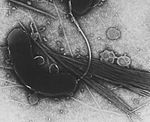 Vibrio cholerae (コレラ菌)
 データ登録者
 米国, 1件
  引用
引用
 構造の表示
構造の表示
 ダウンロードとリンク
 emd_49915.png
 http://ftp.pdbj.org/pub/emdb/structures/EMD-49915


 Z (Sec.)
 Y (Row.)
 X (Col.)


 試料の構成要素
 解析
解析 電子顕微鏡法
 FIELD EMISSION GUN
