 Movie
Movie Controller


+ Open data

- Basic information
| Entry | Database: PDB / ID: 9ny1 | |||||||||||||||||||||
|---|---|---|---|---|---|---|---|---|---|---|---|---|---|---|---|---|---|---|---|---|---|---|
| Title | LmuA_conformation 2_assymetric | |||||||||||||||||||||
 Components Components | ABC-three component systems C-terminal domain-containing protein | |||||||||||||||||||||
 Keywords Keywords | DNA BINDING PROTEIN / LmuA_asymmetric | |||||||||||||||||||||
| Function / homology | ABC-three component systems, C-terminal domain 7 / C-terminal domain 7 of the ABC-three component (ABC-3C) systems / ABC-three component systems C-terminal domain-containing protein Function and homology information Function and homology information | |||||||||||||||||||||
| Biological species |  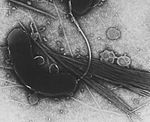 Vibrio cholerae (bacteria) Vibrio cholerae (bacteria) | |||||||||||||||||||||
| Method | ELECTRON MICROSCOPY / single particle reconstruction / cryo EM / Resolution: 3.4 Å | |||||||||||||||||||||
 Authors Authors | Chakravarti, A. / Zhang, Z. | |||||||||||||||||||||
| Funding support |  United States, 1items United States, 1items
| |||||||||||||||||||||
 Citation Citation | Journal: Proc Natl Acad Sci U S A / Year: 2025 Title: Structural basis for Lamassu-based antiviral immunity and its evolution from DNA repair machinery. Authors: Matthieu Haudiquet / Arpita Chakravarti / Zhiying Zhang / Josephine L Ramirez / Alba Herrero Del Valle / Paul Dominic B Olinares / Rachel Lavenir / Massilia Aït Ahmed / M Jason de la Cruz / ...Authors: Matthieu Haudiquet / Arpita Chakravarti / Zhiying Zhang / Josephine L Ramirez / Alba Herrero Del Valle / Paul Dominic B Olinares / Rachel Lavenir / Massilia Aït Ahmed / M Jason de la Cruz / Brian T Chait / Samuel H Sternberg / Aude Bernheim / Dinshaw J Patel /  Abstract: Bacterial immune systems exhibit remarkable diversity and modularity, as a consequence of the continuous selective pressures imposed by phage predation. Despite recent mechanistic advances, the ...Bacterial immune systems exhibit remarkable diversity and modularity, as a consequence of the continuous selective pressures imposed by phage predation. Despite recent mechanistic advances, the evolutionary origins of many antiphage immune systems remain elusive, especially for those that encode homologs of the structural maintenance of chromosomes (SMC) superfamily, which are essential for chromosome maintenance and DNA repair across domains of life. Here, we elucidate the structural basis and evolutionary emergence of Lamassu, a bacterial immune system family featuring diverse effectors but a core conserved SMC-like sensor. Using cryo-EM, we determined structures of the Lamassu complex in both apo- and dsDNA-bound states, revealing unexpected stoichiometry and topological architectures. We further demonstrate how Lamassu specifically senses dsDNA ends in vitro and phage replication origins in vivo, thereby triggering the formation of LmuA tetramers that activate its Cap4 nuclease domain. Our findings reveal that Lamassu evolved via exaptation of the bacterial Rad50-Mre11 DNA repair system to form a compact, modular sensor for viral replication, exemplifying how cellular machinery can be co-opted for novel immune functions. | |||||||||||||||||||||
| History |
|
- Structure visualization
| Structure viewer | Molecule: MolmilJmol/JSmol |
|---|
- Downloads & links
-Download
| PDBx/mmCIF format | 9ny1.cif.gz | 283.8 KB | Display | PDBx/mmCIF format |
|---|---|---|---|---|
| PDB format | pdb9ny1.ent.gz | 233.9 KB | Display | PDB format |
| PDBx/mmJSON format | 9ny1.json.gz | Tree view | PDBx/mmJSON format | |
| Others |  Other downloads Other downloads |
-Validation report
| Arichive directory | https://data.pdbj.org/pub/pdb/validation_reports/ny/9ny1ftp://data.pdbj.org/pub/pdb/validation_reports/ny/9ny1 | HTTPS FTP |
|---|
-Related structure data
| Related structure data |  49915MC  9nxxC  9ny5C  9nygC M: map data used to model this data C: citing same article ( |
|---|---|
| Similar structure data |


-Links
 PDBj
PDBj- Assembly
| Deposited unit | 
|
|---|---|
| 1 |
|
-Components
| #1: Protein | Mass: 44526.617 Da / Num. of mol.: 4 Source method: isolated from a genetically manipulated source Source: (gene. exp.) Vibrio cholerae (bacteria)Gene: D6U24_12485, ERS013200_03523, ERS013201_03639, KIN13_15850, VC_0492 Production host:  Escherichia coli (E. coli) / References: UniProt: A0A060KT36 Escherichia coli (E. coli) / References: UniProt: A0A060KT36Has protein modification | N | |
|---|
-Experimental details
-Experiment
| Experiment | Method: ELECTRON MICROSCOPY |
|---|---|
| EM experiment | Aggregation state: CELL / 3D reconstruction method: single particle reconstruction |
- Sample preparation
| Component | Name: protein / Type: CELL / Entity ID: all / Source: NATURAL |
|---|---|
| Source (natural) | Organism: Escherichia coli (E. coli) |
| Buffer solution | pH: 7.5 |
| Specimen | Embedding applied: NO / Shadowing applied: NO / Staining applied: NO / Vitrification applied: YES |
| Vitrification | Cryogen name: NITROGEN |
- Electron microscopy imaging
| Experimental equipment |  Model: Titan Krios / Image courtesy: FEI Company |
|---|---|
| Microscopy | Model: TFS KRIOS |
| Electron gun | Electron source:  FIELD EMISSION GUN / Accelerating voltage: 300 kV / Illumination mode: OTHER FIELD EMISSION GUN / Accelerating voltage: 300 kV / Illumination mode: OTHER |
| Electron lens | Mode: OTHER / Nominal defocus max: 2200 nm / Nominal defocus min: 800 nm |
| Image recording | Electron dose: 53 e/Å2 / Film or detector model: GATAN K3 (6k x 4k) |
- Processing
| CTF correction | Type: NONE |
|---|---|
| 3D reconstruction | Resolution: 3.4 Å / Resolution method: FSC 0.143 CUT-OFF / Num. of particles: 197714 / Symmetry type: POINT |
