Movie
Movie Controller

[English] 日本語
 Yorodumi
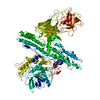
- EMDB-49339: The structure of BoNT/A in complex with a neutralizing antibody 2G11 -
+ Open data

- Basic information
| Entry |  | |||||||||
|---|---|---|---|---|---|---|---|---|---|---|
| Title | The structure of BoNT/A in complex with a neutralizing antibody 2G11 | |||||||||
 Map data Map data | ||||||||||
 Sample Sample |
| |||||||||
 Keywords Keywords | BoNT / antibody / IMMUNE SYSTEM-TOXIN complex | |||||||||
| Function / homology |  Function and homology information Function and homology informationsymbiont-mediated suppression of host exocytosis / Toxicity of botulinum toxin type A (botA) / ganglioside GT1b binding / bontoxilysin / host cell presynaptic membrane / host cell cytoplasmic vesicle / host cell cytosol / transmembrane protein transporter activity / metalloendopeptidase activity / proteolysis ...symbiont-mediated suppression of host exocytosis / Toxicity of botulinum toxin type A (botA) / ganglioside GT1b binding / bontoxilysin / host cell presynaptic membrane / host cell cytoplasmic vesicle / host cell cytosol / transmembrane protein transporter activity / metalloendopeptidase activity / proteolysis / zinc ion binding / extracellular region Similarity search - Function | |||||||||
| Biological species |   Clostridium botulinum (bacteria) / Clostridium botulinum (bacteria) /  Homo sapiens (human) Homo sapiens (human) | |||||||||
| Method | single particle reconstruction / cryo EM / Resolution: 3.06 Å | |||||||||
 Authors Authors | Chen B / Jin R | |||||||||
| Funding support |  United States, 1 items United States, 1 items
| |||||||||
 Citation Citation | Journal: Nat Commun / Year: 2026 Title: A belt-buckle checkpoint regulates the onset of botulinum neurotoxin intoxication. Authors: Baohua Chen / Linfeng Gao / Melvin Bönninger / Ting Huang / Nadja Krez / Weihua Wen / Mark Bowen / Jianlong Lou / James D Marks / Andreas Rummel / Rongsheng Jin /  Abstract: Fast-acting botulinum neurotoxins (BoNTs) are highly desirable for both medical and aesthetic indications, but the underlying mechanism for the differing onset of BoNTs' action remains unknown. Here, ...Fast-acting botulinum neurotoxins (BoNTs) are highly desirable for both medical and aesthetic indications, but the underlying mechanism for the differing onset of BoNTs' action remains unknown. Here, we demonstrate that the "belt" of BoNTs, a largely unstructured loop wrapping around their catalytic light chain (LC), is key to onset of intoxication. The more flexible BoNT/E belt promotes quicker LC translocation into the neuronal cytosol, leading to faster onset of action compared to BoNT/A. Furthermore, we discover a "belt-buckle" checkpoint that regulates this process. By loosening the BoNT/A belt-buckle via protein engineering, we enhance its sensitivity to acidic pH, leading to an accelerated onset of action. Conversely, locking the belt-buckle with an antibody neutralizes BoNT/A. Our findings open avenues for developing fast-acting BoNTs and effective countermeasures. | |||||||||
| History |
|
- Structure visualization
| Supplemental images |
|---|

- Downloads & links
-EMDB archive
| Map data | emd_49339.map.gz | 203.7 MB | EMDB map data format | |
|---|---|---|---|---|
| Header (meta data) | emd-49339-v30.xmlemd-49339.xml | 18.7 KB 18.7 KB | Display Display | EMDB header |
| FSC (resolution estimation) | emd_49339_fsc.xml | 12.7 KB | Display | FSC data file |
| Images |  emd_49339.png emd_49339.png | 69.7 KB | ||
| Filedesc metadata | emd-49339.cif.gz | 6.7 KB | ||
| Others | emd_49339_half_map_1.map.gzemd_49339_half_map_2.map.gz | 200.4 MB 200.4 MB | ||
| Archive directory |  https://data.pdbj.org/pub/emdb/structures/EMD-49339ftp://data.pdbj.org/pub/emdb/structures/EMD-49339 https://data.pdbj.org/pub/emdb/structures/EMD-49339ftp://data.pdbj.org/pub/emdb/structures/EMD-49339 | HTTPS FTP |
-Related structure data
| Related structure data |  9neyMC  9czbC  9czcC M: atomic model generated by this map C: citing same article ( |
|---|---|
| Similar structure data |


-Links
| EMDB pages | EMDB (EBI/PDBe) / EMDataResource |
|---|---|
| Related items in Molecule of the Month |
-Map
| File | Download / File: emd_49339.map.gz / Format: CCP4 / Size: 216 MB / Type: IMAGE STORED AS FLOATING POINT NUMBER (4 BYTES) | ||||||||||||||||||||||||||||||||||||
|---|---|---|---|---|---|---|---|---|---|---|---|---|---|---|---|---|---|---|---|---|---|---|---|---|---|---|---|---|---|---|---|---|---|---|---|---|---|
| Projections & slices | Image control
Images are generated by Spider. | ||||||||||||||||||||||||||||||||||||
| Voxel size | X=Y=Z: 0.8266 Å | ||||||||||||||||||||||||||||||||||||
| Density |
| ||||||||||||||||||||||||||||||||||||
| Symmetry | Space group: 1 | ||||||||||||||||||||||||||||||||||||
| Details | EMDB XML:
|
 Z (Sec.)
 Y (Row.)
 X (Col.)


-Supplemental data
-Half map: #2
| File | emd_49339_half_map_1.map | ||||||||||||
|---|---|---|---|---|---|---|---|---|---|---|---|---|---|
| Projections & Slices |
| ||||||||||||
| Density Histograms |


-Half map: #1
| File | emd_49339_half_map_2.map | ||||||||||||
|---|---|---|---|---|---|---|---|---|---|---|---|---|---|
| Projections & Slices |
| ||||||||||||
| Density Histograms |


- Sample components
-Entire : BoNT-antibody
| Entire | Name: BoNT-antibody |
|---|---|
| Components |
|
-Supramolecule #1: BoNT-antibody
| Supramolecule | Name: BoNT-antibody / type: complex / ID: 1 / Parent: 0 / Macromolecule list: all |
|---|---|
| Source (natural) | Organism: Clostridium botulinum (bacteria) |
| Molecular weight | Theoretical: 200 KDa |
-Macromolecule #1: Botulinum neurotoxin type A
| Macromolecule | Name: Botulinum neurotoxin type A / type: protein_or_peptide / ID: 1 / Number of copies: 1 / Enantiomer: LEVO |
|---|---|
| Source (natural) | Organism: Clostridium botulinum (bacteria) |
| Molecular weight | Theoretical: 149.862266 KDa |
| Recombinant expression | Organism:  Escherichia coli (E. coli) Escherichia coli (E. coli) |
| Sequence | String: GPLGSMPFVN KQFNYKDPVN GVDIAYIKIP NAGQMQPVKA FKIHNKIWVI PERDTFTNPE EGDLNPPPEA KQVPVSYYDS TYLSTDNEK DNYLKGVTKL FERIYSTDLG RMLLTSIVRG IPFWGGSTID TELKVIDTNC INVIQPDGSY RSEELNLVII G PSADIIQF ...String: GPLGSMPFVN KQFNYKDPVN GVDIAYIKIP NAGQMQPVKA FKIHNKIWVI PERDTFTNPE EGDLNPPPEA KQVPVSYYDS TYLSTDNEK DNYLKGVTKL FERIYSTDLG RMLLTSIVRG IPFWGGSTID TELKVIDTNC INVIQPDGSY RSEELNLVII G PSADIIQF ECKSFGHEVL NLTRNGYGST QYIRFSPDFT FGFEESLEVD TNPLLGAGKF ATDPAVTLAH ELIHAGHRLY GI AINPNRV FKVNTNAYYE MSGLEVSFEE LRTFGGHDAK FIDSLQENEF RLYYYNKFKD IASTLNKAKS IVGTTASLQY MKN VFKEKY LLSEDTSGKF SVDKLKFDKL YKMLTEIYTE DNFVKFFKVL NAKTFLNFDK AVFKINIVPK VNYTIYDGFN LRNT NLAAN FNGQNTEINN MNFTKLKNFT GLFEFYKLLC VRGIITSKTK SLDKGYNKAL NDLCIKVNNW DLFFSPSEDN FTNDL NKGE EITSDTNIEA AEENISLDLI QQYYLTFNFD NEPENISIEN LSSDIIGQLE LMPNIERFPN GKKYELDKYT MFHYLR AQE FEHGKSRIAL TNSVNEALLN PSRVYTFFSS DYVKKVNKAT EAAMFLGWVE QLVYDFTDET SEVSTTDKIA DITIIIP YI GPALNIGNML YKDDFVGALI FSGAVILLEF IPEIAIPVLG TFALVSYIAN KVLTVQTIDN ALSKRNEKWD EVYKYIVT N WLAKVNTQID LIRKKMKEAL ENQAEATKAI INYQYNQYTE EEKNNINFNI DDLSSKLNES INKAMININK FLNQCSVSY LMNSMIPYGV KRLEDFDASL KDALLKYIYD NRGTLIGQVD RLKDKVNNTL STDIPFQLSK YVDNQRLLST FTEYIKNIIN TSILNLRYE SNHLIDLSRY ASKINIGSKV NFDPIDKNQI QLFNLESSKI EVILKNAIVY NSMYENFSTS FWIRIPKYFN S ISLNNEYT IINCMENNSG WKVSLNYGEI IWTLQDTQEI KQRVVFKYSQ MINISDYINR WIFVTITNNR LNNSKIYING RL IDQKPIS NLGNIHASNN IMFKLDGCRD THRYIWIKYF NLFDKELNEK EIKDLYDNQS NSGILKDFWG DYLQYDKPYY MLN LYDPNK YVDVNNVGIR GYMYLKGPRG SVMTTNIYLN SSLYRGAKFI IKKYASGNKD NIVRNNDRVY INVVVKNKEY RLAT NASQA GVEKILSALE IPDVGNLSQV VVMKSKNDQG ITNKCKMNLQ DNNGNDIGFI GFHQFNNIAK LVASNWYNRQ IERSS RTLG CSWEFIPVDD GWGERPL UniProtKB: Botulinum neurotoxin type A |
-Macromolecule #2: Heavy Chain
| Macromolecule | Name: Heavy Chain / type: protein_or_peptide / ID: 2 / Number of copies: 1 / Enantiomer: LEVO |
|---|---|
| Source (natural) | Organism: Homo sapiens (human) |
| Molecular weight | Theoretical: 23.483307 KDa |
| Recombinant expression | Organism:   Cricetulus griseus (Chinese hamster) Cricetulus griseus (Chinese hamster) |
| Sequence | String: QVQLQQSGGG LVQPGGSLRL SCAASGFTFS NYAMTWVRQA PGKGLEWVSS ISVGGSDTYY ADSVKGRFTV SRDNSKNTLL LQMNSLRAE DTAVYYCAKV RTKYCSSLSC FAGFDSWGQG TRVTVSSAST KGPSVFPLAP SSKSTSGGTA ALGCLVKDYF P EPVTVSWN ...String: QVQLQQSGGG LVQPGGSLRL SCAASGFTFS NYAMTWVRQA PGKGLEWVSS ISVGGSDTYY ADSVKGRFTV SRDNSKNTLL LQMNSLRAE DTAVYYCAKV RTKYCSSLSC FAGFDSWGQG TRVTVSSAST KGPSVFPLAP SSKSTSGGTA ALGCLVKDYF P EPVTVSWN SGALTSGVHT FPAVLQSSGL YSLSSVVTVP SSSLGTQTYI CNVNHKPSNT KVDKK |
-Macromolecule #3: Light Chain
| Macromolecule | Name: Light Chain / type: protein_or_peptide / ID: 3 / Number of copies: 1 / Enantiomer: LEVO |
|---|---|
| Source (natural) | Organism: Homo sapiens (human) |
| Molecular weight | Theoretical: 23.414908 KDa |
| Recombinant expression | Organism: Cricetulus griseus (Chinese hamster) |
| Sequence | String: DVVMTQSPSS LSASVGDRVT ITCRASQSIS SYLHWYQQKP GKAPTLLISD ASSSQSGVPS RFSGSRFGTD FTLTISSLQP EDFATYYCQ QSYSTRALTF GGGTKVEIKR TVAAPSVFIF PPSDEQLKSG TASVVCLLNN FYPREAKVQW KVDNALQSGN S QESVTEQD ...String: DVVMTQSPSS LSASVGDRVT ITCRASQSIS SYLHWYQQKP GKAPTLLISD ASSSQSGVPS RFSGSRFGTD FTLTISSLQP EDFATYYCQ QSYSTRALTF GGGTKVEIKR TVAAPSVFIF PPSDEQLKSG TASVVCLLNN FYPREAKVQW KVDNALQSGN S QESVTEQD SKDSTYSLSS TLTLSKADYE KHKVYACEVT HQGLSSPVTK SFNRGEC |
-Experimental details
-Structure determination
| Method | cryo EM |
|---|---|
 Processing Processing | single particle reconstruction |
| Aggregation state | particle |
-Sample preparation
| Buffer | pH: 7.5 |
|---|---|
| Vitrification | Cryogen name: PROPANE |
- Electron microscopy
| Microscope | TFS KRIOS |
|---|---|
| Image recording | Film or detector model: GATAN K3 BIOCONTINUUM (6k x 4k) / Average electron dose: 50.0 e/Å2 |
| Electron beam | Acceleration voltage: 300 kV / Electron source:  FIELD EMISSION GUN FIELD EMISSION GUN |
| Electron optics | Illumination mode: SPOT SCAN / Imaging mode: BRIGHT FIELD / Nominal defocus max: 2.2 µm / Nominal defocus min: 0.8 µm |
| Experimental equipment |  Model: Titan Krios / Image courtesy: FEI Company |