purine ribonucleoside triphosphate binding / structural constituent of proteasome / CD8-positive, alpha-beta T cell differentiation / CD8-positive, alpha-beta T cell homeostasis / thymic T cell selection / Antigen processing: Ub, ATP-independent proteasomal degradation / spermatoproteasome complex / negative regulation of regulatory T cell differentiation / T-helper 1 cell differentiation / Regulation of ornithine decarboxylase (ODC) ...purine ribonucleoside triphosphate binding / structural constituent of proteasome / CD8-positive, alpha-beta T cell differentiation / CD8-positive, alpha-beta T cell homeostasis / thymic T cell selection / Antigen processing: Ub, ATP-independent proteasomal degradation / spermatoproteasome complex / negative regulation of regulatory T cell differentiation / T-helper 1 cell differentiation / Regulation of ornithine decarboxylase (ODC) / proteasome core complex / Proteasome assembly / cellular response to type I interferon / T-helper 17 cell differentiation / Cross-presentation of soluble exogenous antigens (endosomes) / Somitogenesis / flagellated sperm motility / sperm end piece / myofibril / proteasomal ubiquitin-independent protein catabolic process / ciliary tip / proteasome storage granule / immune system process / : / proteasome endopeptidase complex / NF-kappaB binding / proteasome core complex, beta-subunit complex / threonine-type endopeptidase activity / Activation of STAT3 by cadherin engagement / proteasome core complex, alpha-subunit complex / proteasome assembly / proteasome complex / regulation of G1/S transition of mitotic cell cycle / positive regulation of interleukin-2 production / response to type II interferon / regulation of proteasomal protein catabolic process / sarcomere / Regulation of activated PAK-2p34 by proteasome mediated degradation / negative regulation of inflammatory response to antigenic stimulus / Autodegradation of Cdh1 by Cdh1:APC/C / proteasomal protein catabolic process / protein catabolic process / APC/C:Cdc20 mediated degradation of Securin / Asymmetric localization of PCP proteins / lipopolysaccharide binding / Ubiquitin-dependent degradation of Cyclin D / meiotic cell cycle / P-body / SCF-beta-TrCP mediated degradation of Emi1 / AUF1 (hnRNP D0) binds and destabilizes mRNA / NIK-->noncanonical NF-kB signaling / TNFR2 non-canonical NF-kB pathway / positive regulation of type II interferon production / Assembly of the pre-replicative complex / Vpu mediated degradation of CD4 / Cdc20:Phospho-APC/C mediated degradation of Cyclin A / Dectin-1 mediated noncanonical NF-kB signaling / Degradation of DVL / Degradation of AXIN / Degradation of CRY and PER proteins / Hh mutants are degraded by ERAD / Activation of NF-kappaB in B cells / G2/M Checkpoints / Degradation of GLI1 by the proteasome / Hedgehog ligand biogenesis / Regulation of RUNX3 expression and activity / Autodegradation of the E3 ubiquitin ligase COP1 / Defective CFTR causes cystic fibrosis / GSK3B and BTRC:CUL1-mediated-degradation of NFE2L2 / response to virus / Negative regulation of NOTCH4 signaling / AMPK-induced ERAD and lysosome mediated degradation of PD-L1(CD274) / Hedgehog 'on' state / APC/C:Cdh1 mediated degradation of Cdc20 and other APC/C:Cdh1 targeted proteins in late mitosis/early G1 / Vif-mediated degradation of APOBEC3G / FBXL7 down-regulates AURKA during mitotic entry and in early mitosis / Degradation of GLI2 by the proteasome / GLI3 is processed to GLI3R by the proteasome / MAPK6/MAPK4 signaling / GSK3B-mediated proteasomal degradation of PD-L1(CD274) / Degradation of CDH1 / Degradation of beta-catenin by the destruction complex / Oxygen-dependent proline hydroxylation of Hypoxia-inducible Factor Alpha / CDK-mediated phosphorylation and removal of Cdc6 / ABC-family protein mediated transport / CLEC7A (Dectin-1) signaling / SCF(Skp2)-mediated degradation of p27/p21 / FCERI mediated NF-kB activation / SPOP-mediated proteasomal degradation of PD-L1(CD274) / nuclear matrix / Regulation of expression of SLITs and ROBOs / Regulation of PTEN stability and activity / Ubiquitin-Mediated Degradation of Phosphorylated Cdc25A / Ribosome Quality Control (RQC) complex extracts and degrades nascent peptide / Interleukin-1 signaling / Orc1 removal from chromatin / Regulation of RUNX2 expression and activity / positive regulation of tumor necrosis factor production / Regulation of RAS by GAPs / The role of GTSE1 in G2/M progression after G2 checkpoint Similarity search - Function
Journal: Proc Natl Acad Sci U S A / Year: 2021 Title: Design of proteasome inhibitors with oral efficacy in vivo against and selectivity over the human proteasome. Authors: Stanley C Xie / Riley D Metcalfe / Hirotake Mizutani / Tanya Puhalovich / Eric Hanssen / Craig J Morton / Yawei Du / Con Dogovski / Shih-Chung Huang / Jeffrey Ciavarri / Paul Hales / Robert ...Authors: Stanley C Xie / Riley D Metcalfe / Hirotake Mizutani / Tanya Puhalovich / Eric Hanssen / Craig J Morton / Yawei Du / Con Dogovski / Shih-Chung Huang / Jeffrey Ciavarri / Paul Hales / Robert J Griffin / Lawrence H Cohen / Bei-Ching Chuang / Sergio Wittlin / Ioanna Deni / Tomas Yeo / Kurt E Ward / Daniel C Barry / Boyin Liu / David L Gillett / Benigno F Crespo-Fernandez / Sabine Ottilie / Nimisha Mittal / Alisje Churchyard / Daniel Ferguson / Anna Caroline C Aguiar / Rafael V C Guido / Jake Baum / Kirsten K Hanson / Elizabeth A Winzeler / Francisco-Javier Gamo / David A Fidock / Delphine Baud / Michael W Parker / Stephen Brand / Lawrence R Dick / Michael D W Griffin / Alexandra E Gould / Leann Tilley / Abstract: The proteasome is a potential antimalarial drug target. We have identified a series of amino-amide boronates that are potent and specific inhibitors of the 20S proteasome (20S) β5 active site and ...The proteasome is a potential antimalarial drug target. We have identified a series of amino-amide boronates that are potent and specific inhibitors of the 20S proteasome (20S) β5 active site and that exhibit fast-acting antimalarial activity. They selectively inhibit the growth of compared with a human cell line and exhibit high potency against field isolates of and They have a low propensity for development of resistance and possess liver stage and transmission-blocking activity. Exemplar compounds, MPI-5 and MPI-13, show potent activity against infections in a SCID mouse model with an oral dosing regimen that is well tolerated. We show that MPI-5 binds more strongly to 20S than to human constitutive 20S (20Sc). Comparison of the cryo-electron microscopy (EM) structures of 20S and 20Sc in complex with MPI-5 and 20S in complex with the clinically used anti-cancer agent, bortezomib, reveal differences in binding modes that help to explain the selectivity. Together, this work provides insights into the 20S proteasome in , underpinning the design of potent and selective antimalarial proteasome inhibitors.
History
Deposition
Mar 5, 2021
-
Header (metadata) release
Sep 22, 2021
-
Map release
Sep 22, 2021
-
Update
May 14, 2025
-
Current status
May 14, 2025
Processing site: RCSB / Status: Released
-
Structure visualization
Movie
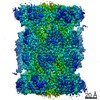
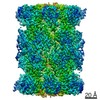
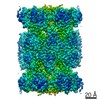
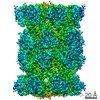
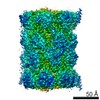
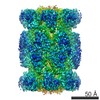
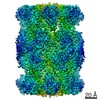
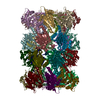
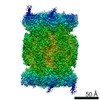
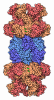
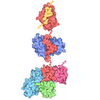
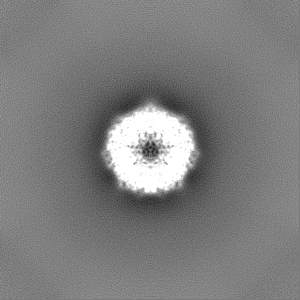
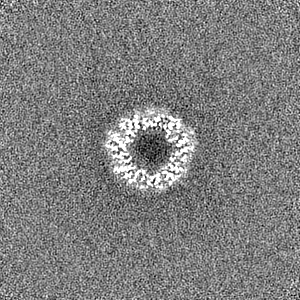
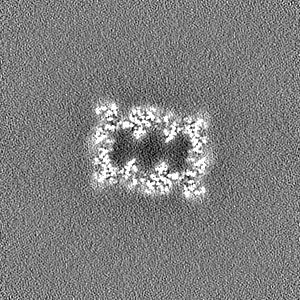
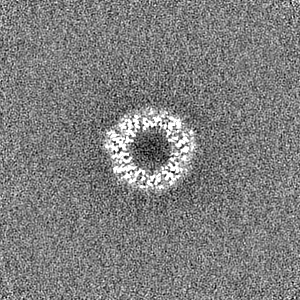
Surface view with section colored by density value
In the structure databanks used in Yorodumi, some data are registered as the other names, "COVID-19 virus" and "2019-nCoV". Here are the details of the virus and the list of structure data.
Jan 31, 2019. EMDB accession codes are about to change! (news from PDBe EMDB page)
EMDB accession codes are about to change! (news from PDBe EMDB page)
The allocation of 4 digits for EMDB accession codes will soon come to an end. Whilst these codes will remain in use, new EMDB accession codes will include an additional digit and will expand incrementally as the available range of codes is exhausted. The current 4-digit format prefixed with “EMD-” (i.e. EMD-XXXX) will advance to a 5-digit format (i.e. EMD-XXXXX), and so on. It is currently estimated that the 4-digit codes will be depleted around Spring 2019, at which point the 5-digit format will come into force.
The EM Navigator/Yorodumi systems omit the EMD- prefix.
Related info.:Q: What is EMD? / ID/Accession-code notation in Yorodumi/EM Navigator
Yorodumi is a browser for structure data from EMDB, PDB, SASBDB, etc.
This page is also the successor to EM Navigator detail page, and also detail information page/front-end page for Omokage search.
The word "yorodu" (or yorozu) is an old Japanese word meaning "ten thousand". "mi" (miru) is to see.
Related info.:EMDB / PDB / SASBDB / Comparison of 3 databanks / Yorodumi Search / Aug 31, 2016. New EM Navigator & Yorodumi / Yorodumi Papers / Jmol/JSmol / Function and homology information / Changes in new EM Navigator and Yorodumi
 Movie
Movie Controller


 Open data
 Basic information
 Map data
 Sample
 Keywords
 Function and homology information
 Plasmodium falciparum 3D7 (eukaryote) /
  Homo sapiens (human)
 Authors
 United States,
  Australia, 2 items
  Citation


 Structure visualization
 Downloads & links
 emd_23576.png
 https://data.pdbj.org/pub/emdb/structures/EMD-23576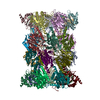



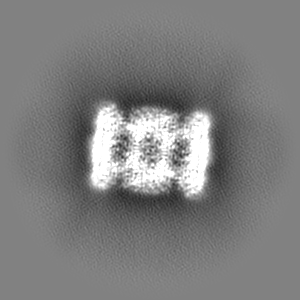
 X (Sec.)
 Y (Row.)
 Z (Col.)











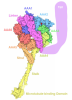
 Sample components
 Processing
 Electron microscopy
 FIELD EMISSION GUN