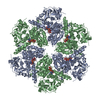
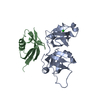
- EMDB-2319: Cryo-EM of full-length p97-FAF1 protein complex -
+
Open data
ID or keywords:
Loading...
-
Basic information
Entry
Database: EMDB / ID: EMD-2319
Title
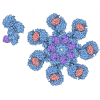
Cryo-EM of full-length p97-FAF1 protein complex
Map data
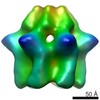
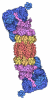
Reconstruction of full-length p97-FAF1 protein complex
Sample
Sample: Full-length p97-FAF1
Protein or peptide: p97
Protein or peptide: Fas-associated factor 1
Function / homology
Function and homology information
: / positive regulation of extrinsic apoptotic signaling pathway via death domain receptors / RHOH GTPase cycle / HSF1 activation / ooplasm / Translesion Synthesis by POLH / Josephin domain DUBs / N-glycan trimming in the ER and Calnexin/Calreticulin cycle / Protein methylation / aggresome assembly ...: / positive regulation of extrinsic apoptotic signaling pathway via death domain receptors / RHOH GTPase cycle / HSF1 activation / ooplasm / Translesion Synthesis by POLH / Josephin domain DUBs / N-glycan trimming in the ER and Calnexin/Calreticulin cycle / Protein methylation / aggresome assembly / AMPK-induced ERAD and lysosome mediated degradation of PD-L1(CD274) / Ovarian tumor domain proteases / Hedgehog ligand biogenesis / ABC-family protein mediated transport / ciliary transition zone / Neddylation / KEAP1-NFE2L2 pathway / flavin adenine dinucleotide catabolic process / VCP-NSFL1C complex / endoplasmic reticulum stress-induced pre-emptive quality control / endosome to lysosome transport via multivesicular body sorting pathway / BAT3 complex binding / cellular response to arsenite ion / cytoplasmic ubiquitin ligase complex / Derlin-1 retrotranslocation complex / positive regulation of protein K63-linked deubiquitination / ATPase complex / protein-DNA covalent cross-linking repair / deubiquitinase activator activity / positive regulation of oxidative phosphorylation / cytoplasm protein quality control / regulation of protein localization to chromatin / ubiquitin-modified protein reader activity / cellular response to misfolded protein / mitotic spindle disassembly / VCP-NPL4-UFD1 AAA ATPase complex / positive regulation of mitochondrial membrane potential / regulation of protein catabolic process / positive regulation of ubiquitin-dependent protein catabolic process / vesicle-fusing ATPase / K48-linked polyubiquitin modification-dependent protein binding / regulation of aerobic respiration / NAD+ metabolic process / retrograde protein transport, ER to cytosol / stress granule disassembly / ubiquitin-specific protease binding / regulation of synapse organization / positive regulation of ATP biosynthetic process / ciliary tip / ubiquitin-like protein ligase binding / MHC class I protein binding / autophagosome maturation / regulation of cell adhesion / negative regulation of hippo signaling / endoplasmic reticulum to Golgi vesicle-mediated transport / polyubiquitin modification-dependent protein binding / mitophagy / NF-kappaB binding / interstrand cross-link repair / ATP metabolic process / canonical NF-kappaB signal transduction / protein unfolding / proteasome complex / heat shock protein binding / ERAD pathway / Neutrophil degranulation / negative regulation of smoothened signaling pathway / viral genome replication / positive regulation of DNA replication / translesion synthesis / negative regulation of protein localization to chromatin / macroautophagy / lipid droplet / ubiquitin binding / myelin sheath / proteasomal protein catabolic process / positive regulation of protein-containing complex assembly / positive regulation of non-canonical NF-kappaB signal transduction / ADP binding / autophagy / cytoplasmic stress granule / positive regulation of protein catabolic process / positive regulation of canonical Wnt signaling pathway / double-strand break repair / positive regulation of proteasomal ubiquitin-dependent protein catabolic process / nuclear envelope / site of double-strand break / cellular response to heat / ciliary basal body / protein phosphatase binding / ubiquitin-dependent protein catabolic process / proteasome-mediated ubiquitin-dependent protein catabolic process / protein ubiquitination / protein domain specific binding / ubiquitin protein ligase binding / DNA repair / apoptotic process / DNA damage response / lipid binding / synapse Similarity search - Function
Journal: J Biol Chem / Year: 2014 Title: The p97-FAF1 protein complex reveals a common mode of p97 adaptor binding. Authors: Caroline A Ewens / Silvia Panico / Patrik Kloppsteck / Ciaran McKeown / Ima-Obong Ebong / Carol Robinson / Xiaodong Zhang / Paul S Freemont / Abstract: p97, also known as valosin-containing protein, is a versatile participant in the ubiquitin-proteasome system. p97 interacts with a large network of adaptor proteins to process ubiquitylated ...p97, also known as valosin-containing protein, is a versatile participant in the ubiquitin-proteasome system. p97 interacts with a large network of adaptor proteins to process ubiquitylated substrates in different cellular pathways, including endoplasmic reticulum-associated degradation and transcription factor activation. p97 and its adaptor Fas-associated factor-1 (FAF1) both have roles in the ubiquitin-proteasome system during NF-κB activation, although the mechanisms are unknown. FAF1 itself also has emerging roles in other cell-cycle pathways and displays altered expression levels in various cancer cell lines. We have performed a detailed study the p97-FAF1 interaction. We show that FAF1 binds p97 stably and in a stoichiometry of 3 to 6. Cryo-EM analysis of p97-FAF1 yielded a 17 Å reconstruction of the complex with FAF1 above the p97 ring. Characteristics of p97-FAF1 uncovered in this study reveal common features in the interactions of p97, providing mechanistic insight into how p97 mediates diverse functionalities.
History
Deposition
Feb 23, 2013
-
Header (metadata) release
Mar 13, 2013
-
Map release
Mar 12, 2014
-
Update
May 7, 2014
-
Current status
May 7, 2014
Processing site: PDBe / Status: Released
-
Structure visualization
Movie
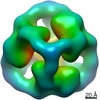
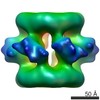
Surface view with section colored by density value
Cryogen name: ETHANE / Chamber humidity: 100 % / Chamber temperature: 120 K / Instrument: FEI VITROBOT MARK IV / Method: 3sec blot, 0sec drain
-
Electron microscopy
Microscope
FEI/PHILIPS CM200FEG
Temperature
Min: 94 K / Max: 104 K / Average: 94 K
Alignment procedure
Legacy - Astigmatism: Objective lens astigmatism was corrected at 100,000 times magnification
Date
Dec 20, 2011
Image recording
Category: CCD / Film or detector model: GENERIC TVIPS / Digitization - Sampling interval: 1.76 µm / Number real images: 281 / Average electron dose: 10 e/Å2 / Bits/pixel: 16
Electron beam
Acceleration voltage: 200 kV / Electron source: FIELD EMISSION GUN
In the structure databanks used in Yorodumi, some data are registered as the other names, "COVID-19 virus" and "2019-nCoV". Here are the details of the virus and the list of structure data.
Jan 31, 2019. EMDB accession codes are about to change! (news from PDBe EMDB page)
EMDB accession codes are about to change! (news from PDBe EMDB page)
The allocation of 4 digits for EMDB accession codes will soon come to an end. Whilst these codes will remain in use, new EMDB accession codes will include an additional digit and will expand incrementally as the available range of codes is exhausted. The current 4-digit format prefixed with “EMD-” (i.e. EMD-XXXX) will advance to a 5-digit format (i.e. EMD-XXXXX), and so on. It is currently estimated that the 4-digit codes will be depleted around Spring 2019, at which point the 5-digit format will come into force.
The EM Navigator/Yorodumi systems omit the EMD- prefix.
Related info.:Q: What is EMD? / ID/Accession-code notation in Yorodumi/EM Navigator
Yorodumi is a browser for structure data from EMDB, PDB, SASBDB, etc.
This page is also the successor to EM Navigator detail page, and also detail information page/front-end page for Omokage search.
The word "yorodu" (or yorozu) is an old Japanese word meaning "ten thousand". "mi" (miru) is to see.
Related info.:EMDB / PDB / SASBDB / Comparison of 3 databanks / Yorodumi Search / Aug 31, 2016. New EM Navigator & Yorodumi / Yorodumi Papers / Jmol/JSmol / Function and homology information / Changes in new EM Navigator and Yorodumi
 Movie
Movie Controller


 Open data
 Basic information
 Map data
 Sample
 Function and homology information
 Mus musculus (house mouse)
 Authors
 Citation
 Structure visualization
 Downloads & links
 2319-for-emdb-2.png
 http://ftp.pdbj.org/pub/emdb/structures/EMD-2319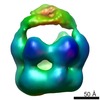

 Z (Sec.)
 Y (Row.)
 X (Col.)


 Sample components
 Escherichia coli BL21(DE3) (bacteria) / Recombinant strain: Rosetta 2 / Recombinant plasmid: PET28b
 Processing
 Electron microscopy
 FIELD EMISSION GUN