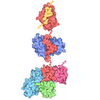
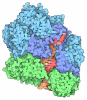
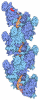
- EMDB-12965: Cryo-EM Structure of the DDB1-DCAF1-CUL4A-RBX1-CSN Complex -
+
データを開く
IDまたはキーワード:
読み込み中...
-
基本情報
登録情報
データベース: EMDB / ID: EMD-12965
タイトル
Cryo-EM Structure of the DDB1-DCAF1-CUL4A-RBX1-CSN Complex
マップデータ
試料
複合体: CRL4(DCAF1)-CSN
タンパク質・ペプチド: x 11種
機能・相同性
機能・相同性情報
cell competition in a multicellular organism / histone H2AT120 kinase activity / negative regulation of granulocyte differentiation / negative regulation of beige fat cell differentiation / cullin-RING-type E3 NEDD8 transferase / NEDD8 transferase activity / V(D)J recombination / cullin-RING ubiquitin ligase complex / Cul7-RING ubiquitin ligase complex / cellular response to chemical stress ...cell competition in a multicellular organism / histone H2AT120 kinase activity / negative regulation of granulocyte differentiation / negative regulation of beige fat cell differentiation / cullin-RING-type E3 NEDD8 transferase / NEDD8 transferase activity / V(D)J recombination / cullin-RING ubiquitin ligase complex / Cul7-RING ubiquitin ligase complex / cellular response to chemical stress / Loss of Function of FBXW7 in Cancer and NOTCH1 Signaling / regulation of DNA damage checkpoint / positive regulation of protein autoubiquitination / regulation of nucleotide-excision repair / positive regulation by virus of viral protein levels in host cell / RNA polymerase II transcription initiation surveillance / protein neddylation / spindle assembly involved in female meiosis / NEDD8 ligase activity / epigenetic programming in the zygotic pronuclei / protein K27-linked ubiquitination / negative regulation of response to oxidative stress / VCB complex / UV-damage excision repair / Cul5-RING ubiquitin ligase complex / ubiquitin-ubiquitin ligase activity / ubiquitin-dependent protein catabolic process via the C-end degron rule pathway / SCF ubiquitin ligase complex / biological process involved in interaction with symbiont / Cul2-RING ubiquitin ligase complex / regulation of mitotic cell cycle phase transition / Cul3-RING ubiquitin ligase complex / negative regulation of type I interferon production / WD40-repeat domain binding / SCF-dependent proteasomal ubiquitin-dependent protein catabolic process / Cul4A-RING E3 ubiquitin ligase complex / Cul4-RING E3 ubiquitin ligase complex / Prolactin receptor signaling / negative regulation of mitophagy / Cul4B-RING E3 ubiquitin ligase complex / ubiquitin ligase complex scaffold activity / negative regulation of reproductive process / negative regulation of developmental process / hemopoiesis / viral release from host cell / somatic stem cell population maintenance / cullin family protein binding / protein monoubiquitination / ectopic germ cell programmed cell death / positive regulation of G1/S transition of mitotic cell cycle / positive regulation of viral genome replication / ubiquitin-like ligase-substrate adaptor activity / site of DNA damage / signal transduction in response to DNA damage / Nuclear events stimulated by ALK signaling in cancer / protein K48-linked ubiquitination / transcription-coupled nucleotide-excision repair / negative regulation of insulin receptor signaling pathway / proteasomal protein catabolic process / regulation of cellular response to insulin stimulus / positive regulation of TORC1 signaling / post-translational protein modification / intrinsic apoptotic signaling pathway / positive regulation of gluconeogenesis / B cell differentiation / T cell activation / Regulation of BACH1 activity / nuclear estrogen receptor binding / negative regulation of canonical NF-kappaB signal transduction / nucleotide-excision repair / sperm end piece / cellular response to amino acid stimulus / Degradation of DVL / Degradation of CRY and PER proteins / G1/S transition of mitotic cell cycle / Degradation of GLI1 by the proteasome / negative regulation of canonical Wnt signaling pathway / GSK3B and BTRC:CUL1-mediated-degradation of NFE2L2 / Negative regulation of NOTCH4 signaling / Recognition of DNA damage by PCNA-containing replication complex / Hedgehog 'on' state / Vif-mediated degradation of APOBEC3G / FBXL7 down-regulates AURKA during mitotic entry and in early mitosis / Ubiquitin-Mediated Degradation of Phosphorylated Cdc25A / regulation of circadian rhythm / Degradation of GLI2 by the proteasome / GLI3 is processed to GLI3R by the proteasome / RING-type E3 ubiquitin transferase / Degradation of beta-catenin by the destruction complex / NOTCH1 Intracellular Domain Regulates Transcription / Evasion by RSV of host interferon responses / Oxygen-dependent proline hydroxylation of Hypoxia-inducible Factor Alpha / DNA Damage Recognition in GG-NER / Constitutive Signaling by NOTCH1 PEST Domain Mutants / Constitutive Signaling by NOTCH1 HD+PEST Domain Mutants / Dual Incision in GG-NER / Transcription-Coupled Nucleotide Excision Repair (TC-NER) / Formation of TC-NER Pre-Incision Complex / Regulation of expression of SLITs and ROBOs / fibrillar center 類似検索 - 分子機能
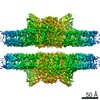
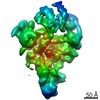
ジャーナル: EMBO J / 年: 2021 タイトル: The CRL4 cullin-RING ubiquitin ligase is activated following a switch in oligomerization state. 著者: Weaam I Mohamed / Andreas D Schenk / Georg Kempf / Simone Cavadini / Anja Basters / Alessandro Potenza / Wassim Abdul Rahman / Julius Rabl / Kurt Reichermeier / Nicolas H Thomä / 要旨: The cullin-4-based RING-type (CRL4) family of E3 ubiquitin ligases functions together with dedicated substrate receptors. Out of the ˜29 CRL4 substrate receptors reported, the DDB1- and CUL4- ...The cullin-4-based RING-type (CRL4) family of E3 ubiquitin ligases functions together with dedicated substrate receptors. Out of the ˜29 CRL4 substrate receptors reported, the DDB1- and CUL4-associated factor 1 (DCAF1) is essential for cellular survival and growth, and its deregulation has been implicated in tumorigenesis. We carried out biochemical and structural studies to examine the structure and mechanism of the CRL4 ligase. In the 8.4 Å cryo-EM map of CRL4 , four CUL4-RBX1-DDB1-DCAF1 protomers are organized into two dimeric sub-assemblies. In this arrangement, the WD40 domain of DCAF1 mediates binding with the cullin C-terminal domain (CTD) and the RBX1 subunit of a neighboring CRL4 protomer. This renders RBX1, the catalytic subunit of the ligase, inaccessible to the E2 ubiquitin-conjugating enzymes. Upon CRL4 activation by neddylation, the interaction between the cullin CTD and the neighboring DCAF1 protomer is broken, and the complex assumes an active dimeric conformation. Accordingly, a tetramerization-deficient CRL4 mutant has higher ubiquitin ligase activity compared to the wild-type. This study identifies a novel mechanism by which unneddylated and substrate-free CUL4 ligases can be maintained in an inactive state.
 ムービー
ムービー コントローラー


 データを開く
 基本情報
基本情報 マップデータ
 試料
試料 機能・相同性情報
 Homo sapiens (ヒト)
 データ登録者
 引用
引用

 構造の表示
構造の表示
 ダウンロードとリンク
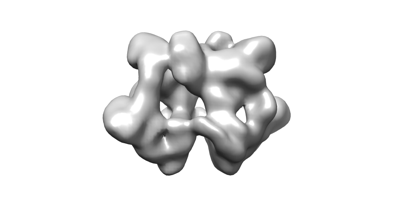 emd_12965.png
 http://ftp.pdbj.org/pub/emdb/structures/EMD-12965




 Z (Sec.)
 Y (Row.)
 X (Col.)


 試料の構成要素
 Trichoplusia ni (イラクサキンウワバ)
 解析
解析 電子顕微鏡法
 FIELD EMISSION GUN