- EMDB-12965: Cryo-EM Structure of the DDB1-DCAF1-CUL4A-RBX1-CSN Complex -
+
Open data
ID or keywords:
Loading...
-
Basic information
Entry
Database: EMDB / ID: EMD-12965
Title
Cryo-EM Structure of the DDB1-DCAF1-CUL4A-RBX1-CSN Complex
Map data
Sample
Complex: CRL4(DCAF1)-CSN
Protein or peptide: x 11 types
Function / homology
Function and homology information
cell competition in a multicellular organism / histone H2AT120 kinase activity / V(D)J recombination / negative regulation of beige fat cell differentiation / cullin-RING-type E3 NEDD8 transferase / NEDD8 transferase activity / negative regulation of mitophagy / cullin-RING ubiquitin ligase complex / regulation of xenophagy / Loss of Function of FBXW7 in Cancer and NOTCH1 Signaling ...cell competition in a multicellular organism / histone H2AT120 kinase activity / V(D)J recombination / negative regulation of beige fat cell differentiation / cullin-RING-type E3 NEDD8 transferase / NEDD8 transferase activity / negative regulation of mitophagy / cullin-RING ubiquitin ligase complex / regulation of xenophagy / Loss of Function of FBXW7 in Cancer and NOTCH1 Signaling / cellular response to chemical stress / Cul7-RING ubiquitin ligase complex / regulation of cell cycle process / neural crest cell differentiation / RNA polymerase II transcription initiation surveillance / positive regulation by virus of viral protein levels in host cell / positive regulation of protein autoubiquitination / protein neddylation / spindle assembly involved in female meiosis / regulation of BMP signaling pathway / NEDD8 ligase activity / epigenetic programming in the zygotic pronuclei / regulation of mitophagy / negative regulation of response to oxidative stress / regulation of centrosome duplication / UV-damage excision repair / protein K27-linked ubiquitination / VCB complex / Cul5-RING ubiquitin ligase complex / regulation of TOR signaling / ubiquitin-ubiquitin ligase activity / ubiquitin-dependent protein catabolic process via the C-end degron rule pathway / Cul2-RING ubiquitin ligase complex / SCF ubiquitin ligase complex / biological process involved in interaction with symbiont / negative regulation of DNA-templated DNA replication / regulation of mitotic cytokinesis / Cul3-RING ubiquitin ligase complex / regulation of DNA damage checkpoint / regulation of mitotic cell cycle phase transition / negative regulation of type I interferon production / regulation of miRNA-mediated gene silencing / regulation of natural killer cell activation / SCF-dependent proteasomal ubiquitin-dependent protein catabolic process / WD40-repeat domain binding / Prolactin receptor signaling / regulation of cell cycle phase transition / Cul4A-RING E3 ubiquitin ligase complex / Cul4-RING E3 ubiquitin ligase complex / regulation of stem cell population maintenance / Cul4B-RING E3 ubiquitin ligase complex / ubiquitin ligase complex scaffold activity / negative regulation of adipose tissue development / regulation of cellular response to stress / limb development / viral release from host cell / protein monoubiquitination / cullin family protein binding / centrosome duplication / regulation of DNA-templated DNA replication initiation / positive regulation of viral genome replication / positive regulation of gluconeogenesis / cilium assembly / B cell differentiation / ubiquitin-like ligase-substrate adaptor activity / intrinsic apoptotic signaling pathway / ribosome-associated ubiquitin-dependent protein catabolic process / signal transduction in response to DNA damage / negative regulation of insulin receptor signaling pathway / Nuclear events stimulated by ALK signaling in cancer / protein K48-linked ubiquitination / regulation of cellular response to insulin stimulus / positive regulation of TORC1 signaling / in utero embryonic development / transcription-coupled nucleotide-excision repair / post-translational protein modification / cellular response to amino acid stimulus / regulation of embryonic development / replication fork processing / nuclear estrogen receptor binding / negative regulation of canonical NF-kappaB signal transduction / regulation of mitotic cell cycle / Regulation of BACH1 activity / site of DNA damage / T cell activation / G1/S transition of mitotic cell cycle / proteasomal protein catabolic process / negative regulation of canonical Wnt signaling pathway / epigenetic regulation of gene expression / Degradation of DVL / Degradation of CRY and PER proteins / nucleotide-excision repair / Degradation of GLI1 by the proteasome / Recognition of DNA damage by PCNA-containing replication complex / GSK3B and BTRC:CUL1-mediated-degradation of NFE2L2 / Negative regulation of NOTCH4 signaling / regulation of autophagy / fibrillar center / RING-type E3 ubiquitin transferase / Hedgehog 'on' state Similarity search - Function
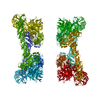
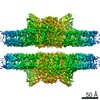
Journal: EMBO J / Year: 2021 Title: The CRL4 cullin-RING ubiquitin ligase is activated following a switch in oligomerization state. Authors: Weaam I Mohamed / Andreas D Schenk / Georg Kempf / Simone Cavadini / Anja Basters / Alessandro Potenza / Wassim Abdul Rahman / Julius Rabl / Kurt Reichermeier / Nicolas H Thomä / Abstract: The cullin-4-based RING-type (CRL4) family of E3 ubiquitin ligases functions together with dedicated substrate receptors. Out of the ˜29 CRL4 substrate receptors reported, the DDB1- and CUL4- ...The cullin-4-based RING-type (CRL4) family of E3 ubiquitin ligases functions together with dedicated substrate receptors. Out of the ˜29 CRL4 substrate receptors reported, the DDB1- and CUL4-associated factor 1 (DCAF1) is essential for cellular survival and growth, and its deregulation has been implicated in tumorigenesis. We carried out biochemical and structural studies to examine the structure and mechanism of the CRL4 ligase. In the 8.4 Å cryo-EM map of CRL4 , four CUL4-RBX1-DDB1-DCAF1 protomers are organized into two dimeric sub-assemblies. In this arrangement, the WD40 domain of DCAF1 mediates binding with the cullin C-terminal domain (CTD) and the RBX1 subunit of a neighboring CRL4 protomer. This renders RBX1, the catalytic subunit of the ligase, inaccessible to the E2 ubiquitin-conjugating enzymes. Upon CRL4 activation by neddylation, the interaction between the cullin CTD and the neighboring DCAF1 protomer is broken, and the complex assumes an active dimeric conformation. Accordingly, a tetramerization-deficient CRL4 mutant has higher ubiquitin ligase activity compared to the wild-type. This study identifies a novel mechanism by which unneddylated and substrate-free CUL4 ligases can be maintained in an inactive state.
History
Deposition
May 18, 2021
-
Header (metadata) release
Oct 13, 2021
-
Map release
Oct 13, 2021
-
Update
Dec 1, 2021
-
Current status
Dec 1, 2021
Processing site: PDBe / Status: Released
-
Structure visualization
Movie
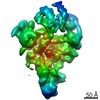
Surface view with section colored by density value
In the structure databanks used in Yorodumi, some data are registered as the other names, "COVID-19 virus" and "2019-nCoV". Here are the details of the virus and the list of structure data.
Jan 31, 2019. EMDB accession codes are about to change! (news from PDBe EMDB page)
EMDB accession codes are about to change! (news from PDBe EMDB page)
The allocation of 4 digits for EMDB accession codes will soon come to an end. Whilst these codes will remain in use, new EMDB accession codes will include an additional digit and will expand incrementally as the available range of codes is exhausted. The current 4-digit format prefixed with “EMD-” (i.e. EMD-XXXX) will advance to a 5-digit format (i.e. EMD-XXXXX), and so on. It is currently estimated that the 4-digit codes will be depleted around Spring 2019, at which point the 5-digit format will come into force.
The EM Navigator/Yorodumi systems omit the EMD- prefix.
Related info.:Q: What is EMD? / ID/Accession-code notation in Yorodumi/EM Navigator
Yorodumi is a browser for structure data from EMDB, PDB, SASBDB, etc.
This page is also the successor to EM Navigator detail page, and also detail information page/front-end page for Omokage search.
The word "yorodu" (or yorozu) is an old Japanese word meaning "ten thousand". "mi" (miru) is to see.
Related info.:EMDB / PDB / SASBDB / Comparison of 3 databanks / Yorodumi Search / Aug 31, 2016. New EM Navigator & Yorodumi / Yorodumi Papers / Jmol/JSmol / Function and homology information / Changes in new EM Navigator and Yorodumi
 Movie
Movie Controller


 Open data
 Basic information
 Map data
 Sample
 Function and homology information
 Homo sapiens (human)
 Authors
 Citation

 Structure visualization
 Downloads & links
 emd_12965.png
 https://data.pdbj.org/pub/emdb/structures/EMD-12965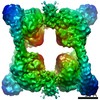






 Z (Sec.)
 Y (Row.)
 X (Col.)


 Sample components
 Trichoplusia ni (cabbage looper)
 Processing
 Electron microscopy
 FIELD EMISSION GUN