 Movie
Movie Controller

[English] 日本語
 Yorodumi
- PDB-9xk9: In situ C2S2M2L4-type PSII-LHCII supercomplex, moderately bound (... -
+ Open data

- Basic information
| Entry | Database: PDB / ID: 9xk9 | |||||||||
|---|---|---|---|---|---|---|---|---|---|---|
| Title | In situ C2S2M2L4-type PSII-LHCII supercomplex, moderately bound (M-) LHCII trimer with CP29 and CP24, protomer 2 | |||||||||
 Components Components |
| |||||||||
 Keywords Keywords | PHOTOSYNTHESIS / Photosystem II / C2S2M2L4-type / M-LHCII / in situ / Oryza sativa / chloroplast | |||||||||
| Function / homology |  Function and homology information Function and homology informationphotosynthesis, light harvesting / chloroplast thylakoid membrane / photosynthesis / mRNA binding Similarity search - Function | |||||||||
| Biological species |   Oryza sativa Japonica Group (Japanese rice) Oryza sativa Japonica Group (Japanese rice) | |||||||||
| Method | ELECTRON MICROSCOPY / single particle reconstruction / cryo EM / Resolution: 3.64 Å | |||||||||
 Authors Authors | Li, J. / Elias, E. / Zhang, K. / Croce, R. / Zhu, J. | |||||||||
| Funding support |  China, 1items China, 1items
| |||||||||
 Citation Citation | Journal: Nature / Year: 2026 Title: In situ structures of plant photosystem supercomplexes. Authors: Jiao Li / Eduard Elias / Kai Zhang / Roberta Croce / Jiapeng Zhu /  Abstract: Photosynthesis sustains life on Earth by converting light to chemical energy through the coordinated action of photosystem I (PSI) and photosystem II (PSII) within thylakoid membranes. Although ...Photosynthesis sustains life on Earth by converting light to chemical energy through the coordinated action of photosystem I (PSI) and photosystem II (PSII) within thylakoid membranes. Although structures of isolated photosystems are available, their native organization in chloroplasts remains unknown. Here, using in situ cryo-electron microscopy, we directly imaged Oryza sativa (rice) chloroplasts and determined structures of photosystem supercomplexes in their native membrane environment. We resolved a CSML-type PSII-light harvesting complex II (LHCII) supercomplex, including four LHCII antenna trimers that were not retained in purified preparations. Excitation energy transfer calculations based on this architecture closely reproduce in vivo measurements, indicating its physiological relevance. We also resolved asymmetric PSII-LHCII dimers, including side-by-side, trans-lumenal and trans-stromal architectures, and higher-order assemblies of trimers and tetramers. On the basis of these observations, we propose that PSII forms a trans-lumenal and trans-stromal 'skeleton' that shapes thylakoid morphology and supports grana stacking. In addition, we obtained high-resolution structures of PSI-LHCI-LHCII and PSI-LHCI supercomplexes. Together, these structures reveal extensive networks of lipids, pigments and cofactors, providing the first molecular framework for understanding how the native architecture of plant photosystem supports the exceptional photon-to-electron efficiency of photosynthesis. | |||||||||
| History |
|
- Structure visualization
| Structure viewer | Molecule: MolmilJmol/JSmol |
|---|
- Downloads & links
-Download
| PDBx/mmCIF format | 9xk9.cif.gz | 277.2 KB | Display | PDBx/mmCIF format |
|---|---|---|---|---|
| PDB format | pdb9xk9.ent.gz | Display | PDB format | |
| PDBx/mmJSON format | 9xk9.json.gz | Tree view | PDBx/mmJSON format | |
| Others |  Other downloads Other downloads |
-Validation report
| Arichive directory | https://data.pdbj.org/pub/pdb/validation_reports/xk/9xk9ftp://data.pdbj.org/pub/pdb/validation_reports/xk/9xk9 | HTTPS FTP |
|---|
-Related structure data
| Related structure data |  66952MC  21wdC  21wgC  21whC  21wiC  21wvC  27urC  27utC  9xj1C  9xj9C  9xk3C  9xk4C  9xk6C  9xk7C  9xk8C M: map data used to model this data C: citing same article ( |
|---|---|
| Similar structure data |


-Links
 PDBj
PDBj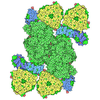
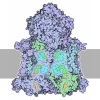
- Assembly
| Deposited unit | 
|
|---|---|
| 1 |
|
-Components
-Protein , 2 types, 3 molecules 050607
| #1: Protein | Mass: 23441.461 Da / Num. of mol.: 2 / Source method: isolated from a natural source Source: (natural) Oryza sativa Japonica Group (Japanese rice)References: UniProt: P12331 #2: Protein | | Mass: 24065.338 Da / Num. of mol.: 1 / Source method: isolated from a natural source Source: (natural) Oryza sativa Japonica Group (Japanese rice)References: UniProt: B7E6H8 |
|---|
-Chlorophyll a-b binding protein, ... , 2 types, 2 molecules 081r
| #3: Protein | Mass: 22550.580 Da / Num. of mol.: 1 / Source method: isolated from a natural source Source: (natural) Oryza sativa Japonica Group (Japanese rice)References: UniProt: Q7XV11 |
|---|---|
| #4: Protein | Mass: 25938.283 Da / Num. of mol.: 1 / Source method: isolated from a natural source Source: (natural) Oryza sativa Japonica Group (Japanese rice)References: UniProt: Q6Z411 |
-Non-polymers , 5 types, 68 molecules 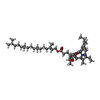
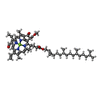
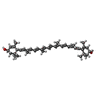
| #5: Chemical | ChemComp-CLA / 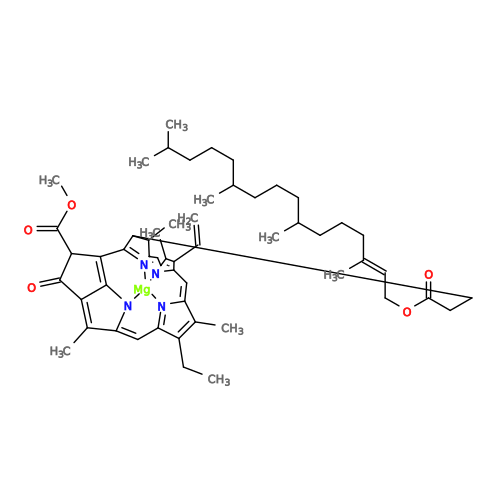 Mass: 893.489 Da / Num. of mol.: 37 / Source method: obtained synthetically / Formula: C55H72MgN4O5 / Feature type: SUBJECT OF INVESTIGATION Mass: 893.489 Da / Num. of mol.: 37 / Source method: obtained synthetically / Formula: C55H72MgN4O5 / Feature type: SUBJECT OF INVESTIGATION#6: Chemical | ChemComp-CHL /  Mass: 907.472 Da / Num. of mol.: 25 / Source method: obtained synthetically / Formula: C55H70MgN4O6 / Feature type: SUBJECT OF INVESTIGATION Mass: 907.472 Da / Num. of mol.: 25 / Source method: obtained synthetically / Formula: C55H70MgN4O6 / Feature type: SUBJECT OF INVESTIGATION#7: Chemical | 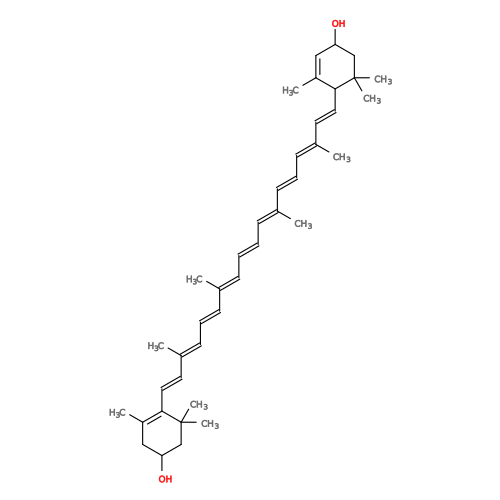 Mass: 568.871 Da / Num. of mol.: 3 / Source method: obtained synthetically / Formula: C40H56O2 / Feature type: SUBJECT OF INVESTIGATION Mass: 568.871 Da / Num. of mol.: 3 / Source method: obtained synthetically / Formula: C40H56O2 / Feature type: SUBJECT OF INVESTIGATION#8: Chemical | 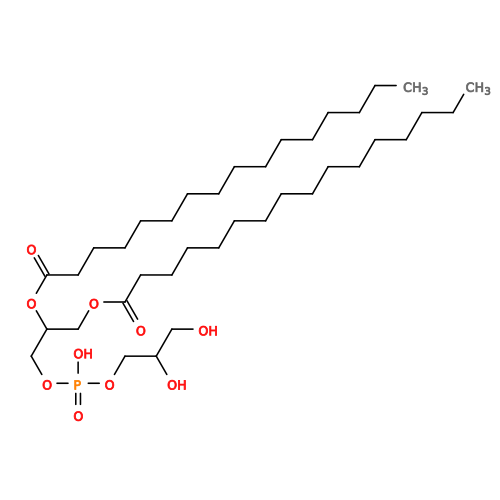 Mass: 722.970 Da / Num. of mol.: 2 / Source method: obtained synthetically / Formula: C38H75O10P / Feature type: SUBJECT OF INVESTIGATION / Comment: phospholipid*YM Mass: 722.970 Da / Num. of mol.: 2 / Source method: obtained synthetically / Formula: C38H75O10P / Feature type: SUBJECT OF INVESTIGATION / Comment: phospholipid*YM#9: Chemical | ChemComp-XAT / ( | 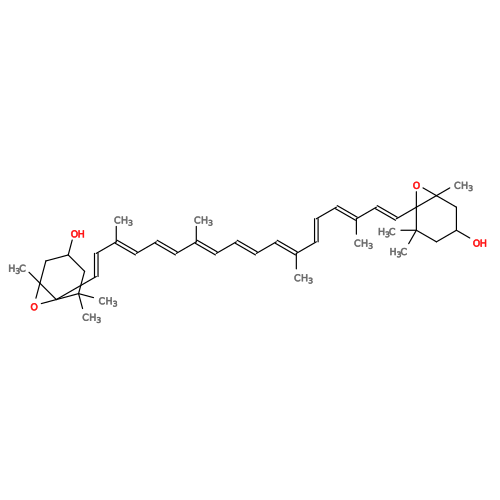 Mass: 600.870 Da / Num. of mol.: 1 / Source method: obtained synthetically / Formula: C40H56O4 / Feature type: SUBJECT OF INVESTIGATION Mass: 600.870 Da / Num. of mol.: 1 / Source method: obtained synthetically / Formula: C40H56O4 / Feature type: SUBJECT OF INVESTIGATION |
|---|
-Details
| Has ligand of interest | Y |
|---|---|
| Has protein modification | Y |
-Experimental details
-Experiment
| Experiment | Method: ELECTRON MICROSCOPY |
|---|---|
| EM experiment | Aggregation state: PARTICLE / 3D reconstruction method: single particle reconstruction |
- Sample preparation
| Component | Name: In situ C2S2M2L4-type PSII-LHCII supercomplex, moderately bound (M-) LHCII trimer with CP29 and CP24, protomer 2 Type: COMPLEX / Entity ID: #1-#4 / Source: NATURAL |
|---|---|
| Source (natural) | Organism: Oryza sativa Japonica Group (Japanese rice) |
| Buffer solution | pH: 7.3 |
| Specimen | Embedding applied: NO / Shadowing applied: NO / Staining applied: NO / Vitrification applied: YES |
| Vitrification | Cryogen name: ETHANE |
- Electron microscopy imaging
| Experimental equipment |  Model: Titan Krios / Image courtesy: FEI Company |
|---|---|
| Microscopy | Model: TFS KRIOS |
| Electron gun | Electron source:  FIELD EMISSION GUN / Accelerating voltage: 300 kV / Illumination mode: FLOOD BEAM FIELD EMISSION GUN / Accelerating voltage: 300 kV / Illumination mode: FLOOD BEAM |
| Electron lens | Mode: BRIGHT FIELD / Nominal defocus max: 2200 nm / Nominal defocus min: 1400 nm |
| Image recording | Electron dose: 1.375 e/Å2 / Film or detector model: GATAN K3 (6k x 4k) |
- Processing
| EM software |
| ||||||||||||||||||||||||
|---|---|---|---|---|---|---|---|---|---|---|---|---|---|---|---|---|---|---|---|---|---|---|---|---|---|
| CTF correction | Type: PHASE FLIPPING AND AMPLITUDE CORRECTION | ||||||||||||||||||||||||
| 3D reconstruction | Resolution: 3.64 Å / Resolution method: FSC 0.143 CUT-OFF / Num. of particles: 172752 / Symmetry type: POINT | ||||||||||||||||||||||||
| Refinement | Highest resolution: 3.64 Å Stereochemistry target values: REAL-SPACE (WEIGHTED MAP SUM AT ATOM CENTERS) | ||||||||||||||||||||||||
| Refine LS restraints |
|
