Movie
Movie Controller

[English] 日本語
 Yorodumi
- EMDB-66974: In situ C2S2M2L4-type PSII-LHCII supercomplex, two loosely bound ... -
+ Open data

- Basic information
| Entry |  | |||||||||
|---|---|---|---|---|---|---|---|---|---|---|
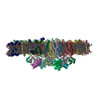
| Title | In situ C2S2M2L4-type PSII-LHCII supercomplex, two loosely bound (L-) LHCII trimers at one side, protomer 2 | |||||||||
 Map data Map data | ||||||||||
 Sample Sample |
| |||||||||
 Keywords Keywords | Photosystem II / C2S2M2L4-type / L-LHCII / in situ / Oryza sativa / chloroplast / photosynthesis | |||||||||
| Biological species |   Oryza sativa Japonica Group (Japanese rice) Oryza sativa Japonica Group (Japanese rice) | |||||||||
| Method | single particle reconstruction / cryo EM / Resolution: 5.04 Å | |||||||||
 Authors Authors | Li J / Elias E / Zhang K / Croce R / Zhu J | |||||||||
| Funding support |  China, 1 items China, 1 items
| |||||||||
 Citation Citation | Journal: Nature / Year: 2026 Title: In situ structures of plant photosystem supercomplexes. Authors: Jiao Li / Eduard Elias / Kai Zhang / Roberta Croce / Jiapeng Zhu /  Abstract: Photosynthesis sustains life on Earth by converting light to chemical energy through the coordinated action of photosystem I (PSI) and photosystem II (PSII) within thylakoid membranes. Although ...Photosynthesis sustains life on Earth by converting light to chemical energy through the coordinated action of photosystem I (PSI) and photosystem II (PSII) within thylakoid membranes. Although structures of isolated photosystems are available, their native organization in chloroplasts remains unknown. Here, using in situ cryo-electron microscopy, we directly imaged Oryza sativa (rice) chloroplasts and determined structures of photosystem supercomplexes in their native membrane environment. We resolved a CSML-type PSII-light harvesting complex II (LHCII) supercomplex, including four LHCII antenna trimers that were not retained in purified preparations. Excitation energy transfer calculations based on this architecture closely reproduce in vivo measurements, indicating its physiological relevance. We also resolved asymmetric PSII-LHCII dimers, including side-by-side, trans-lumenal and trans-stromal architectures, and higher-order assemblies of trimers and tetramers. On the basis of these observations, we propose that PSII forms a trans-lumenal and trans-stromal 'skeleton' that shapes thylakoid morphology and supports grana stacking. In addition, we obtained high-resolution structures of PSI-LHCI-LHCII and PSI-LHCI supercomplexes. Together, these structures reveal extensive networks of lipids, pigments and cofactors, providing the first molecular framework for understanding how the native architecture of plant photosystem supports the exceptional photon-to-electron efficiency of photosynthesis. | |||||||||
| History |
|
- Structure visualization
| Supplemental images |
|---|

- Downloads & links
-EMDB archive
| Map data | emd_66974.map.gz | 13.5 MB |  EMDB map data format EMDB map data format | |
|---|---|---|---|---|
| Header (meta data) | emd-66974-v30.xmlemd-66974.xml | 14.5 KB 14.5 KB | Display Display | EMDB header |
| Images |  emd_66974.png emd_66974.png | 38 KB | ||
| Filedesc metadata | emd-66974.cif.gz | 5 KB | ||
| Others | emd_66974_half_map_1.map.gzemd_66974_half_map_2.map.gz | 475.6 MB 475.6 MB | ||
| Archive directory |  https://data.pdbj.org/pub/emdb/structures/EMD-66974ftp://data.pdbj.org/pub/emdb/structures/EMD-66974 https://data.pdbj.org/pub/emdb/structures/EMD-66974ftp://data.pdbj.org/pub/emdb/structures/EMD-66974 | HTTPS FTP |
-Related structure data


-Links
| EMDB pages | EMDB (EBI/PDBe) / EMDataResource |
|---|
-Map
| File | Download / File: emd_66974.map.gz / Format: CCP4 / Size: 512 MB / Type: IMAGE STORED AS FLOATING POINT NUMBER (4 BYTES) | ||||||||||||||||||||||||||||||||||||
|---|---|---|---|---|---|---|---|---|---|---|---|---|---|---|---|---|---|---|---|---|---|---|---|---|---|---|---|---|---|---|---|---|---|---|---|---|---|
| Projections & slices | Image control
Images are generated by Spider. | ||||||||||||||||||||||||||||||||||||
| Voxel size | X=Y=Z: 1.28125 Å | ||||||||||||||||||||||||||||||||||||
| Density |
| ||||||||||||||||||||||||||||||||||||
| Symmetry | Space group: 1 | ||||||||||||||||||||||||||||||||||||
| Details | EMDB XML:
|
 Z (Sec.)
 Y (Row.)
 X (Col.)


-Supplemental data
-Half map: #1
| File | emd_66974_half_map_1.map | ||||||||||||
|---|---|---|---|---|---|---|---|---|---|---|---|---|---|
| Projections & Slices |
| ||||||||||||
| Density Histograms |


-Half map: #2
| File | emd_66974_half_map_2.map | ||||||||||||
|---|---|---|---|---|---|---|---|---|---|---|---|---|---|
| Projections & Slices |
| ||||||||||||
| Density Histograms |


- Sample components
-Entire : In situ C2S2M2L4-type PSII-LHCII supercomplex, two loosely bound ...
| Entire | Name: In situ C2S2M2L4-type PSII-LHCII supercomplex, two loosely bound (L-) LHCII trimers at one side, protomer 2 |
|---|---|
| Components |
|
-Supramolecule #1: In situ C2S2M2L4-type PSII-LHCII supercomplex, two loosely bound ...
| Supramolecule | Name: In situ C2S2M2L4-type PSII-LHCII supercomplex, two loosely bound (L-) LHCII trimers at one side, protomer 2 type: complex / ID: 1 / Parent: 0 / Macromolecule list: all |
|---|---|
| Source (natural) | Organism: Oryza sativa Japonica Group (Japanese rice) |
-Macromolecule #1: Chlorophyll a-b binding protein 1, chloroplastic
| Macromolecule | Name: Chlorophyll a-b binding protein 1, chloroplastic / type: other / ID: 1 / Classification: other |
|---|---|
| Source (natural) | Organism: Oryza sativa Japonica Group (Japanese rice) |
| Sequence | String: SPWYGADRVL YLGPLSGEPP SYLTGEFPGD YGWDTAGLSA DPETFAKNRE LEVIHSRWAM LGALGCVFPE LLARNGVKFG EAVWFKAGSQ IFSEGGLDYL GNPSLIHAQS ILAIWAVQVV LMGAVEGYRI AGGPLGEVVD PLYPGGAFDP LGLADDPEAF AELKVKEIKN ...String: SPWYGADRVL YLGPLSGEPP SYLTGEFPGD YGWDTAGLSA DPETFAKNRE LEVIHSRWAM LGALGCVFPE LLARNGVKFG EAVWFKAGSQ IFSEGGLDYL GNPSLIHAQS ILAIWAVQVV LMGAVEGYRI AGGPLGEVVD PLYPGGAFDP LGLADDPEAF AELKVKEIKN GRLAMFSMFG FFVQAIVTGK GPLENLADHL ADPVNNNAWA YATNFVPGK |
-Macromolecule #2: Chlorophyll a-b binding protein, chloroplastic
| Macromolecule | Name: Chlorophyll a-b binding protein, chloroplastic / type: other / ID: 2 / Classification: other |
|---|---|
| Source (natural) | Organism: Oryza sativa Japonica Group (Japanese rice) |
| Sequence | String: APQSIWYGPD RPKYLGPFSE QTPSYLTGEF PGDYGWDTAG LSADPETFAR NRELEVIHSR WAMLGALGCV FPEILSKNGV KFGEAVWFKA GAQIFSEGGL DYLGNPNLVH AQSILAIWAV QVVLMGFVEG YRVGGGPLGE GLDKVYPGGA FDPLGLADDP DTFAELKVKE ...String: APQSIWYGPD RPKYLGPFSE QTPSYLTGEF PGDYGWDTAG LSADPETFAR NRELEVIHSR WAMLGALGCV FPEILSKNGV KFGEAVWFKA GAQIFSEGGL DYLGNPNLVH AQSILAIWAV QVVLMGFVEG YRVGGGPLGE GLDKVYPGGA FDPLGLADDP DTFAELKVKE LKNGRLAMFS MFGFFVQAIV TGKGPIENLF DHVADPVANN AWAYATNFVP GK |
-Experimental details
-Structure determination
| Method | cryo EM |
|---|---|
 Processing Processing | single particle reconstruction |
| Aggregation state | particle |
-Sample preparation
| Buffer | pH: 7.3 |
|---|---|
| Vitrification | Cryogen name: ETHANE |
- Electron microscopy
| Microscope | TFS KRIOS |
|---|---|
| Image recording | Film or detector model: GATAN K3 (6k x 4k) / Average electron dose: 1.375 e/Å2 |
| Electron beam | Acceleration voltage: 300 kV / Electron source:  FIELD EMISSION GUN FIELD EMISSION GUN |
| Electron optics | Illumination mode: FLOOD BEAM / Imaging mode: BRIGHT FIELD / Nominal defocus max: 2.2 µm / Nominal defocus min: 1.4000000000000001 µm |
| Experimental equipment |  Model: Titan Krios / Image courtesy: FEI Company |