 Movie
Movie Controller

[English] 日本語
 Yorodumi
- PDB-9wpe: Cryo-EM structure of the insect sex pheromone receptor ApisOR22-O... -
+ Open data

- Basic information
| Entry | Database: PDB / ID: 9wpe | |||||||||
|---|---|---|---|---|---|---|---|---|---|---|
| Title | Cryo-EM structure of the insect sex pheromone receptor ApisOR22-Orco heterocomplex bound with nepetalactone in the closed state. | |||||||||
 Components Components | (Odorant receptor) x 2 | |||||||||
 Keywords Keywords | MEMBRANE PROTEIN / pheromone receptor / Apo | |||||||||
| Function / homology |  Function and homology information Function and homology informationolfactory receptor activity / odorant binding / signal transduction / plasma membrane Similarity search - Function | |||||||||
| Biological species |   Acyrthosiphon pisum (pea aphid) Acyrthosiphon pisum (pea aphid) | |||||||||
| Method | ELECTRON MICROSCOPY / single particle reconstruction / cryo EM / Resolution: 3.1 Å | |||||||||
 Authors Authors | Dong, Z. / Wang, Y.D. / Guan, Z.Y. / Wang, G.R. / Yin, P. | |||||||||
| Funding support |  China, 1items China, 1items
| |||||||||
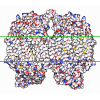
 Citation Citation | Journal: Cell Res / Year: 2026 Title: Structural basis of sex pheromone detection in aphids. Authors: Zhi Dong / Yidong Wang / Ying Tian / Zeyuan Guan / Minghui Bai / Bo Zhang / Zhongqiang Jia / Jinan Wu / Song Cao / Zhou Gong / Xincheng Zhao / Weihua Ma / Bing Wang / Guirong Wang / Ping Yin / Abstract: Sex pheromones play a central role in regulating animal behavior and reproduction. In insects, these signals are perceived through specialized odorant receptors (ORs) that mediate species-specific ...Sex pheromones play a central role in regulating animal behavior and reproduction. In insects, these signals are perceived through specialized odorant receptors (ORs) that mediate species-specific communication and safeguard genetic integrity. However, the structural basis of sex pheromone detection remains largely unresolved. Here, we identified two ORs in the pea aphid Acyrthosiphon pisum, along with the conserved OR co-receptor (Orco), which together mediate recognition of the pheromone components nepetalactone and nepetalactol. Functional assays demonstrated that ApOR21-Orco and ApOR22-Orco specifically respond to nepetalactol and nepetalactone, respectively. Using cryo-electron microscopy, we resolved the structure of the ApOR22-Orco complex in three states - unbound closed, nepetalactone-bound closed, and nepetalactone-bound open - revealing a heterotetrameric ion channel formed by one ApOR22 and three ApOrco subunits. Ligand binding to ApOR22 triggers conformational rearrangements that induce asymmetric pore dilation, thereby enabling ion conduction. Together, these results provide a mechanistic framework for understanding sex pheromone perception in insects and establish a structural foundation for the rational development of environmentally sustainable pest-control strategies. | |||||||||
| History |
|
- Structure visualization
| Structure viewer | Molecule: MolmilJmol/JSmol |
|---|
- Downloads & links
-Download
| PDBx/mmCIF format | 9wpe.cif.gz | 613.5 KB | Display | PDBx/mmCIF format |
|---|---|---|---|---|
| PDB format | pdb9wpe.ent.gz | Display | PDB format | |
| PDBx/mmJSON format | 9wpe.json.gz | Tree view | PDBx/mmJSON format | |
| Others |  Other downloads Other downloads |
-Validation report
| Arichive directory | https://data.pdbj.org/pub/pdb/validation_reports/wp/9wpeftp://data.pdbj.org/pub/pdb/validation_reports/wp/9wpe | HTTPS FTP |
|---|
-Related structure data
| Related structure data |  66140MC M: map data used to model this data C: citing same article ( |
|---|---|
| Similar structure data |
-Links
 PDBj
PDBj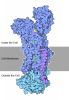
- Assembly
| Deposited unit | 
|
|---|---|
| 1 |
|
-Components
| #1: Protein | Mass: 50506.777 Da / Num. of mol.: 1 Source method: isolated from a genetically manipulated source Source: (gene. exp.) Acyrthosiphon pisum (pea aphid) / Production host:  Homo sapiens (human) / References: UniProt: A0A8R2JM50 Homo sapiens (human) / References: UniProt: A0A8R2JM50 | ||||||||
|---|---|---|---|---|---|---|---|---|---|
| #2: Protein | Mass: 52916.766 Da / Num. of mol.: 3 Source method: isolated from a genetically manipulated source Source: (gene. exp.) Acyrthosiphon pisum (pea aphid) / Gene: Orco / Production host: Homo sapiens (human) / References: UniProt: A0A1S6J137#3: Chemical | ChemComp-A1EX6 / ( | Mass: 166.217 Da / Num. of mol.: 1 / Source method: obtained synthetically / Formula: C10H14O2 / Feature type: SUBJECT OF INVESTIGATION #4: Chemical | ChemComp-PC1 /  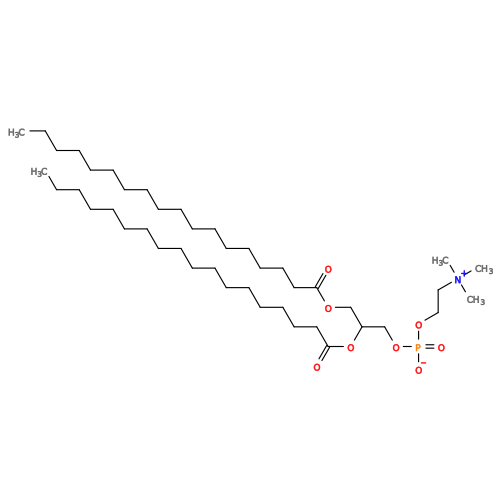 Mass: 790.145 Da / Num. of mol.: 6 / Source method: obtained synthetically / Formula: C44H88NO8P / Feature type: SUBJECT OF INVESTIGATION / Comment: phospholipid*YM Mass: 790.145 Da / Num. of mol.: 6 / Source method: obtained synthetically / Formula: C44H88NO8P / Feature type: SUBJECT OF INVESTIGATION / Comment: phospholipid*YMHas ligand of interest | Y | Has protein modification | Y | |
-Experimental details
-Experiment
| Experiment | Method: ELECTRON MICROSCOPY |
|---|---|
| EM experiment | Aggregation state: PARTICLE / 3D reconstruction method: single particle reconstruction |
- Sample preparation
| Component | Name: ApisOR22-Orco heterocomplex / Type: COMPLEX / Entity ID: #1-#2 / Source: RECOMBINANT |
|---|---|
| Source (natural) | Organism: Acyrthosiphon pisum (pea aphid) |
| Source (recombinant) | Organism: Homo sapiens (human) |
| Buffer solution | pH: 8 |
| Specimen | Embedding applied: NO / Shadowing applied: NO / Staining applied: NO / Vitrification applied: YES |
| Vitrification | Cryogen name: ETHANE |
- Electron microscopy imaging
| Experimental equipment |  Model: Titan Krios / Image courtesy: FEI Company |
|---|---|
| Microscopy | Model: TFS KRIOS |
| Electron gun | Electron source:  FIELD EMISSION GUN / Accelerating voltage: 300 kV / Illumination mode: FLOOD BEAM FIELD EMISSION GUN / Accelerating voltage: 300 kV / Illumination mode: FLOOD BEAM |
| Electron lens | Mode: BRIGHT FIELD / Nominal defocus max: 1800 nm / Nominal defocus min: 1200 nm |
| Image recording | Electron dose: 50 e/Å2 / Film or detector model: GATAN K3 BIOQUANTUM (6k x 4k) |
- Processing
| EM software |
| |||||||||
|---|---|---|---|---|---|---|---|---|---|---|
| CTF correction | Type: NONE | |||||||||
| 3D reconstruction | Resolution: 3.1 Å / Resolution method: FSC 0.143 CUT-OFF / Num. of particles: 209120 / Symmetry type: POINT |
