 Movie
Movie Controller

[English] 日本語
 Yorodumi
- PDB-9unx: Cryo-EM structure of human OAT1 in complex with olmesartan and br... -
+ Open data

- Basic information
| Entry | Database: PDB / ID: 9unx | ||||||
|---|---|---|---|---|---|---|---|
| Title | Cryo-EM structure of human OAT1 in complex with olmesartan and bromide ion. | ||||||
 Components Components | Solute carrier family 22 member 6 | ||||||
 Keywords Keywords | MEMBRANE PROTEIN / drug-drug interaction / transporter / substrate / organic anion. | ||||||
| Function / homology |  Function and homology information Function and homology informationrenal tubular secretion / alpha-ketoglutarate transmembrane transporter activity / alpha-ketoglutarate transport / Organic anion transport by SLC22 transporters / secondary active transmembrane transporter activity / sodium-independent organic anion transport / metanephric proximal tubule development / prostaglandin transport / prostaglandin transmembrane transporter activity / solute:inorganic anion antiporter activity ...renal tubular secretion / alpha-ketoglutarate transmembrane transporter activity / alpha-ketoglutarate transport / Organic anion transport by SLC22 transporters / secondary active transmembrane transporter activity / sodium-independent organic anion transport / metanephric proximal tubule development / prostaglandin transport / prostaglandin transmembrane transporter activity / solute:inorganic anion antiporter activity / : / antiporter activity / xenobiotic transmembrane transporter activity / transmembrane transporter activity / basal plasma membrane / protein homooligomerization / caveola / basolateral plasma membrane / protein-containing complex / extracellular exosome / plasma membrane Similarity search - Function | ||||||
| Biological species |  Homo sapiens (human) Homo sapiens (human) | ||||||
| Method | ELECTRON MICROSCOPY / single particle reconstruction / cryo EM / Resolution: 3.45 Å | ||||||
 Authors Authors | Jeon, H.M. / Eun, J. / Kim, K.H. / Kim, Y. | ||||||
| Funding support |  Korea, Republic Of, 1items Korea, Republic Of, 1items
| ||||||
 Citation Citation | Journal: Structure / Year: 2025 Title: Cryo-EM structures of human OAT1 reveal drug binding and inhibition mechanisms. Authors: Hyung-Min Jeon / Jisung Eun / Kelly H Kim / Youngjin Kim /  Abstract: The organic anion transporter 1 (OAT1) plays a key role in excreting waste from organic drug metabolism and contributes significantly to drug-drug interactions and drug disposition. However, the ...The organic anion transporter 1 (OAT1) plays a key role in excreting waste from organic drug metabolism and contributes significantly to drug-drug interactions and drug disposition. However, the structural basis of specific substrate and inhibitor transport by human OAT1 (hOAT1) has remained elusive. We determined four cryogenic electron microscopy (cryo-EM) structures of hOAT1 in its inward-facing conformation: the apo form, the substrate (olmesartan)-bound form with different anions, and the inhibitor (probenecid)-bound form. Structural and functional analyses revealed that Ser203 has an auxiliary role in chloride coordination, and it is a critical residue modulating olmesartan transport via chloride ion interactions. Structural comparisons indicate that inhibitors not only compete with substrates, but also obstruct substrate exit and entry from the cytoplasmic side, thereby increasing inhibitor retention. The findings can support drug development by providing insights into substrate recognition and the mechanism by which inhibitors arrest the OAT1 transport cycle. | ||||||
| History |
|
- Structure visualization
| Structure viewer | Molecule: MolmilJmol/JSmol |
|---|
- Downloads & links
-Download
| PDBx/mmCIF format | 9unx.cif.gz | 105.2 KB | Display | PDBx/mmCIF format |
|---|---|---|---|---|
| PDB format | pdb9unx.ent.gz | 76.6 KB | Display | PDB format |
| PDBx/mmJSON format | 9unx.json.gz | Tree view | PDBx/mmJSON format | |
| Others |  Other downloads Other downloads |
-Validation report
| Arichive directory | https://data.pdbj.org/pub/pdb/validation_reports/un/9unxftp://data.pdbj.org/pub/pdb/validation_reports/un/9unx | HTTPS FTP |
|---|
-Related structure data
| Related structure data |  64368MC  9kkkC  9kl5C  9klzC M: map data used to model this data C: citing same article ( |
|---|---|
| Similar structure data |


-Links
 PDBj
PDBj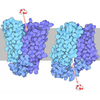

- Assembly
| Deposited unit | 
|
|---|---|
| 1 |
|
-Components
| #1: Protein | Mass: 61869.027 Da / Num. of mol.: 1 Source method: isolated from a genetically manipulated source Details: human OAT1 in complex with olmesartan and bromide ion, adopting inward facing conformation and embedded in LMNG/CHS micelle Source: (gene. exp.) Homo sapiens (human) / Cell: Epithelial / Gene: SLC22A6, OAT1, PAHT / Organ: Kidney / Plasmid: pEG BacMam / Cell line (production host): HEK293S GnTi- / Organ (production host): Kidney / Production host: Homo sapiens (human) / References: UniProt: Q4U2R8 |
|---|---|
| #2: Chemical | ChemComp-BR /  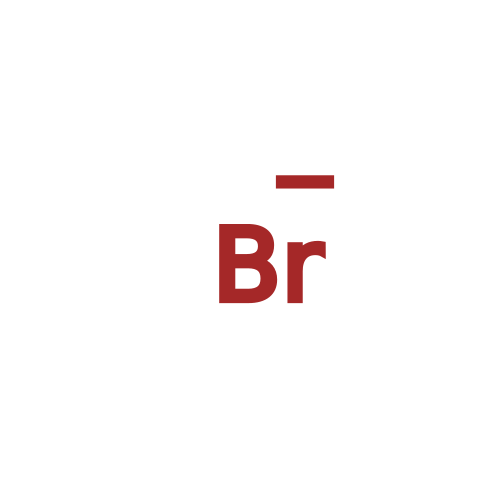 Mass: 79.904 Da / Num. of mol.: 1 / Source method: obtained synthetically / Formula: Br / Feature type: SUBJECT OF INVESTIGATION Mass: 79.904 Da / Num. of mol.: 1 / Source method: obtained synthetically / Formula: Br / Feature type: SUBJECT OF INVESTIGATION |
| #3: Chemical | ChemComp-OLM /   Mass: 446.502 Da / Num. of mol.: 1 / Source method: obtained synthetically / Formula: C24H26N6O3 / Feature type: SUBJECT OF INVESTIGATION Mass: 446.502 Da / Num. of mol.: 1 / Source method: obtained synthetically / Formula: C24H26N6O3 / Feature type: SUBJECT OF INVESTIGATION |
| Has ligand of interest | Y |
| Has protein modification | Y |
-Experimental details
-Experiment
| Experiment | Method: ELECTRON MICROSCOPY |
|---|---|
| EM experiment | Aggregation state: PARTICLE / 3D reconstruction method: single particle reconstruction |
- Sample preparation
| Component | Name: Human OAT1 in complex with olmesartan and bromide / Type: COMPLEX Details: human OAT1 in complex with olmesartan and, adopting inward facing conformation and embedded in LMNG/CHS micelle Entity ID: #1 / Source: RECOMBINANT | ||||||||||||||||||||
|---|---|---|---|---|---|---|---|---|---|---|---|---|---|---|---|---|---|---|---|---|---|
| Molecular weight | Value: 0.062 MDa / Experimental value: NO | ||||||||||||||||||||
| Source (natural) | Organism: Homo sapiens (human) / Cellular location: Plasma membrane / Organ: kidney | ||||||||||||||||||||
| Source (recombinant) | Organism: Homo sapiens (human) / Cell: HEK293S GnTi- / Plasmid: pEG BacMam | ||||||||||||||||||||
| Buffer solution | pH: 7.5 Details: 20 mM HEPES, 150 mM NaCl, 20 mM Na/K-tartrate, 0.0015% LMNG, 0.00015% CHS | ||||||||||||||||||||
| Buffer component |
| ||||||||||||||||||||
| Specimen | Conc.: 18 mg/ml / Embedding applied: NO / Shadowing applied: NO / Staining applied: NO / Vitrification applied: YES Details: This sample is a complex formed by composition of human OAT1, Fab targeting C-terminus of human OAT1, and the substrate olmesartan, purified in bromide buffer. | ||||||||||||||||||||
| Specimen support | Grid material: GOLD / Grid mesh size: 300 divisions/in. / Grid type: Quantifoil R1.2/1.3 | ||||||||||||||||||||
| Vitrification | Instrument: FEI VITROBOT MARK IV / Cryogen name: ETHANE / Humidity: 100 % / Chamber temperature: 283 K |
- Electron microscopy imaging
| Experimental equipment |  Model: Titan Krios / Image courtesy: FEI Company |
|---|---|
| Microscopy | Model: TFS KRIOS |
| Electron gun | Electron source:  FIELD EMISSION GUN / Accelerating voltage: 300 kV / Illumination mode: OTHER FIELD EMISSION GUN / Accelerating voltage: 300 kV / Illumination mode: OTHER |
| Electron lens | Mode: BRIGHT FIELD / Nominal magnification: 105000 X / Nominal defocus max: 1800 nm / Nominal defocus min: 800 nm |
| Specimen holder | Specimen holder model: FEI TITAN KRIOS AUTOGRID HOLDER |
| Image recording | Electron dose: 60 e/Å2 / Film or detector model: GATAN K3 BIOQUANTUM (6k x 4k) / Num. of grids imaged: 3 / Num. of real images: 32271 |
| Image scans | Width: 5760 / Height: 4092 |
- Processing
| EM software |
| ||||||||||||||||||||||||||||||||||||
|---|---|---|---|---|---|---|---|---|---|---|---|---|---|---|---|---|---|---|---|---|---|---|---|---|---|---|---|---|---|---|---|---|---|---|---|---|---|
| CTF correction | Type: PHASE FLIPPING AND AMPLITUDE CORRECTION | ||||||||||||||||||||||||||||||||||||
| Particle selection | Num. of particles selected: 10849658 | ||||||||||||||||||||||||||||||||||||
| Symmetry | Point symmetry: C1 (asymmetric) | ||||||||||||||||||||||||||||||||||||
| 3D reconstruction | Resolution: 3.45 Å / Resolution method: FSC 0.143 CUT-OFF / Num. of particles: 118678 / Num. of class averages: 1 / Symmetry type: POINT | ||||||||||||||||||||||||||||||||||||
| Atomic model building | Protocol: RIGID BODY FIT | ||||||||||||||||||||||||||||||||||||
| Atomic model building | PDB-ID: 9KLZ Pdb chain-ID: A / Accession code: 9KLZ / Source name: PDB / Type: experimental model | ||||||||||||||||||||||||||||||||||||
| Refinement | Highest resolution: 3.45 Å Stereochemistry target values: REAL-SPACE (WEIGHTED MAP SUM AT ATOM CENTERS) | ||||||||||||||||||||||||||||||||||||
| Refine LS restraints |
|
