 Movie
Movie Controller

[English] 日本語
 Yorodumi
- PDB-9uat: The structure of mCAT1 in complex with its substrate ornithine an... -
+ Open data

- Basic information
| Entry | Database: PDB / ID: 9uat | |||||||||||||||||||||
|---|---|---|---|---|---|---|---|---|---|---|---|---|---|---|---|---|---|---|---|---|---|---|
| Title | The structure of mCAT1 in complex with its substrate ornithine and the RBD of FrMLV. | |||||||||||||||||||||
 Components Components |
| |||||||||||||||||||||
 Keywords Keywords | MEMBRANE PROTEIN / receptor / complex | |||||||||||||||||||||
| Function / homology |  Function and homology information Function and homology informationL-ornithine transmembrane transporter activity / L-lysine transmembrane transporter activity / lysine transport / L-ornithine transmembrane transport / L-lysine transmembrane transport / L-amino acid transport / L-histidine import across plasma membrane / ornithine transport / L-arginine import across plasma membrane / Amino acid transport across the plasma membrane ...L-ornithine transmembrane transporter activity / L-lysine transmembrane transporter activity / lysine transport / L-ornithine transmembrane transport / L-lysine transmembrane transport / L-amino acid transport / L-histidine import across plasma membrane / ornithine transport / L-arginine import across plasma membrane / Amino acid transport across the plasma membrane / L-arginine transmembrane transport / basic amino acid transmembrane transporter activity / L-histidine transmembrane transporter activity / L-arginine transmembrane transporter activity / amino acid transmembrane transporter activity / regulation of TOR signaling / amino acid import across plasma membrane / positive regulation of T cell proliferation / basal plasma membrane / virus receptor activity / basolateral plasma membrane / apical plasma membrane / fusion of virus membrane with host plasma membrane / viral envelope / symbiont entry into host cell / virion attachment to host cell / host cell plasma membrane / virion membrane / protein-containing complex / membrane / metal ion binding / plasma membrane Similarity search - Function | |||||||||||||||||||||
| Biological species |   Mus musculus (house mouse) Mus musculus (house mouse) Friend murine leukemia virus Friend murine leukemia virus | |||||||||||||||||||||
| Method | ELECTRON MICROSCOPY / single particle reconstruction / cryo EM / Resolution: 3.65 Å | |||||||||||||||||||||
 Authors Authors | Xia, L.Y. / Yang, Y. / Chen, X.M. | |||||||||||||||||||||
| Funding support |  China, 1items China, 1items
| |||||||||||||||||||||
 Citation Citation | Journal: Nat Commun / Year: 2025 Title: Structural insights into cationic amino acid transport and viral receptor engagement by CAT1. Authors: Lingyun Xia / Bingqian Lin / Rongfeng Zou / Yanyan Wu / Jiaying Xu / Yan Pan / Yuan Yuan / Shuo Li / Yang Yang / Xuemin Chen /  Abstract: Cationic amino acid transporter 1 (CAT1) transports cationic amino acids and plays pivotal roles in cancer proliferation, immune modulation, and nitric oxide metabolism. It also serves as the ...Cationic amino acid transporter 1 (CAT1) transports cationic amino acids and plays pivotal roles in cancer proliferation, immune modulation, and nitric oxide metabolism. It also serves as the specific cellular receptor for certain murine leukemia viruses. Here, we report the cryo-electron microscopy (cryo-EM) structure of mammalian CAT1 in complex with its substrate ornithine and the receptor-binding domain (RBD) of Friend murine leukemia virus (FrMLV). CAT1 specifically recognizes the side-chain amino group of ornithine via residue S347 on transmembrane helix 8 (TM8), capturing the transporter in an inward-facing occluded conformation. Notably, the FrMLV RBD (frRBD) primarily engages the third extracellular loop (ECL3) of CAT1-a region marked by substantial species-specific variation that likely governs cross-species viral tropism. Together, our structural and biochemical results elucidate the molecular mechanism of substrate recognition and transport by mCAT1, and unveil the molecular basis for FrMLV receptor specificity. These findings provide a valuable framework for structure-based drug design targeting CAT1 in cancer and infectious diseases. | |||||||||||||||||||||
| History |
|
- Structure visualization
| Structure viewer | Molecule: MolmilJmol/JSmol |
|---|
- Downloads & links
-Download
| PDBx/mmCIF format | 9uat.cif.gz | 142.8 KB | Display | PDBx/mmCIF format |
|---|---|---|---|---|
| PDB format | pdb9uat.ent.gz | 109.4 KB | Display | PDB format |
| PDBx/mmJSON format | 9uat.json.gz | Tree view | PDBx/mmJSON format | |
| Others |  Other downloads Other downloads |
-Validation report
| Arichive directory | https://data.pdbj.org/pub/pdb/validation_reports/ua/9uatftp://data.pdbj.org/pub/pdb/validation_reports/ua/9uat | HTTPS FTP |
|---|
-Related structure data
| Related structure data |  63995MC M: map data used to model this data C: citing same article ( |
|---|---|
| Similar structure data |
-Links
 PDBj
PDBj- Assembly
| Deposited unit | 
|
|---|---|
| 1 |
|
-Components
-Protein , 2 types, 2 molecules AB
| #1: Protein | Mass: 64978.207 Da / Num. of mol.: 1 Source method: isolated from a genetically manipulated source Source: (gene. exp.) Mus musculus (house mouse) / Gene: Slc7a1, Atrc1, Rec-1 / Production host:  Homo sapiens (human) / References: UniProt: Q09143 Homo sapiens (human) / References: UniProt: Q09143 |
|---|---|
| #2: Protein | Mass: 25411.256 Da / Num. of mol.: 1 Source method: isolated from a genetically manipulated source Source: (gene. exp.) Friend murine leukemia virus (ISOLATE 57)Gene: env / Production host: Homo sapiens (human) / References: UniProt: P03390 |
-Sugars , 3 types, 4 molecules 
| #3: Polysaccharide | | #4: Polysaccharide | beta-D-mannopyranose-(1-4)-2-acetamido-2-deoxy-beta-D-glucopyranose-(1-4)-2-acetamido-2-deoxy-beta- ...beta-D-mannopyranose-(1-4)-2-acetamido-2-deoxy-beta-D-glucopyranose-(1-4)-2-acetamido-2-deoxy-beta-D-glucopyranose | #6: Sugar | ChemComp-NAG / | 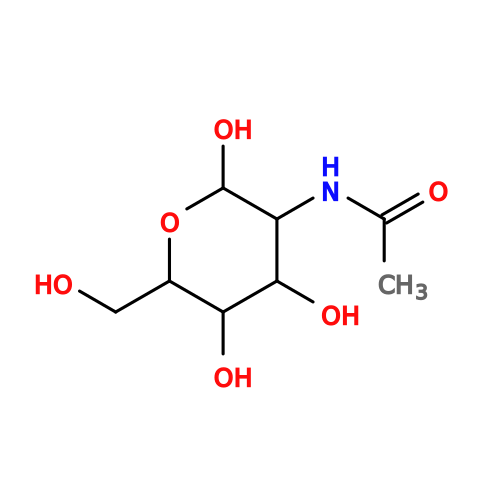 Type: D-saccharide, beta linking / Mass: 221.208 Da / Num. of mol.: 1 / Source method: obtained synthetically / Formula: C8H15NO6 Type: D-saccharide, beta linking / Mass: 221.208 Da / Num. of mol.: 1 / Source method: obtained synthetically / Formula: C8H15NO6 |
|---|
-Non-polymers , 1 types, 1 molecules 
| #5: Chemical | ChemComp-ORN / 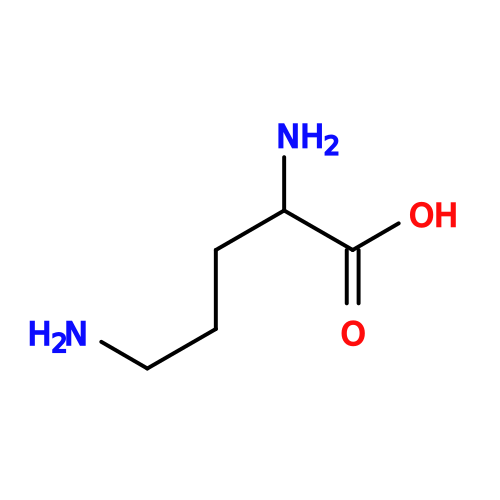 Type: L-peptide linking / Mass: 132.161 Da / Num. of mol.: 1 Type: L-peptide linking / Mass: 132.161 Da / Num. of mol.: 1Source method: isolated from a genetically manipulated source Formula: C5H12N2O2 / Feature type: SUBJECT OF INVESTIGATION |
|---|
-Details
| Has ligand of interest | Y |
|---|---|
| Has protein modification | Y |
-Experimental details
-Experiment
| Experiment | Method: ELECTRON MICROSCOPY |
|---|---|
| EM experiment | Aggregation state: PARTICLE / 3D reconstruction method: single particle reconstruction |
- Sample preparation
| Component | Name: The structure of mCAT1 in complex with its substrate ornithine and the RBD of FrMLV Type: COMPLEX / Entity ID: #1-#2 / Source: RECOMBINANT |
|---|---|
| Source (natural) | Organism: Mus musculus (house mouse) |
| Source (recombinant) | Organism: Homo sapiens (human) |
| Buffer solution | pH: 8 |
| Specimen | Embedding applied: NO / Shadowing applied: NO / Staining applied: NO / Vitrification applied: YES |
| Vitrification | Cryogen name: ETHANE |
- Electron microscopy imaging
| Experimental equipment |  Model: Titan Krios / Image courtesy: FEI Company |
|---|---|
| Microscopy | Model: TFS KRIOS |
| Electron gun | Electron source:  FIELD EMISSION GUN / Accelerating voltage: 300 kV / Illumination mode: FLOOD BEAM FIELD EMISSION GUN / Accelerating voltage: 300 kV / Illumination mode: FLOOD BEAM |
| Electron lens | Mode: BRIGHT FIELD / Nominal defocus max: 2200 nm / Nominal defocus min: 1200 nm |
| Image recording | Electron dose: 50 e/Å2 / Film or detector model: GATAN K3 BIOQUANTUM (6k x 4k) |
- Processing
| EM software |
| |||||||||||||||
|---|---|---|---|---|---|---|---|---|---|---|---|---|---|---|---|---|
| CTF correction | Type: PHASE FLIPPING AND AMPLITUDE CORRECTION | |||||||||||||||
| 3D reconstruction | Resolution: 3.65 Å / Resolution method: FSC 0.143 CUT-OFF / Num. of particles: 106963 / Symmetry type: POINT |
