Journal: Protein Sci / Year: 2026 Title: Structural basis of secreted acid phosphatase polymerization in the Leishmania parasite. Authors: Priyanka Bose / Irit Dahan / Alexander Upcher / Ran Zalk / Iris Grossman-Haham / Abstract: Enzymes that assemble into filaments typically transition between protomeric and polymeric states in response to cellular conditions. In contrast, the secreted acid phosphatase (SAP) of Leishmania, ...Enzymes that assemble into filaments typically transition between protomeric and polymeric states in response to cellular conditions. In contrast, the secreted acid phosphatase (SAP) of Leishmania, one of the most abundant extracellular glycoproteins produced by the parasite and regarded as a major virulence factor in the neglected tropical disease leishmaniasis, exhibits fundamentally different behavior. Depending on the species, SAP forms either highly stable extracellular filaments or remains exclusively as globular particles, with no evidence of reversible interconversion. This binary assembly pattern is particularly intriguing given that SAP orthologs that differ in their ability to polymerize share a high degree of sequence conservation, leaving the molecular determinants of filament formation unknown. Here, we report the cryo-EM structure of filamentous Leishmania mexicana SAP to a global resolution of 3.0 Å. The structure resolves the multilevel organization of the enzyme, from individual catalytic phosphatase domains and their unique substrate-binding pockets to the formation of homodimeric protomers, the decoration with N-linked glycans, and the supramolecular organization into filaments. At the core of the polymerization interface, we identified a unique β-hairpin motif that has not been observed in any other phosphatase or enzyme filament, which provides exceptional filament stability. By integrating structural data with comparative sequence analysis and machine-learning-based structure predictions, we define the molecular basis for the species-specific assembly behaviors observed across Leishmania SAPs. This work establishes the principles governing SAP filament formation and provides a framework for understanding its evolution, enzymatic function, and potential applications.
History
Deposition
Nov 20, 2025
Deposition site: PDBE / Processing site: PDBE
Revision 1.0
Apr 29, 2026
Provider: repository / Type: Initial release
Revision 1.0
Apr 29, 2026
Data content type: EM metadata / Data content type: EM metadata / Provider: repository / Type: Initial release
Revision 1.0
Apr 29, 2026
Data content type: Additional map / Part number: 1 / Data content type: Additional map / Provider: repository / Type: Initial release
Revision 1.0
Apr 29, 2026
Data content type: FSC / Data content type: FSC / Provider: repository / Type: Initial release
Revision 1.0
Apr 29, 2026
Data content type: Half map / Part number: 1 / Data content type: Half map / Provider: repository / Type: Initial release
Revision 1.0
Apr 29, 2026
Data content type: Half map / Part number: 2 / Data content type: Half map / Provider: repository / Type: Initial release
Revision 1.0
Apr 29, 2026
Data content type: Image / Data content type: Image / Provider: repository / Type: Initial release
Revision 1.0
Apr 29, 2026
Data content type: Primary map / Data content type: Primary map / Provider: repository / Type: Initial release
Data content type: EM metadata / Data content type: EM metadata / EM metadata / Group: Database references / Experimental summary / Data content type: EM metadata / EM metadata / EM metadata / Category: citation / citation_author / em_admin Data content type: EM metadata / EM metadata ...EM metadata / EM metadata / EM metadata / EM metadata / EM metadata / EM metadata / EM metadata / EM metadata / EM metadata / EM metadata / EM metadata / EM metadata / EM metadata / EM metadata Item: _citation.country / _citation.journal_abbrev ..._citation.country / _citation.journal_abbrev / _citation.journal_id_ASTM / _citation.journal_id_CSD / _citation.journal_id_ISSN / _citation.journal_volume / _citation.page_first / _citation.page_last / _citation.pdbx_database_id_DOI / _citation.pdbx_database_id_PubMed / _citation.title / _citation.year / _citation_author.identifier_ORCID / _em_admin.last_update
In the structure databanks used in Yorodumi, some data are registered as the other names, "COVID-19 virus" and "2019-nCoV". Here are the details of the virus and the list of structure data.
Jan 31, 2019. EMDB accession codes are about to change! (news from PDBe EMDB page)
EMDB accession codes are about to change! (news from PDBe EMDB page)
The allocation of 4 digits for EMDB accession codes will soon come to an end. Whilst these codes will remain in use, new EMDB accession codes will include an additional digit and will expand incrementally as the available range of codes is exhausted. The current 4-digit format prefixed with “EMD-” (i.e. EMD-XXXX) will advance to a 5-digit format (i.e. EMD-XXXXX), and so on. It is currently estimated that the 4-digit codes will be depleted around Spring 2019, at which point the 5-digit format will come into force.
The EM Navigator/Yorodumi systems omit the EMD- prefix.
Related info.:Q: What is EMD? / ID/Accession-code notation in Yorodumi/EM Navigator
Yorodumi is a browser for structure data from EMDB, PDB, SASBDB, etc.
This page is also the successor to EM Navigator detail page, and also detail information page/front-end page for Omokage search.
The word "yorodu" (or yorozu) is an old Japanese word meaning "ten thousand". "mi" (miru) is to see.
Related info.:EMDB / PDB / SASBDB / Comparison of 3 databanks / Yorodumi Search / Aug 31, 2016. New EM Navigator & Yorodumi / Yorodumi Papers / Jmol/JSmol / Function and homology information / Changes in new EM Navigator and Yorodumi
 Movie
Movie Controller


 Open data
 Basic information
 Components
 Keywords
 Function and homology information
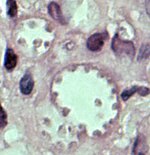 Leishmania mexicana (eukaryote)
 Authors
 Israel, 1items
  Citation
 Structure visualization
 Downloads & links
 Other downloads


 PDBj
PDBj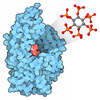
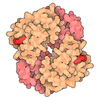
 Assembly
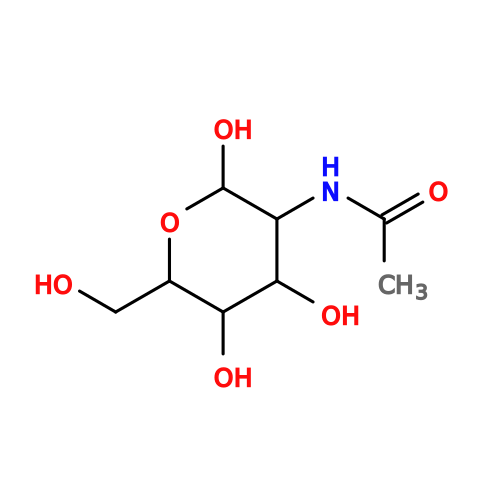 Type: D-saccharide, beta linking / Mass: 221.208 Da / Num. of mol.: 6 / Source method: isolated from a natural source / Formula: C8H15NO6 / Feature type: SUBJECT OF INVESTIGATION

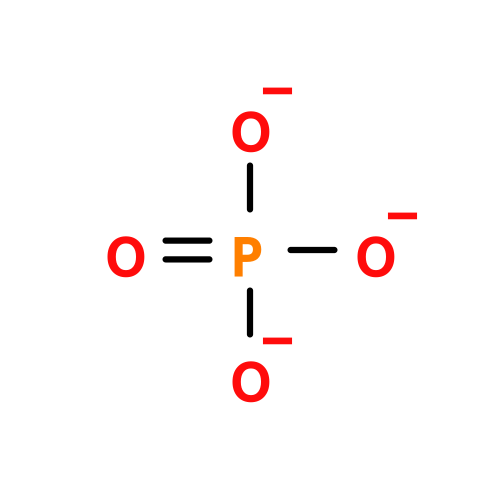 Mass: 94.971 Da / Num. of mol.: 3 / Source method: isolated from a natural source / Formula: PO4 / Feature type: SUBJECT OF INVESTIGATION
 Sample preparation
 Electron microscopy imaging
 FIELD EMISSION GUN / Accelerating voltage: 200 kV / Illumination mode: OTHER
 Processing