 Movie
Movie Controller


+ Open data

- Basic information
| Entry |  | |||||||||
|---|---|---|---|---|---|---|---|---|---|---|
| Title | Leishmania mexicana secreted acid phosphatase | |||||||||
 Map data Map data | ||||||||||
 Sample Sample |
| |||||||||
 Keywords Keywords | Leishmania / acid phosphatase / enzyme filaments / HYDROLASE | |||||||||
| Function / homology | : / Histidine phosphatase superfamily, clade-2 / Histidine phosphatase superfamily (branch 2) / Histidine phosphatase superfamily / phosphatase activity / Secreted acid phosphatase 1 (SAP1) Function and homology information Function and homology information | |||||||||
| Biological species |   Leishmania mexicana (eukaryote) Leishmania mexicana (eukaryote) | |||||||||
| Method | single particle reconstruction / cryo EM / Resolution: 3.0 Å | |||||||||
 Authors Authors | Bose P / Grossman-Haham I | |||||||||
| Funding support |  Israel, 1 items Israel, 1 items
| |||||||||
 Citation Citation | Journal: Protein Sci / Year: 2026 Title: Structural basis of secreted acid phosphatase polymerization in the Leishmania parasite. Authors: Priyanka Bose / Irit Dahan / Alexander Upcher / Ran Zalk / Iris Grossman-Haham / Abstract: Enzymes that assemble into filaments typically transition between protomeric and polymeric states in response to cellular conditions. In contrast, the secreted acid phosphatase (SAP) of Leishmania, ...Enzymes that assemble into filaments typically transition between protomeric and polymeric states in response to cellular conditions. In contrast, the secreted acid phosphatase (SAP) of Leishmania, one of the most abundant extracellular glycoproteins produced by the parasite and regarded as a major virulence factor in the neglected tropical disease leishmaniasis, exhibits fundamentally different behavior. Depending on the species, SAP forms either highly stable extracellular filaments or remains exclusively as globular particles, with no evidence of reversible interconversion. This binary assembly pattern is particularly intriguing given that SAP orthologs that differ in their ability to polymerize share a high degree of sequence conservation, leaving the molecular determinants of filament formation unknown. Here, we report the cryo-EM structure of filamentous Leishmania mexicana SAP to a global resolution of 3.0 Å. The structure resolves the multilevel organization of the enzyme, from individual catalytic phosphatase domains and their unique substrate-binding pockets to the formation of homodimeric protomers, the decoration with N-linked glycans, and the supramolecular organization into filaments. At the core of the polymerization interface, we identified a unique β-hairpin motif that has not been observed in any other phosphatase or enzyme filament, which provides exceptional filament stability. By integrating structural data with comparative sequence analysis and machine-learning-based structure predictions, we define the molecular basis for the species-specific assembly behaviors observed across Leishmania SAPs. This work establishes the principles governing SAP filament formation and provides a framework for understanding its evolution, enzymatic function, and potential applications. | |||||||||
| History |
|
- Structure visualization
| Supplemental images |
|---|

- Downloads & links
-EMDB archive
| Map data | emd_55773.map.gz | 204 MB | EMDB map data format | |
|---|---|---|---|---|
| Header (meta data) | emd-55773-v30.xmlemd-55773.xml | 23.6 KB 23.6 KB | Display Display | EMDB header |
| FSC (resolution estimation) | emd_55773_fsc.xml | 12.7 KB | Display | FSC data file |
| Images |  emd_55773.png emd_55773.png | 76 KB | ||
| Filedesc metadata | emd-55773.cif.gz | 7 KB | ||
| Others | emd_55773_additional_1.map.gzemd_55773_half_map_1.map.gzemd_55773_half_map_2.map.gz | 180.5 MB 200.3 MB 200.3 MB | ||
| Archive directory |  https://data.pdbj.org/pub/emdb/structures/EMD-55773ftp://data.pdbj.org/pub/emdb/structures/EMD-55773 https://data.pdbj.org/pub/emdb/structures/EMD-55773ftp://data.pdbj.org/pub/emdb/structures/EMD-55773 | HTTPS FTP |
-Related structure data
| Related structure data |  9tbjMC  28ikC M: atomic model generated by this map C: citing same article ( |
|---|---|
| Similar structure data |

-Links
| EMDB pages | EMDB (EBI/PDBe) / EMDataResource |
|---|---|
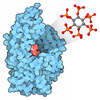
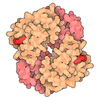
| Related items in Molecule of the Month |
-Map
| File | Download / File: emd_55773.map.gz / Format: CCP4 / Size: 216 MB / Type: IMAGE STORED AS FLOATING POINT NUMBER (4 BYTES) | ||||||||||||||||||||||||||||||||||||
|---|---|---|---|---|---|---|---|---|---|---|---|---|---|---|---|---|---|---|---|---|---|---|---|---|---|---|---|---|---|---|---|---|---|---|---|---|---|
| Projections & slices | Image control
Images are generated by Spider. | ||||||||||||||||||||||||||||||||||||
| Voxel size | X=Y=Z: 0.89 Å | ||||||||||||||||||||||||||||||||||||
| Density |
| ||||||||||||||||||||||||||||||||||||
| Symmetry | Space group: 1 | ||||||||||||||||||||||||||||||||||||
| Details | EMDB XML:
|
 Z (Sec.)
 Y (Row.)
 X (Col.)


-Supplemental data
-Additional map: #1
| File | emd_55773_additional_1.map | ||||||||||||
|---|---|---|---|---|---|---|---|---|---|---|---|---|---|
| Projections & Slices |
| ||||||||||||
| Density Histograms |


-Half map: #2
| File | emd_55773_half_map_1.map | ||||||||||||
|---|---|---|---|---|---|---|---|---|---|---|---|---|---|
| Projections & Slices |
| ||||||||||||
| Density Histograms |


-Half map: #1
| File | emd_55773_half_map_2.map | ||||||||||||
|---|---|---|---|---|---|---|---|---|---|---|---|---|---|
| Projections & Slices |
| ||||||||||||
| Density Histograms |


- Sample components
-Entire : Filamentous secreted acid phosphatase from Leishmania mexicana
| Entire | Name: Filamentous secreted acid phosphatase from Leishmania mexicana |
|---|---|
| Components |
|
-Supramolecule #1: Filamentous secreted acid phosphatase from Leishmania mexicana
| Supramolecule | Name: Filamentous secreted acid phosphatase from Leishmania mexicana type: complex / ID: 1 / Parent: 0 / Macromolecule list: #1 |
|---|---|
| Source (natural) | Organism: Leishmania mexicana (eukaryote) / Location in cell: extracellular |
| Molecular weight | Theoretical: 7.2 kDa/nm |
-Macromolecule #1: Secreted acid phosphatase 1 (SAP1)
| Macromolecule | Name: Secreted acid phosphatase 1 (SAP1) / type: protein_or_peptide / ID: 1 / Details: The sequence provided was overexpressed / Number of copies: 3 / Enantiomer: LEVO |
|---|---|
| Source (natural) | Organism: Leishmania mexicana (eukaryote) |
| Molecular weight | Theoretical: 62.17566 KDa |
| Recombinant expression | Organism: Leishmania mexicana (eukaryote) |
| Sequence | String: MASRLVRVLA AAMLVAAAVS VDAHFVVRMV QVVHRHGARS ALIDDNTTEI CGTLYPCGEL TGEGVEMVRA IGEFARSRYN NLSLVESPL FPSTRYNSSV VHTRSTHTQR TIQSATAFLR GLFQDDNFYP VVYSTNRTTE TLLSTDAVPS VVARSWLDNP A LHAALNPV ...String: MASRLVRVLA AAMLVAAAVS VDAHFVVRMV QVVHRHGARS ALIDDNTTEI CGTLYPCGEL TGEGVEMVRA IGEFARSRYN NLSLVESPL FPSTRYNSSV VHTRSTHTQR TIQSATAFLR GLFQDDNFYP VVYSTNRTTE TLLSTDAVPS VVARSWLDNP A LHAALNPV IDEHLSWDAI QCAAKDAWVE GLCADYNART SCVLDMYDVA AAFEAAGRLD NATNLKAVYP GLQEVNAAWF KY VFSWNHT SKLDLTQGSA SQNLAQTVLA NINAHRLSPS YNMFQYSAHD TTVTPLAVTF GDQGETTMRP PFAVTIFVEL LQD TADASG WYVRLIRGNP VKAADGTYVF QESGIKAYCI DEAGNKYLAH TGICPLNNFR RMIDYSRPAV ADGHCTMTQT QYSN MDCPP TIADNKSVPS RCWLYRYVCP SKACPDSYIL SAVDHQCYPG SDVTNLTSSS SKSTSSSDVP SFKKPANWSP RVLSP ERGR HIAGDIIRGV TNGVTIGAGV RKHDEYSRHR QQSRMDEKTT GWRGGHVVEG LAGELEQLRA RLEHHPQGQR EPSGGC KLG LY UniProtKB: Secreted acid phosphatase 1 (SAP1) |
-Macromolecule #4: 2-acetamido-2-deoxy-beta-D-glucopyranose
| Macromolecule | Name: 2-acetamido-2-deoxy-beta-D-glucopyranose / type: ligand / ID: 4 / Number of copies: 6 / Formula: NAG |
|---|---|
| Molecular weight | Theoretical: 221.208 Da |
| Chemical component information | 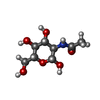 ChemComp-NAG: |
-Macromolecule #5: PHOSPHATE ION
| Macromolecule | Name: PHOSPHATE ION / type: ligand / ID: 5 / Number of copies: 3 / Formula: PO4 |
|---|---|
| Molecular weight | Theoretical: 94.971 Da |
| Chemical component information | 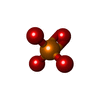 ChemComp-PO4: |
-Macromolecule #6: water
| Macromolecule | Name: water / type: ligand / ID: 6 / Number of copies: 19 / Formula: HOH |
|---|---|
| Molecular weight | Theoretical: 18.015 Da |
| Chemical component information |  ChemComp-HOH: |
-Experimental details
-Structure determination
| Method | cryo EM |
|---|---|
 Processing Processing | single particle reconstruction |
| Aggregation state | filament |
-Sample preparation
| Buffer | pH: 7.4 / Details: 10mM MgCL2, 100 mM NaCL, 40mM HEPES pH 7.4 |
|---|---|
| Vitrification | Cryogen name: ETHANE / Chamber temperature: 298 K |
- Electron microscopy
| Microscope | TFS GLACIOS |
|---|---|
| Specialist optics | Energy filter - Name: TFS Selectris X / Energy filter - Slit width: 10 eV |
| Image recording | Film or detector model: FEI FALCON IV (4k x 4k) / Number grids imaged: 2 / Number real images: 15039 / Average electron dose: 30.0 e/Å2 |
| Electron beam | Acceleration voltage: 200 kV / Electron source:  FIELD EMISSION GUN FIELD EMISSION GUN |
| Electron optics | Illumination mode: OTHER / Imaging mode: OTHER / Cs: 2.7 mm / Nominal defocus max: 2.0 µm / Nominal defocus min: 0.75 µm / Nominal magnification: 130000 |
| Sample stage | Cooling holder cryogen: NITROGEN |
+Image processing

-Atomic model buiding 1
| Initial model | Chain - Source name: AlphaFold / Chain - Initial model type: in silico model |
|---|---|
| Output model | PDB-9tbj: |
