 ムービー
ムービー コントローラー


+ データを開く

- 基本情報
基本情報
| 登録情報 | データベース: PDB / ID: 9os2 | |||||||||||||||||||||
|---|---|---|---|---|---|---|---|---|---|---|---|---|---|---|---|---|---|---|---|---|---|---|
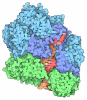
| タイトル | Cryo-EM structure of the DDB1/CRBN-MRT-5702-G3BP2 ternary complex | |||||||||||||||||||||
 要素 要素 |
| |||||||||||||||||||||
 キーワード キーワード | LIGASE / molecular glue degrader / neo-substrate / cereblon / E3 ubiquitin ligase | |||||||||||||||||||||
| 機能・相同性 |  機能・相同性情報 機能・相同性情報: / positive regulation of stress granule assembly / negative regulation of monoatomic ion transmembrane transport / positive regulation by virus of viral protein levels in host cell / spindle assembly involved in female meiosis / epigenetic programming in the zygotic pronuclei / UV-damage excision repair / biological process involved in interaction with symbiont / regulation of mitotic cell cycle phase transition / WD40-repeat domain binding ...: / positive regulation of stress granule assembly / negative regulation of monoatomic ion transmembrane transport / positive regulation by virus of viral protein levels in host cell / spindle assembly involved in female meiosis / epigenetic programming in the zygotic pronuclei / UV-damage excision repair / biological process involved in interaction with symbiont / regulation of mitotic cell cycle phase transition / WD40-repeat domain binding / Cul4A-RING E3 ubiquitin ligase complex / Cul4-RING E3 ubiquitin ligase complex / Cul4B-RING E3 ubiquitin ligase complex / ubiquitin ligase complex scaffold activity / negative regulation of reproductive process / negative regulation of developmental process / locomotory exploration behavior / viral release from host cell / cullin family protein binding / mRNA transport / positive regulation of Wnt signaling pathway / ectopic germ cell programmed cell death / positive regulation of viral genome replication / negative regulation of protein-containing complex assembly / proteasomal protein catabolic process / positive regulation of gluconeogenesis / stress granule assembly / nucleotide-excision repair / molecular condensate scaffold activity / positive regulation of protein-containing complex assembly / Recognition of DNA damage by PCNA-containing replication complex / protein homooligomerization / regulation of circadian rhythm / DNA Damage Recognition in GG-NER / Dual Incision in GG-NER / Transcription-Coupled Nucleotide Excision Repair (TC-NER) / Formation of TC-NER Pre-Incision Complex / Wnt signaling pathway / Formation of Incision Complex in GG-NER / cytoplasmic stress granule / Dual incision in TC-NER / Gap-filling DNA repair synthesis and ligation in TC-NER / positive regulation of protein catabolic process / cellular response to UV / rhythmic process / site of double-strand break / signaling receptor complex adaptor activity / Neddylation / ubiquitin-dependent protein catabolic process / protein-macromolecule adaptor activity / Potential therapeutics for SARS / proteasome-mediated ubiquitin-dependent protein catabolic process / damaged DNA binding / Ras protein signal transduction / transmembrane transporter binding / chromosome, telomeric region / protein ubiquitination / innate immune response / DNA repair / mRNA binding / apoptotic process / DNA damage response / negative regulation of apoptotic process / protein-containing complex binding / nucleolus / perinuclear region of cytoplasm / SARS-CoV-2 activates/modulates innate and adaptive immune responses / protein-containing complex / extracellular space / DNA binding / RNA binding / extracellular exosome / nucleoplasm / metal ion binding / nucleus / membrane / cytosol / cytoplasm 類似検索 - 分子機能 | |||||||||||||||||||||
| 生物種 |  Homo sapiens (ヒト) Homo sapiens (ヒト) | |||||||||||||||||||||
| 手法 | 電子顕微鏡法 / 単粒子再構成法 / クライオ電子顕微鏡法 / 解像度: 2.5 Å | |||||||||||||||||||||
 データ登録者 データ登録者 | Quan, C. / Petzold, G. / Gainza, P. / Tsai, J. / Bunker, R.D. / Wiedmer, L. / Donckele, E.J. | |||||||||||||||||||||
| 資金援助 | 1件
| |||||||||||||||||||||
 引用 引用 | ジャーナル: Nat Struct Mol Biol / 年: 2026 タイトル: Cereblon induces G3BP2 neosubstrate degradation using molecular surface mimicry. 著者: Stefano Annunziato / Chao Quan / Etienne J Donckele / Ilaria Lamberto / Richard D Bunker / Mary Zlotosch / Laura Schwander / Anastasia Murthy / Lars Wiedmer / Camille Staehly / Michelle ...著者: Stefano Annunziato / Chao Quan / Etienne J Donckele / Ilaria Lamberto / Richard D Bunker / Mary Zlotosch / Laura Schwander / Anastasia Murthy / Lars Wiedmer / Camille Staehly / Michelle Matysik / Samuel Gilberto / Despina Kapsitidou / Daric Wible / Gian Marco De Donatis / Peter Trenh / Rohitha SriRamaratnam / Vaik Strande / Raphael Lieberherr / David Lyon / Danielle Steiner / Joao Silva / Reinaldo Almeida / Elena Dolgikh / Bradley DeMarco / Jennifer Tsai / Amine Sadok / Vladislav Zarayskiy / Magnus Walter / Ralph Tiedt / Kevin J Lumb / Debora Bonenfant / Bernhard Fasching / John C Castle / Sharon A Townson / Pablo Gainza / Georg Petzold /  要旨: Molecular glue degraders (MGDs) are small-molecule compounds that divert E3 ligases to degrade nonnatural substrates called neosubstrates. Clinically effective MGDs bind cereblon (CRBN), a substrate ...Molecular glue degraders (MGDs) are small-molecule compounds that divert E3 ligases to degrade nonnatural substrates called neosubstrates. Clinically effective MGDs bind cereblon (CRBN), a substrate receptor of the Cullin 4-RING E3 ubiquitin ligase (CRL4), and recruit neosubstrates to an MGD-induced neosurface on the CRBN CULT domain through molecular mimicry of a natural CRBN degron. Here, we identify G3BP2 (Ras-GAP SH3 domain-binding protein 2), a neosubstrate that bypasses canonical interactions with CRBN by engaging an unconventional binding site on the CRBN LON domain. The ternary complex interface does not resemble known interactions with CRBN. Instead, CRBN leverages a preexisting protein-protein interaction (PPI) hotspot on the target protein by mimicking an endogenous binding partner of G3BP2. Our findings suggest that composite neosurfaces that mimic and stabilize the footprint of natural PPIs (in short, 'glueprints') could become a viable strategy for the rational expansion of the MGD target repertoire. | |||||||||||||||||||||
| 履歴 |
|
- 構造の表示
構造の表示
| 構造ビューア | 分子: MolmilJmol/JSmol |
|---|
- ダウンロードとリンク
-ダウンロード
| PDBx/mmCIF形式 | 9os2.cif.gz | 309.6 KB | 表示 | PDBx/mmCIF形式 |
|---|---|---|---|---|
| PDB形式 | pdb9os2.ent.gz | 表示 | PDB形式 | |
| PDBx/mmJSON形式 | 9os2.json.gz | ツリー表示 | PDBx/mmJSON形式 | |
| その他 |  その他のダウンロード その他のダウンロード |
-検証レポート
| アーカイブディレクトリ | https://data.pdbj.org/pub/pdb/validation_reports/os/9os2ftp://data.pdbj.org/pub/pdb/validation_reports/os/9os2 | HTTPS FTP |
|---|
-関連構造データ

-リンク
 PDBj
PDBj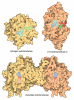

- 集合体
集合体
| 登録構造単位 | 
|
|---|---|
| 1 |
|
-要素
| #1: タンパク質 | 分子量: 43554.090 Da / 分子数: 1 / 由来タイプ: 組換発現 / 由来: (組換発現) Homo sapiens (ヒト) / 遺伝子: CRBN, AD-006発現宿主:   Spodoptera frugiperda (ツマジロクサヨトウ) Spodoptera frugiperda (ツマジロクサヨトウ)参照: UniProt: Q96SW2 | ||||||||
|---|---|---|---|---|---|---|---|---|---|
| #2: タンパク質 | 分子量: 127097.469 Da / 分子数: 1 / 由来タイプ: 組換発現 / 由来: (組換発現) Homo sapiens (ヒト) / 遺伝子: DDB1, XAP1発現宿主: Spodoptera frugiperda (ツマジロクサヨトウ)参照: UniProt: Q16531 | ||||||||
| #3: タンパク質 | 分子量: 54198.070 Da / 分子数: 2 / 由来タイプ: 組換発現 / 由来: (組換発現) Homo sapiens (ヒト) / 遺伝子: G3BP2, KIAA0660 / 発現宿主:   Escherichia coli (大腸菌) / 参照: UniProt: Q9UN86 Escherichia coli (大腸菌) / 参照: UniProt: Q9UN86#4: 化合物 | ChemComp-ZN / |   分子量: 65.409 Da / 分子数: 1 / 由来タイプ: 合成 / 式: Zn 分子量: 65.409 Da / 分子数: 1 / 由来タイプ: 合成 / 式: Zn#5: 化合物 | ChemComp-A1CED / ( | 分子量: 621.106 Da / 分子数: 1 / 由来タイプ: 合成 / 式: C30H29ClN6O5S / タイプ: SUBJECT OF INVESTIGATION 研究の焦点であるリガンドがあるか | Y | Has protein modification | Y | |
-実験情報
-実験
| 実験 | 手法: 電子顕微鏡法 |
|---|---|
| EM実験 | 試料の集合状態: PARTICLE / 3次元再構成法: 単粒子再構成法 |
- 試料調製
試料調製
| 構成要素 | 名称: DDB1/CRBN-MRT-5702-G3BP2 ternary complex / タイプ: COMPLEX / Entity ID: #1-#3 / 由来: RECOMBINANT |
|---|---|
| 分子量 | 実験値: NO |
| 由来(天然) | 生物種: Homo sapiens (ヒト) |
| 由来(組換発現) | 生物種: Spodoptera frugiperda (ツマジロクサヨトウ) |
| 緩衝液 | pH: 7.4 |
| 試料 | 包埋: NO / シャドウイング: NO / 染色: NO / 凍結: YES |
| 試料支持 | グリッドの材料: GOLD / グリッドのサイズ: 300 divisions/in. / グリッドのタイプ: C-flat-1.2/1.3 |
| 急速凍結 | 装置: FEI VITROBOT MARK IV / 凍結剤: ETHANE / 湿度: 100 % / 凍結前の試料温度: 277 K |
- 電子顕微鏡撮影
| 実験機器 |  モデル: Titan Krios / 画像提供: FEI Company |
|---|---|
| 顕微鏡 | モデル: TFS KRIOS |
| 電子銃 | 電子線源:  FIELD EMISSION GUN / 加速電圧: 300 kV / 照射モード: FLOOD BEAM FIELD EMISSION GUN / 加速電圧: 300 kV / 照射モード: FLOOD BEAM |
| 電子レンズ | モード: BRIGHT FIELD / 倍率(公称値): 130000 X / 最大 デフォーカス(公称値): 2000 nm / 最小 デフォーカス(公称値): 300 nm / Cs: 2.7 mm / C2レンズ絞り径: 50 µm |
| 試料ホルダ | 凍結剤: NITROGEN 試料ホルダーモデル: FEI TITAN KRIOS AUTOGRID HOLDER |
| 撮影 | 電子線照射量: 50.5056 e/Å2 フィルム・検出器のモデル: GATAN K3 BIOQUANTUM (6k x 4k) |
- 解析
解析
| EMソフトウェア | 名称: PHENIX / バージョン: 1.21_5207 / カテゴリ: モデル精密化 | ||||||||||||||||||||||||
|---|---|---|---|---|---|---|---|---|---|---|---|---|---|---|---|---|---|---|---|---|---|---|---|---|---|
| CTF補正 | タイプ: NONE | ||||||||||||||||||||||||
| 3次元再構成 | 解像度: 2.5 Å / 解像度の算出法: FSC 0.143 CUT-OFF / 粒子像の数: 565661 / 対称性のタイプ: POINT | ||||||||||||||||||||||||
| 精密化 | 最高解像度: 2.5 Å 立体化学のターゲット値: REAL-SPACE (WEIGHTED MAP SUM AT ATOM CENTERS) | ||||||||||||||||||||||||
| 拘束条件 |
|
