[English] 日本語
Yorodumi
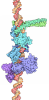
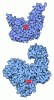
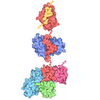
- PDB-9n7f: HsSTING with cGAMP/C53/DCA -

+
Open data


ID or keywords:

Loading...

-
Basic information

Entry
Database: PDB / ID: 9n7f
TitleHsSTING with cGAMP/C53/DCA
ComponentsStimulator of interferon genes protein
KeywordsIMMUNE SYSTEM / Innate immunity / membrane protein
Function / homology
Function and homology information


STING complex / STAT6-mediated induction of chemokines / protein localization to endoplasmic reticulum / 2',3'-cyclic GMP-AMP binding / cyclic-di-GMP binding / STING mediated induction of host immune responses / serine/threonine protein kinase complex / positive regulation of type I interferon-mediated signaling pathway / IRF3-mediated induction of type I IFN / cGAS/STING signaling pathway ...STING complex / STAT6-mediated induction of chemokines / protein localization to endoplasmic reticulum / 2',3'-cyclic GMP-AMP binding / cyclic-di-GMP binding / STING mediated induction of host immune responses / serine/threonine protein kinase complex / positive regulation of type I interferon-mediated signaling pathway / IRF3-mediated induction of type I IFN / cGAS/STING signaling pathway / proton channel activity / reticulophagy / pattern recognition receptor signaling pathway / cytoplasmic pattern recognition receptor signaling pathway / cellular response to exogenous dsRNA / protein complex oligomerization / autophagosome membrane / positive regulation of macroautophagy / autophagosome assembly / : / cellular response to interferon-beta / positive regulation of type I interferon production / positive regulation of defense response to virus by host / endoplasmic reticulum-Golgi intermediate compartment membrane / signaling adaptor activity / antiviral innate immune response / activation of innate immune response / positive regulation of interferon-beta production / autophagosome / protein serine/threonine kinase binding / Regulation of innate immune responses to cytosolic DNA / secretory granule membrane / cytoplasmic vesicle membrane / SARS-CoV-1 activates/modulates innate immune responses / peroxisome / regulation of inflammatory response / defense response to virus / DNA-binding transcription factor binding / RNA polymerase II-specific DNA-binding transcription factor binding / mitochondrial outer membrane / endosome / cilium / ciliary basal body / Golgi membrane / innate immune response / ubiquitin protein ligase binding / Neutrophil degranulation / protein kinase binding / endoplasmic reticulum membrane / perinuclear region of cytoplasm / SARS-CoV-2 activates/modulates innate and adaptive immune responses / protein homodimerization activity / positive regulation of transcription by RNA polymerase II / nucleoplasm / identical protein binding / plasma membrane / cytosol
Similarity search - Function
: / STING transmembrane domain / : / : / Stimulator of interferon genes protein / Stimulator of interferon genes protein, C-terminal domain superfamily / STING ligand-binding domain
Similarity search - Domain/homology
cGAMP / Chem-9IM / Stimulator of interferon genes protein
Similarity search - Component
Biological speciesHomo sapiens (human)
MethodELECTRON MICROSCOPY / single particle reconstruction / cryo EM / Resolution: 2.93 Å
AuthorsGharpure, A. / Ward, A.B.
Funding support United States, 1items
OrganizationGrant numberCountry
National Institutes of Health/National Institute Of Allergy and Infectious Diseases (NIH/NIAID)1R01AI182439-01A1 United States
CitationJournal: To Be Published
Title: Microbiota-derived secondary bile acids promote STING activation and antitumor activity
Authors: Yang, X. / Zhang, X. / Li, W. / Gharpure, A. / Hansel, A. / Tillack, A. / Wu, C. / Hsieh, Y. / Sulpizio, A. / Dikiy, S. / Zhao, X. / Forli, S. / Ward, A.B. / Parker, C.G. / Hang, H.C.
History
DepositionFeb 5, 2025Deposition site: RCSB / Processing site: RCSB
Revision 1.0Feb 18, 2026Provider: repository / Type: Initial release
Revision 1.0Feb 18, 2026Data content type: EM metadata / Data content type: EM metadata / Provider: repository / Type: Initial release
Revision 1.0Feb 18, 2026Data content type: Additional map / Part number: 1 / Data content type: Additional map / Provider: repository / Type: Initial release
Revision 1.0Feb 18, 2026Data content type: Half map / Part number: 1 / Data content type: Half map / Provider: repository / Type: Initial release
Revision 1.0Feb 18, 2026Data content type: Half map / Part number: 2 / Data content type: Half map / Provider: repository / Type: Initial release
Revision 1.0Feb 18, 2026Data content type: Image / Data content type: Image / Provider: repository / Type: Initial release
Revision 1.0Feb 18, 2026Data content type: Primary map / Data content type: Primary map / Provider: repository / Type: Initial release

-
Structure visualization

Structure viewerMolecule:
MolmilJmol/JSmol

Downloads & links

-
Assembly

Deposited unit
A: Stimulator of interferon genes protein
B: Stimulator of interferon genes protein
C: Stimulator of interferon genes protein
D: Stimulator of interferon genes protein
hetero molecules


Theoretical massNumber of molelcules
Total (without water)163,3158
Polymers160,9844
Non-polymers2,3314
Water00
1


  • Idetical with deposited unit
  • defined by author
  • Evidence: electron microscopy
TypeNameSymmetry operationNumber
identity operation1_5551

-
Components

#1: Protein
Stimulator of interferon genes protein / hSTING / Endoplasmic reticulum interferon stimulator / ERIS / Mediator of IRF3 activation / hMITA / ...hSTING / Endoplasmic reticulum interferon stimulator / ERIS / Mediator of IRF3 activation / hMITA / Transmembrane protein 173


Mass: 40246.000 Da / Num. of mol.: 4
Source method: isolated from a genetically manipulated source
Source: (gene. exp.) Homo sapiens (human) / Gene: STING1, ERIS, MITA, STING, TMEM173 / Cell line (production host): HEK 293F / Production host: Homo sapiens (human) / References: UniProt: Q86WV6
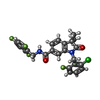
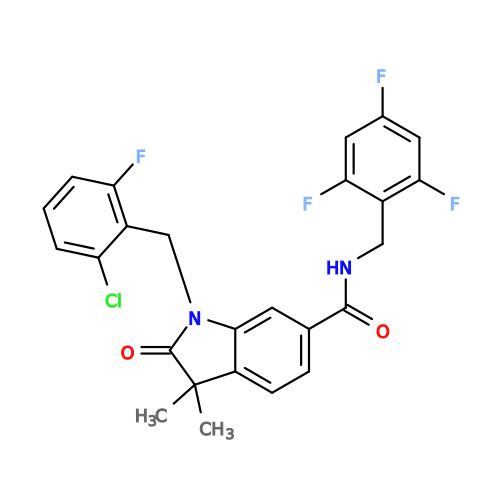
#2: Chemical ChemComp-9IM / 1-[(2-chloro-6-fluorophenyl)methyl]-3,3-dimethyl-2-oxo-N-[(2,4,6-trifluorophenyl)methyl]-2,3-dihydro-1H-indole-6-carboxamide


Mass: 490.877 Da / Num. of mol.: 2 / Source method: obtained synthetically / Formula: C25H19ClF4N2O2
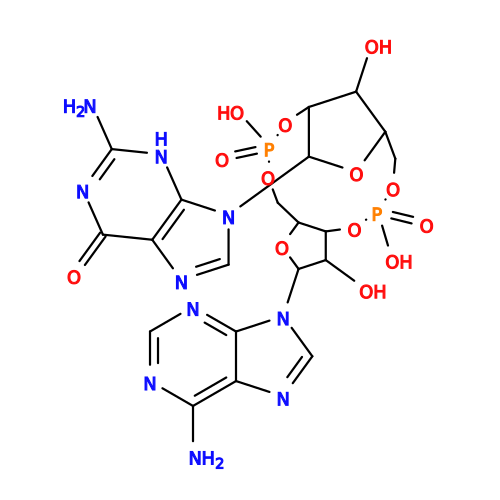
#3: Chemical ChemComp-1SY / cGAMP / 2',3' cGAMP / c-GMP-AMP / c[G(2',5')pA(3',5')p]


Mass: 674.411 Da / Num. of mol.: 2 / Source method: obtained synthetically / Formula: C20H24N10O13P2
Has ligand of interestN
Has protein modificationN

-
Experimental details

-
Experiment

ExperimentMethod: ELECTRON MICROSCOPY
EM experimentAggregation state: PARTICLE / 3D reconstruction method: single particle reconstruction

-
Sample preparation

ComponentName: Stimulator of interferon genes / Type: COMPLEX / Entity ID: #1 / Source: RECOMBINANT
Molecular weightValue: 0.40 MDa / Experimental value: NO
Source (natural)Organism: Homo sapiens (human)
Source (recombinant)Organism: Homo sapiens (human) / Strain: HEK293F
Buffer solutionpH: 7.4
Buffer component
IDConc.NameFormulaBuffer-ID
120 mMTrisC4H11NO31
2150 mMSodium ChlorideNaCl1
30.5 mMTCEPC9H15O6P1
40.02 %Dodecyl maltosideC24H46O111
50.004 %Cholesteryl hemisuccinateC31H50O41
60.1 mMDeoxycholic acidC24H40O41
SpecimenConc.: 8 mg/ml / Embedding applied: NO / Shadowing applied: NO / Staining applied: NO / Vitrification applied: YES
Specimen supportGrid material: GOLD / Grid mesh size: 300 divisions/in. / Grid type: UltrAuFoil R1.2/1.3
VitrificationInstrument: FEI VITROBOT MARK IV / Cryogen name: ETHANE / Humidity: 100 % / Chamber temperature: 277 K

-
Electron microscopy imaging

MicroscopyModel: TFS GLACIOS
Electron gunElectron source: FIELD EMISSION GUN / Accelerating voltage: 200 kV / Illumination mode: SPOT SCAN
Electron lensMode: OTHER / Nominal magnification: 190000 X / Nominal defocus max: 1500 nm / Nominal defocus min: 600 nm / Cs: 2.7 mm / C2 aperture diameter: 20 µm
Specimen holderCryogen: NITROGEN
Image recordingAverage exposure time: 3.2 sec. / Electron dose: 45.12 e/Å2 / Film or detector model: TFS FALCON 4i (4k x 4k) / Num. of real images: 5839

-
Processing

EM software
IDNameCategory
1cryoSPARCparticle selection
2EPUimage acquisition
4cryoSPARCCTF correction
7Cootmodel fitting
9PHENIXmodel refinement
10cryoSPARCinitial Euler assignment
11cryoSPARCfinal Euler assignment
12cryoSPARCclassification
13cryoSPARC3D reconstruction
CTF correctionType: PHASE FLIPPING AND AMPLITUDE CORRECTION
SymmetryPoint symmetry: C2 (2 fold cyclic)
3D reconstructionResolution: 2.93 Å / Resolution method: FSC 0.143 CUT-OFF / Num. of particles: 284997 / Symmetry type: POINT
Atomic model buildingProtocol: FLEXIBLE FIT / Space: REAL
Atomic model buildingPDB-ID: 7SII
Accession code: 7SII / Source name: PDB / Type: experimental model
RefinementHighest resolution: 2.93 Å
Stereochemistry target values: REAL-SPACE (WEIGHTED MAP SUM AT ATOM CENTERS)
Refine LS restraints
Refine-IDTypeDev idealNumber
ELECTRON MICROSCOPYf_bond_d0.00210546
ELECTRON MICROSCOPYf_angle_d0.53214354
ELECTRON MICROSCOPYf_dihedral_angle_d4.0771448
ELECTRON MICROSCOPYf_chiral_restr0.0371594
ELECTRON MICROSCOPYf_plane_restr0.0051814

+
About Yorodumi

-
News

-
Feb 9, 2022. New format data for meta-information of EMDB entries

New format data for meta-information of EMDB entries

  • Version 3 of the EMDB header file is now the official format.
  • The previous official version 1.9 will be removed from the archive.

Related info.:EMDB header

External links:wwPDB to switch to version 3 of the EMDB data model

-
Aug 12, 2020. Covid-19 info

Covid-19 info

URL: https://pdbj.org/emnavi/covid19.php

New page: Covid-19 featured information page in EM Navigator.

Related info.:Covid-19 info / Mar 5, 2020. Novel coronavirus structure data

+
Mar 5, 2020. Novel coronavirus structure data

Novel coronavirus structure data

Related info.:Yorodumi Speices / Aug 12, 2020. Covid-19 info

External links:COVID-19 featured content - PDBj / Molecule of the Month (242):Coronavirus Proteases

+
Jan 31, 2019. EMDB accession codes are about to change! (news from PDBe EMDB page)

EMDB accession codes are about to change! (news from PDBe EMDB page)

  • The allocation of 4 digits for EMDB accession codes will soon come to an end. Whilst these codes will remain in use, new EMDB accession codes will include an additional digit and will expand incrementally as the available range of codes is exhausted. The current 4-digit format prefixed with “EMD-” (i.e. EMD-XXXX) will advance to a 5-digit format (i.e. EMD-XXXXX), and so on. It is currently estimated that the 4-digit codes will be depleted around Spring 2019, at which point the 5-digit format will come into force.
  • The EM Navigator/Yorodumi systems omit the EMD- prefix.

Related info.:Q: What is EMD? / ID/Accession-code notation in Yorodumi/EM Navigator

External links:EMDB Accession Codes are Changing Soon! / Contact to PDBj

+
Jul 12, 2017. Major update of PDB

Major update of PDB

  • wwPDB released updated PDB data conforming to the new PDBx/mmCIF dictionary.
  • This is a major update changing the version number from 4 to 5, and with Remediation, in which all the entries are updated.
  • In this update, many items about electron microscopy experimental information are reorganized (e.g. em_software).
  • Now, EM Navigator and Yorodumi are based on the updated data.

External links:wwPDB Remediation / Enriched Model Files Conforming to OneDep Data Standards Now Available in the PDB FTP Archive

-
Yorodumi

Thousand views of thousand structures

  • Yorodumi is a browser for structure data from EMDB, PDB, SASBDB, etc.
  • This page is also the successor to EM Navigator detail page, and also detail information page/front-end page for Omokage search.
  • The word "yorodu" (or yorozu) is an old Japanese word meaning "ten thousand". "mi" (miru) is to see.

Related info.:EMDB / PDB / SASBDB / Comparison of 3 databanks / Yorodumi Search / Aug 31, 2016. New EM Navigator & Yorodumi / Yorodumi Papers / Jmol/JSmol / Function and homology information / Changes in new EM Navigator and Yorodumi

Read more