 ムービー
ムービー コントローラー


+ データを開く

- 基本情報
基本情報
| 登録情報 | データベース: PDB / ID: 9gaw | |||||||||
|---|---|---|---|---|---|---|---|---|---|---|
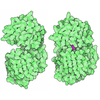
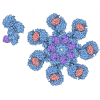
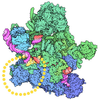
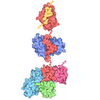
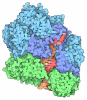
| タイトル | High-resolution structure of the Anaphase-promoting complex/cyclosome (APC/C) bound to co-activator Cdh1 | |||||||||
 要素 要素 |
| |||||||||
 キーワード キーワード | CELL CYCLE / APC/C / cyclosome / Cdc20 / Cdh1 / ubiquitination / Emi1 / mitosis | |||||||||
| 機能・相同性 |  機能・相同性情報 機能・相同性情報negative regulation of DNA endoreduplication / positive regulation of biomineral tissue development / negative regulation of meiotic nuclear division / positive regulation of mesenchymal stem cell migration / negative regulation of mitotic metaphase/anaphase transition / positive regulation of ubiquitin protein ligase activity / negative regulation of ubiquitin protein ligase activity / positive regulation of anaphase-promoting complex-dependent catabolic process / positive regulation of synapse maturation / negative regulation of ubiquitin-protein transferase activity ...negative regulation of DNA endoreduplication / positive regulation of biomineral tissue development / negative regulation of meiotic nuclear division / positive regulation of mesenchymal stem cell migration / negative regulation of mitotic metaphase/anaphase transition / positive regulation of ubiquitin protein ligase activity / negative regulation of ubiquitin protein ligase activity / positive regulation of anaphase-promoting complex-dependent catabolic process / positive regulation of synapse maturation / negative regulation of ubiquitin-protein transferase activity / Mitotic Metaphase/Anaphase Transition / regulation of meiotic nuclear division / Conversion from APC/C:Cdc20 to APC/C:Cdh1 in late anaphase / regulation of mitotic cell cycle spindle assembly checkpoint / Inactivation of APC/C via direct inhibition of the APC/C complex / APC/C:Cdc20 mediated degradation of mitotic proteins / anaphase-promoting complex / Phosphorylation of Emi1 / Aberrant regulation of mitotic exit in cancer due to RB1 defects / anaphase-promoting complex-dependent catabolic process / regulation of meiotic cell cycle / protein branched polyubiquitination / lens fiber cell differentiation / vesicle organization / metaphase/anaphase transition of mitotic cell cycle / Phosphorylation of the APC/C / anaphase-promoting complex binding / regulation of exit from mitosis / spindle assembly involved in female meiosis I / positive regulation of synaptic plasticity / positive regulation of dendrite morphogenesis / positive regulation of mitotic metaphase/anaphase transition / protein K11-linked ubiquitination / oocyte maturation / meiotic spindle / ubiquitin ligase activator activity / regulation of mitotic metaphase/anaphase transition / molecular function inhibitor activity / ubiquitin-ubiquitin ligase activity / mitotic metaphase chromosome alignment / regulation of mitotic nuclear division / G1/S-Specific Transcription / mitotic G2 DNA damage checkpoint signaling / Regulation of APC/C activators between G1/S and early anaphase / regulation of DNA replication / microtubule polymerization / Transcriptional Regulation by VENTX / negative regulation of cellular senescence / cullin family protein binding / positive regulation of G2/M transition of mitotic cell cycle / positive regulation of osteoblast differentiation / enzyme-substrate adaptor activity / ubiquitin ligase inhibitor activity / positive regulation of axon extension / Cyclin A:Cdk2-associated events at S phase entry / intercellular bridge / Cyclin A/B1/B2 associated events during G2/M transition / ubiquitin-like ligase-substrate adaptor activity / heterochromatin / protein K48-linked ubiquitination / nuclear periphery / regulation of mitotic cell cycle / APC/C:Cdc20 mediated degradation of Cyclin B / APC-Cdc20 mediated degradation of Nek2A / Autodegradation of Cdh1 by Cdh1:APC/C / APC/C:Cdc20 mediated degradation of Securin / SCF-beta-TrCP mediated degradation of Emi1 / Assembly of the pre-replicative complex / Cdc20:Phospho-APC/C mediated degradation of Cyclin A / brain development / APC/C:Cdh1 mediated degradation of Cdc20 and other APC/C:Cdh1 targeted proteins in late mitosis/early G1 / G protein-coupled receptor binding / kinetochore / CDK-mediated phosphorylation and removal of Cdc6 / spindle / neuron projection development / ubiquitin-protein transferase activity / mitotic spindle / Separation of Sister Chromatids / ubiquitin protein ligase activity / nervous system development / mitotic cell cycle / Antigen processing: Ubiquitination & Proteasome degradation / microtubule cytoskeleton / Senescence-Associated Secretory Phenotype (SASP) / protein phosphatase binding / nuclear membrane / molecular adaptor activity / ubiquitin-dependent protein catabolic process / cell differentiation / protein ubiquitination / negative regulation of gene expression / cell division / DNA repair / positive regulation of cell population proliferation / DNA damage response / ubiquitin protein ligase binding / centrosome / protein kinase binding / nucleolus 類似検索 - 分子機能 | |||||||||
| 生物種 |  Homo sapiens (ヒト) Homo sapiens (ヒト) | |||||||||
| 手法 | 電子顕微鏡法 / 単粒子再構成法 / クライオ電子顕微鏡法 / 解像度: 2.9 Å | |||||||||
 データ登録者 データ登録者 | Hoefler, A. / Yu, J. / Chang, L. / Zhang, Z. / Yang, J. / Boland, A. / Barford, D. | |||||||||
| 資金援助 |  スイス, スイス,  英国, 2件 英国, 2件
| |||||||||
 引用 引用 | ジャーナル: Nat Commun / 年: 2024 タイトル: Cryo-EM structures of apo-APC/C and APC/C complexes provide insights into APC/C regulation. 著者: Anna Höfler / Jun Yu / Jing Yang / Ziguo Zhang / Leifu Chang / Stephen H McLaughlin / Geoffrey W Grime / Elspeth F Garman / Andreas Boland / David Barford / 要旨: APC/C is a multi-subunit complex that functions as a master regulator of cell division. It controls progression through the cell cycle by timely marking mitotic cyclins and other cell cycle ...APC/C is a multi-subunit complex that functions as a master regulator of cell division. It controls progression through the cell cycle by timely marking mitotic cyclins and other cell cycle regulatory proteins for degradation. The APC/C itself is regulated by the sequential action of its coactivator subunits CDC20 and CDH1, post-translational modifications, and its inhibitory binding partners EMI1 and the mitotic checkpoint complex. In this study, we took advantage of developments in cryo-electron microscopy to determine the structures of human APC/C and apo-APC/C at 2.9 Å and 3.2 Å resolution, respectively, providing insights into the regulation of APC/C activity. The high-resolution maps allow the unambiguous assignment of an α-helix to the N-terminus of CDH1 (CDH1) in the APC/C ternary complex. We also identify a zinc-binding module in APC2 that confers structural stability to the complex, and we confirm the presence of zinc ions experimentally. Finally, due to the higher resolution and well defined density of these maps, we are able to build, aided by AlphaFold predictions, several intrinsically disordered regions in different APC/C subunits that likely play a role in proper APC/C assembly and regulation of its activity. | |||||||||
| 履歴 |
|
- 構造の表示
構造の表示
| 構造ビューア | 分子: MolmilJmol/JSmol |
|---|
- ダウンロードとリンク
-ダウンロード
| PDBx/mmCIF形式 | 9gaw.cif.gz | 1.6 MB | 表示 | PDBx/mmCIF形式 |
|---|---|---|---|---|
| PDB形式 | pdb9gaw.ent.gz | 1.3 MB | 表示 | PDB形式 |
| PDBx/mmJSON形式 | 9gaw.json.gz | ツリー表示 | PDBx/mmJSON形式 | |
| その他 |  その他のダウンロード その他のダウンロード |
-検証レポート
| アーカイブディレクトリ | https://data.pdbj.org/pub/pdb/validation_reports/ga/9gawftp://data.pdbj.org/pub/pdb/validation_reports/ga/9gaw | HTTPS FTP |
|---|
-関連構造データ





-リンク
 PDBj
PDBj
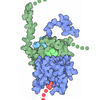
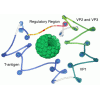
- 集合体
集合体
| 登録構造単位 | 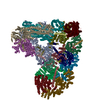
|
|---|---|
| 1 |
|
-要素
-Anaphase-promoting complex subunit ... , 11種, 13分子 LDANIOGWMHYZC
| #1: タンパク質 | 分子量: 21282.143 Da / 分子数: 1 / 由来タイプ: 組換発現 / 由来: (組換発現) Homo sapiens (ヒト) / 遺伝子: ANAPC10, APC10 / 発現宿主:  Trichoplusia ni (イラクサキンウワバ) / 参照: UniProt: Q9UM13 Trichoplusia ni (イラクサキンウワバ) / 参照: UniProt: Q9UM13 | ||||||||
|---|---|---|---|---|---|---|---|---|---|
| #2: タンパク質 | 分子量: 14286.727 Da / 分子数: 1 / 由来タイプ: 組換発現 / 由来: (組換発現) Homo sapiens (ヒト) / 遺伝子: ANAPC15, C11orf51, HSPC020 / 発現宿主: Trichoplusia ni (イラクサキンウワバ) / 参照: UniProt: P60006 | ||||||||
| #3: タンパク質 | 分子量: 216725.469 Da / 分子数: 1 / 由来タイプ: 組換発現 / 由来: (組換発現) Homo sapiens (ヒト) / 遺伝子: ANAPC1, TSG24 / 発現宿主: Trichoplusia ni (イラクサキンウワバ) / 参照: UniProt: Q9H1A4 | ||||||||
| #4: タンパク質 | 分子量: 93938.977 Da / 分子数: 1 / 由来タイプ: 組換発現 / 由来: (組換発現) Homo sapiens (ヒト) / 遺伝子: ANAPC2, APC2, KIAA1406 / 発現宿主: Trichoplusia ni (イラクサキンウワバ) / 参照: UniProt: Q9UJX6 | ||||||||
| #5: タンパク質 | 分子量: 93014.070 Da / 分子数: 1 / 由来タイプ: 組換発現 / 由来: (組換発現) Homo sapiens (ヒト) / 遺伝子: ANAPC4, APC4 / 発現宿主: Trichoplusia ni (イラクサキンウワバ) / 株 (発現宿主): ANAPC4 / 参照: UniProt: Q9UJX5 | ||||||||
| #6: タンパク質 | 分子量: 85179.766 Da / 分子数: 1 / 由来タイプ: 組換発現 / 由来: (組換発現) Homo sapiens (ヒト) / 遺伝子: ANAPC5, APC5 / 発現宿主: Trichoplusia ni (イラクサキンウワバ) / 株 (発現宿主): APC4 / 参照: UniProt: Q9UJX4 | ||||||||
| #9: タンパク質 | 分子量: 9793.999 Da / 分子数: 2 / 由来タイプ: 組換発現 / 由来: (組換発現) Homo sapiens (ヒト) / 遺伝子: CDC26, ANAPC12, C9orf17 / 発現宿主: Trichoplusia ni (イラクサキンウワバ) / 参照: UniProt: Q8NHZ8#10: タンパク質 | | 分子量: 8528.309 Da / 分子数: 1 / 由来タイプ: 組換発現 / 由来: (組換発現) Homo sapiens (ヒト) / 遺伝子: ANAPC13 / 発現宿主: Trichoplusia ni (イラクサキンウワバ) / 参照: UniProt: Q9BS18#11: タンパク質 | | 分子量: 11677.995 Da / 分子数: 1 / 由来タイプ: 組換発現 / 由来: (組換発現) Homo sapiens (ヒト) / 遺伝子: ANAPC16, C10orf104, CENP-27 / 発現宿主: Trichoplusia ni (イラクサキンウワバ) / 参照: UniProt: Q96DE5#13: タンパク質 | 分子量: 66929.367 Da / 分子数: 2 / 由来タイプ: 組換発現 / 由来: (組換発現) Homo sapiens (ヒト) / 遺伝子: ANAPC7, APC7 / 発現宿主: Trichoplusia ni (イラクサキンウワバ) / 参照: UniProt: Q9UJX3#16: タンパク質 | | 分子量: 9854.647 Da / 分子数: 1 / 由来タイプ: 組換発現 / 由来: (組換発現) Homo sapiens (ヒト) / 遺伝子: ANAPC11, HSPC214 / 発現宿主: Trichoplusia ni (イラクサキンウワバ) / 参照: UniProt: Q9NYG5 |
-タンパク質 , 2種, 2分子 SR
| #7: タンパク質 | 分子量: 50227.488 Da / 分子数: 1 / 由来タイプ: 組換発現 / 由来: (組換発現) Homo sapiens (ヒト) / 遺伝子: FBXO5, EMI1, FBX5 / 発現宿主:   Escherichia coli (大腸菌) / 参照: UniProt: Q9UKT4 Escherichia coli (大腸菌) / 参照: UniProt: Q9UKT4 |
|---|---|
| #15: タンパク質 | 分子量: 55253.207 Da / 分子数: 1 / 由来タイプ: 組換発現 / 由来: (組換発現) Homo sapiens (ヒト) / 遺伝子: FZR1, CDH1, FYR, FZR, KIAA1242 / 発現宿主: Trichoplusia ni (イラクサキンウワバ) / 参照: UniProt: Q9UM11 |
-Cell division cycle protein ... , 3種, 6分子 KQJPUV
| #8: タンパク質 | 分子量: 71747.516 Da / 分子数: 2 / 由来タイプ: 組換発現 / 由来: (組換発現) Homo sapiens (ヒト) / 遺伝子: CDC16, ANAPC6 / 発現宿主: Trichoplusia ni (イラクサキンウワバ) / 参照: UniProt: Q13042#12: タンパク質 | 分子量: 91973.125 Da / 分子数: 2 / 由来タイプ: 組換発現 / 由来: (組換発現) Homo sapiens (ヒト) / 遺伝子: CDC27, ANAPC3, D0S1430E, D17S978E / 発現宿主: Trichoplusia ni (イラクサキンウワバ) / 参照: UniProt: P30260#14: タンパク質 | 分子量: 68921.031 Da / 分子数: 2 / 由来タイプ: 組換発現 / 由来: (組換発現) Homo sapiens (ヒト) / 遺伝子: CDC23, ANAPC8 / 発現宿主: Trichoplusia ni (イラクサキンウワバ) / 参照: UniProt: Q9UJX2 |
|---|
-非ポリマー , 1種, 6分子 
| #17: 化合物 | ChemComp-ZN /  分子量: 65.409 Da / 分子数: 6 / 由来タイプ: 合成 / 式: Zn / タイプ: SUBJECT OF INVESTIGATION 分子量: 65.409 Da / 分子数: 6 / 由来タイプ: 合成 / 式: Zn / タイプ: SUBJECT OF INVESTIGATION |
|---|
-詳細
| 研究の焦点であるリガンドがあるか | Y |
|---|---|
| Has protein modification | N |
-実験情報
-実験
| 実験 | 手法: 電子顕微鏡法 |
|---|---|
| EM実験 | 試料の集合状態: PARTICLE / 3次元再構成法: 単粒子再構成法 |
- 試料調製
試料調製
| 構成要素 | 名称: Anaphase-promoting complex (APC/C) bound to co-activator Cdh1 タイプ: COMPLEX / Entity ID: #1-#14 / 由来: RECOMBINANT | ||||||||||||||||||||
|---|---|---|---|---|---|---|---|---|---|---|---|---|---|---|---|---|---|---|---|---|---|
| 分子量 | 値: 1.2 MDa / 実験値: NO | ||||||||||||||||||||
| 由来(天然) | 生物種: Homo sapiens (ヒト) | ||||||||||||||||||||
| 由来(組換発現) | 生物種: Trichoplusia ni (イラクサキンウワバ) | ||||||||||||||||||||
| 緩衝液 | pH: 8 | ||||||||||||||||||||
| 緩衝液成分 |
| ||||||||||||||||||||
| 試料 | 濃度: 0.1 mg/ml / 包埋: NO / シャドウイング: NO / 染色: NO / 凍結: YES | ||||||||||||||||||||
| 試料支持 | グリッドの材料: COPPER / グリッドのタイプ: Quantifoil R2/2 | ||||||||||||||||||||
| 急速凍結 | 装置: FEI VITROBOT MARK III / 凍結剤: ETHANE / 湿度: 100 % / 凍結前の試料温度: 277.15 K |
- 電子顕微鏡撮影
| 実験機器 |  モデル: Titan Krios / 画像提供: FEI Company |
|---|---|
| 顕微鏡 | モデル: FEI TITAN KRIOS |
| 電子銃 | 電子線源:  FIELD EMISSION GUN / 加速電圧: 300 kV / 照射モード: FLOOD BEAM FIELD EMISSION GUN / 加速電圧: 300 kV / 照射モード: FLOOD BEAM |
| 電子レンズ | モード: BRIGHT FIELD / 最大 デフォーカス(公称値): 3500 nm / 最小 デフォーカス(公称値): 1500 nm / Cs: 2.7 mm / アライメント法: COMA FREE |
| 試料ホルダ | 凍結剤: NITROGEN / 試料ホルダーモデル: OTHER |
| 撮影 | 電子線照射量: 40 e/Å2 / 検出モード: COUNTING フィルム・検出器のモデル: FEI FALCON III (4k x 4k) 実像数: 8297 |
| 画像スキャン | 横: 4096 / 縦: 4096 |
- 解析
解析
| EMソフトウェア |
| |||||||||||||||||||||||||||||||||||||||||||||||||||||||
|---|---|---|---|---|---|---|---|---|---|---|---|---|---|---|---|---|---|---|---|---|---|---|---|---|---|---|---|---|---|---|---|---|---|---|---|---|---|---|---|---|---|---|---|---|---|---|---|---|---|---|---|---|---|---|---|---|
| CTF補正 | タイプ: PHASE FLIPPING AND AMPLITUDE CORRECTION | |||||||||||||||||||||||||||||||||||||||||||||||||||||||
| 粒子像の選択 | 選択した粒子像数: 1800000 / 詳細: The particles were automatically selected | |||||||||||||||||||||||||||||||||||||||||||||||||||||||
| 3次元再構成 | 解像度: 2.9 Å / 解像度の算出法: FSC 0.143 CUT-OFF / 粒子像の数: 364331 / 対称性のタイプ: POINT | |||||||||||||||||||||||||||||||||||||||||||||||||||||||
| 原子モデル構築 | B value: 80 / プロトコル: RIGID BODY FIT / 空間: REAL | |||||||||||||||||||||||||||||||||||||||||||||||||||||||
| 原子モデル構築 | PDB-ID: 4UI9 Accession code: 4UI9 / Source name: PDB / タイプ: experimental model |

