 ムービー
ムービー コントローラー


+ データを開く

- 基本情報
基本情報
| 登録情報 | データベース: PDB / ID: 9.0E+28 | |||||||||||||||||||||||||||
|---|---|---|---|---|---|---|---|---|---|---|---|---|---|---|---|---|---|---|---|---|---|---|---|---|---|---|---|---|
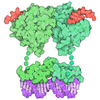
| タイトル | Cryo-EM structure of Phi dynein tail | |||||||||||||||||||||||||||
 要素 要素 |
| |||||||||||||||||||||||||||
 キーワード キーワード | MOTOR PROTEIN / human / complex | |||||||||||||||||||||||||||
| 機能・相同性 |  機能・相同性情報 機能・相同性情報intracellular transport of viral protein in host cell / nitric-oxide synthase inhibitor activity / negative regulation of DNA strand resection involved in replication fork processing / secretory vesicle / negative regulation of phosphorylation / intraciliary retrograde transport / visual behavior / dynein light chain binding / transport along microtubule / dynein heavy chain binding ...intracellular transport of viral protein in host cell / nitric-oxide synthase inhibitor activity / negative regulation of DNA strand resection involved in replication fork processing / secretory vesicle / negative regulation of phosphorylation / intraciliary retrograde transport / visual behavior / dynein light chain binding / transport along microtubule / dynein heavy chain binding / Activation of BIM and translocation to mitochondria / motile cilium assembly / Intraflagellar transport / positive regulation of intracellular transport / regulation of metaphase plate congression / positive regulation of spindle assembly / negative regulation of nitric oxide biosynthetic process / establishment of spindle localization / regulation of G protein-coupled receptor signaling pathway / microtubule-dependent intracellular transport of viral material towards nucleus / retrograde axonal transport / COPI-independent Golgi-to-ER retrograde traffic / P-body assembly / minus-end-directed microtubule motor activity / centrosome localization / dynein light intermediate chain binding / cytoplasmic dynein complex / microtubule motor activity / microtubule-based movement / nuclear migration / Macroautophagy / establishment of mitotic spindle orientation / dynein intermediate chain binding / tertiary granule membrane / ficolin-1-rich granule membrane / spermatid development / COPI-mediated anterograde transport / cytoplasmic microtubule / cytoplasmic microtubule organization / Amplification of signal from unattached kinetochores via a MAD2 inhibitory signal / axon cytoplasm / Loss of Nlp from mitotic centrosomes / Loss of proteins required for interphase microtubule organization from the centrosome / Recruitment of mitotic centrosome proteins and complexes / MHC class II antigen presentation / Recruitment of NuMA to mitotic centrosomes / Anchoring of the basal body to the plasma membrane / substantia nigra development / Mitotic Prometaphase / ciliary tip / EML4 and NUDC in mitotic spindle formation / HSP90 chaperone cycle for steroid hormone receptors (SHR) in the presence of ligand / enzyme inhibitor activity / AURKA Activation by TPX2 / Resolution of Sister Chromatid Cohesion / stress granule assembly / regulation of mitotic spindle organization / positive regulation of insulin secretion involved in cellular response to glucose stimulus / mitotic spindle organization / filopodium / RHO GTPases Activate Formins / cellular response to nerve growth factor stimulus / negative regulation of neurogenesis / kinetochore / microtubule cytoskeleton organization / spindle / HCMV Early Events / Aggrephagy / azurophil granule lumen / mitotic spindle / Separation of Sister Chromatids / Regulation of PLK1 Activity at G2/M Transition / late endosome / nervous system development / host cell / positive regulation of cold-induced thermogenesis / site of double-strand break / scaffold protein binding / secretory granule lumen / cell cortex / vesicle / ficolin-1-rich granule lumen / cytoskeleton / microtubule / cilium / cell division / apoptotic process / DNA damage response / Neutrophil degranulation / symbiont entry into host cell / centrosome / protein-containing complex binding / enzyme binding / Golgi apparatus / mitochondrion / RNA binding / extracellular exosome / extracellular region / ATP binding / membrane 類似検索 - 分子機能 | |||||||||||||||||||||||||||
| 生物種 |  Homo sapiens (ヒト) Homo sapiens (ヒト) | |||||||||||||||||||||||||||
| 手法 | 電子顕微鏡法 / 単粒子再構成法 / クライオ電子顕微鏡法 / 解像度: 4.4 Å | |||||||||||||||||||||||||||
 データ登録者 データ登録者 | Nguyen, K.H.V. / Kendrick, A.A. / Leschziner, A.E. | |||||||||||||||||||||||||||
| 資金援助 |  米国, 2件 米国, 2件
| |||||||||||||||||||||||||||
 引用 引用 | ジャーナル: Nat Commun / 年: 2025 タイトル: Cryo-EM captures early intermediate steps in dynein activation by LIS1. 著者: Kendrick H V Nguyen / Eva P Karasmanis / Agnieszka A Kendrick / Samara L Reck-Peterson / Andres E Leschziner / 要旨: Cytoplasmic dynein-1 (dynein) is an essential molecular motor in eukaryotic cells. Dynein primarily exists in an autoinhibited Phi state and requires conformational changes to assemble with its ...Cytoplasmic dynein-1 (dynein) is an essential molecular motor in eukaryotic cells. Dynein primarily exists in an autoinhibited Phi state and requires conformational changes to assemble with its cofactors and form active transport complexes. LIS1, a key dynein regulator, enhances dynein activation and assembly. Using cryo-EM and a human dynein-LIS1 sample incubated with ATP, we map the conformational landscape of dynein activation by LIS1 and identify an early intermediate state that we propose precedes the previously identified dynein-LIS1 Chi state. Mutations that disrupt this species, which we termed "Pre-Chi", lead to motility defects in vitro, emphasizing its functional importance. Together, our findings provide insights into how LIS1 relieves dynein autoinhibition during the activation pathway. | |||||||||||||||||||||||||||
| 履歴 |
|
- 構造の表示
構造の表示
| 構造ビューア | 分子: MolmilJmol/JSmol |
|---|
- ダウンロードとリンク
-ダウンロード
| PDBx/mmCIF形式 | 9e28.cif.gz | 962 KB | 表示 | PDBx/mmCIF形式 |
|---|---|---|---|---|
| PDB形式 | pdb9e28.ent.gz | 510.8 KB | 表示 | PDB形式 |
| PDBx/mmJSON形式 | 9e28.json.gz | ツリー表示 | PDBx/mmJSON形式 | |
| その他 |  その他のダウンロード その他のダウンロード |
-検証レポート
| アーカイブディレクトリ | https://data.pdbj.org/pub/pdb/validation_reports/e2/9e28ftp://data.pdbj.org/pub/pdb/validation_reports/e2/9e28 | HTTPS FTP |
|---|
-関連構造データ
| 関連構造データ |  47443MC  9dzyC  9e0kC  9e0tC  9e0uC  9e0wC  9e0xC  9e0yC  9e22C  9e23C C: 同じ文献を引用 ( M: このデータのモデリングに利用したマップデータ |
|---|---|
| 類似構造データ |


-リンク
 PDBj
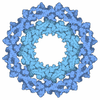
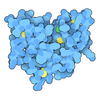
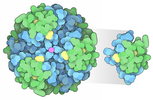
PDBj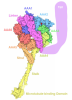

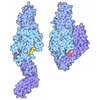



- 集合体
集合体
| 登録構造単位 | 
|
|---|---|
| 1 |
|
-要素
-Cytoplasmic dynein 1 ... , 2種, 6分子 AGefBC
| #1: タンパク質 | 分子量: 554126.250 Da / 分子数: 4 / 由来タイプ: 組換発現 / 由来: (組換発現) Homo sapiens (ヒト)遺伝子: DYNC1H1, DHC1, DNCH1, DNCL, DNECL, DYHC, KIAA0325 発現宿主:  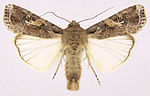 Spodoptera frugiperda (ツマジロクサヨトウ) Spodoptera frugiperda (ツマジロクサヨトウ)参照: UniProt: Q14204 #2: タンパク質 | 分子量: 54173.156 Da / 分子数: 2 / 由来タイプ: 組換発現 / 由来: (組換発現) Homo sapiens (ヒト) / 遺伝子: DYNC1LI2, DNCLI2, LIC2発現宿主: Spodoptera frugiperda (ツマジロクサヨトウ)参照: UniProt: O43237 |
|---|
-タンパク質 , 1種, 4分子 DHgh
| #3: タンパク質 | 分子量: 68442.141 Da / 分子数: 4 / 由来タイプ: 組換発現 / 由来: (組換発現) Homo sapiens (ヒト) / 遺伝子: DYNC1I2, DNCI2, DNCIC2発現宿主: Spodoptera frugiperda (ツマジロクサヨトウ)参照: UniProt: Q13409 |
|---|
-Dynein light chain ... , 3種, 6分子 EFdikv
| #4: タンパク質 | 分子量: 10934.576 Da / 分子数: 2 / 由来タイプ: 組換発現 / 由来: (組換発現) Homo sapiens (ヒト) / 遺伝子: DYNLRB1, BITH, DNCL2A, DNLC2A, ROBLD1, HSPC162発現宿主: Spodoptera frugiperda (ツマジロクサヨトウ)参照: UniProt: Q9NP97 #5: タンパク質 | 分子量: 10381.899 Da / 分子数: 2 / 由来タイプ: 組換発現 / 由来: (組換発現) Homo sapiens (ヒト) / 遺伝子: DYNLL1, DLC1, DNCL1, DNCLC1, HDLC1発現宿主: Spodoptera frugiperda (ツマジロクサヨトウ)参照: UniProt: P63167 #6: タンパク質 | 分子量: 12461.996 Da / 分子数: 2 / 由来タイプ: 組換発現 / 由来: (組換発現) Homo sapiens (ヒト) / 遺伝子: DYNLT1, TCTEL1, TCTEX-1, TCTEX1発現宿主: Spodoptera frugiperda (ツマジロクサヨトウ)参照: UniProt: P63172 |
|---|
-詳細
| Has protein modification | N |
|---|
-実験情報
-実験
| 実験 | 手法: 電子顕微鏡法 |
|---|---|
| EM実験 | 試料の集合状態: PARTICLE / 3次元再構成法: 単粒子再構成法 |
- 試料調製
試料調製
| 構成要素 | 名称: Human Cytoplasmic dynein-1 / タイプ: COMPLEX / Entity ID: #4, #3, #5-#6, #2, #1 / 由来: RECOMBINANT |
|---|---|
| 由来(天然) | 生物種: Homo sapiens (ヒト) |
| 由来(組換発現) | 生物種: Spodoptera frugiperda (ツマジロクサヨトウ) |
| 緩衝液 | pH: 7.4 |
| 試料 | 包埋: NO / シャドウイング: NO / 染色: NO / 凍結: YES |
| 急速凍結 | 装置: HOMEMADE PLUNGER / 凍結剤: ETHANE-PROPANE |
- 電子顕微鏡撮影
| 実験機器 |  モデル: Titan Krios / 画像提供: FEI Company |
|---|---|
| 顕微鏡 | モデル: TFS KRIOS |
| 電子銃 | 電子線源:  FIELD EMISSION GUN / 加速電圧: 300 kV / 照射モード: FLOOD BEAM FIELD EMISSION GUN / 加速電圧: 300 kV / 照射モード: FLOOD BEAM |
| 電子レンズ | モード: BRIGHT FIELD / 最大 デフォーカス(公称値): 3250 nm / 最小 デフォーカス(公称値): 610 nm |
| 撮影 | 電子線照射量: 55 e/Å2 フィルム・検出器のモデル: FEI FALCON IV (4k x 4k) |
- 解析
解析
| EMソフトウェア | 名称: PHENIX / カテゴリ: モデル精密化 | ||||||||||||||||||||||||
|---|---|---|---|---|---|---|---|---|---|---|---|---|---|---|---|---|---|---|---|---|---|---|---|---|---|
| CTF補正 | タイプ: PHASE FLIPPING AND AMPLITUDE CORRECTION | ||||||||||||||||||||||||
| 3次元再構成 | 解像度: 4.4 Å / 解像度の算出法: FSC 0.143 CUT-OFF / 粒子像の数: 21400 / 対称性のタイプ: POINT | ||||||||||||||||||||||||
| 拘束条件 |
|
