 Movie
Movie Controller


+ Open data

- Basic information
| Entry | Database: PDB / ID: 8ua6 | ||||||
|---|---|---|---|---|---|---|---|
| Title | Cryo-EM Structure of SCF-FBOX22-BACH1BTB | ||||||
 Components Components |
| ||||||
 Keywords Keywords | LIGASE / F-box protein / FBXO22 / BACH1 | ||||||
| Function / homology |  Function and homology information Function and homology informationRegulation of HMOX1 expression and activity / regulation of skeletal muscle fiber development / regulation of xenophagy / Parkin-FBXW7-Cul1 ubiquitin ligase complex / F-box domain binding / synaptic assembly at neuromuscular junction / regulation of cell cycle process / neural crest cell differentiation / ligand-modulated transcription factor activity / regulation of BMP signaling pathway ...Regulation of HMOX1 expression and activity / regulation of skeletal muscle fiber development / regulation of xenophagy / Parkin-FBXW7-Cul1 ubiquitin ligase complex / F-box domain binding / synaptic assembly at neuromuscular junction / regulation of cell cycle process / neural crest cell differentiation / ligand-modulated transcription factor activity / regulation of BMP signaling pathway / PcG protein complex / regulation of mitophagy / regulation of centrosome duplication / cullin-RING ubiquitin ligase complex / maintenance of protein location in nucleus / Cul7-RING ubiquitin ligase complex / Loss of Function of FBXW7 in Cancer and NOTCH1 Signaling / regulation of TOR signaling / ubiquitin ligase activator activity / regulation of DNA damage checkpoint / nucleocytoplasmic transport / NFE2L2 regulating anti-oxidant/detoxification enzymes / SCF ubiquitin ligase complex / SCF-dependent proteasomal ubiquitin-dependent protein catabolic process / Prolactin receptor signaling / limb development / ubiquitin ligase complex scaffold activity / centrosome duplication / cilium assembly / protein monoubiquitination / cullin family protein binding / GSK3B-mediated proteasomal degradation of PD-L1(CD274) / ubiquitin-like ligase-substrate adaptor activity / Nuclear events stimulated by ALK signaling in cancer / protein K48-linked ubiquitination / animal organ morphogenesis / intrinsic apoptotic signaling pathway / regulation of mitotic cell cycle / cellular response to starvation / molecular function activator activity / protein modification process / Regulation of BACH1 activity / MAP3K8 (TPL2)-dependent MAPK1/3 activation / Heme signaling / G1/S transition of mitotic cell cycle / SCF-beta-TrCP mediated degradation of Emi1 / NIK-->noncanonical NF-kB signaling / Vpu mediated degradation of CD4 / Dectin-1 mediated noncanonical NF-kB signaling / cell population proliferation / Degradation of CRY and PER proteins / Activation of NF-kappaB in B cells / Iron uptake and transport / Degradation of GLI1 by the proteasome / GSK3B and BTRC:CUL1-mediated-degradation of NFE2L2 / Negative regulation of NOTCH4 signaling / regulation of circadian rhythm / beta-catenin binding / DNA-binding transcription repressor activity, RNA polymerase II-specific / FBXL7 down-regulates AURKA during mitotic entry and in early mitosis / Degradation of GLI2 by the proteasome / GLI3 is processed to GLI3R by the proteasome / Ubiquitin-Mediated Degradation of Phosphorylated Cdc25A / NOTCH1 Intracellular Domain Regulates Transcription / Degradation of beta-catenin by the destruction complex / Constitutive Signaling by NOTCH1 PEST Domain Mutants / Constitutive Signaling by NOTCH1 HD+PEST Domain Mutants / CLEC7A (Dectin-1) signaling / Z disc / SCF(Skp2)-mediated degradation of p27/p21 / FCERI mediated NF-kB activation / protein polyubiquitination / Interleukin-1 signaling / Orc1 removal from chromatin / ubiquitin-protein transferase activity / Cyclin D associated events in G1 / Regulation of RUNX2 expression and activity / Regulation of PLK1 Activity at G2/M Transition / Downstream TCR signaling / positive regulation of proteasomal ubiquitin-dependent protein catabolic process / Antigen processing: Ubiquitination & Proteasome degradation / regulation of inflammatory response / cellular response to oxidative stress / Neddylation / heterochromatin formation / DNA-binding transcription activator activity, RNA polymerase II-specific / regulation of apoptotic process / ubiquitin-dependent protein catabolic process / intracellular iron ion homeostasis / proteasome-mediated ubiquitin-dependent protein catabolic process / regulation of cell cycle / DNA-binding transcription factor activity, RNA polymerase II-specific / positive regulation of canonical NF-kappaB signal transduction / protein-macromolecule adaptor activity / RNA polymerase II cis-regulatory region sequence-specific DNA binding / protein ubiquitination / chromatin remodeling / DNA-binding transcription factor activity / protein domain specific binding / negative regulation of DNA-templated transcription Similarity search - Function | ||||||
| Biological species |  Homo sapiens (human) Homo sapiens (human) | ||||||
| Method | ELECTRON MICROSCOPY / single particle reconstruction / cryo EM / Resolution: 3.9 Å | ||||||
 Authors Authors | Shi, H. / Cao, S. / Zheng, N. | ||||||
| Funding support |  United States, 1items United States, 1items
| ||||||
 Citation Citation | Journal: Cell / Year: 2024 Title: Recognition of BACH1 quaternary structure degrons by two F-box proteins under oxidative stress. Authors: Shiyun Cao / Sheena Faye Garcia / Huigang Shi / Ellie I James / Yuki Kito / Hui Shi / Haibin Mao / Sharon Kaisari / Gergely Rona / Sophia Deng / Hailey V Goldberg / Jackeline Ponce / Beatrix ...Authors: Shiyun Cao / Sheena Faye Garcia / Huigang Shi / Ellie I James / Yuki Kito / Hui Shi / Haibin Mao / Sharon Kaisari / Gergely Rona / Sophia Deng / Hailey V Goldberg / Jackeline Ponce / Beatrix Ueberheide / Luca Lignitto / Miklos Guttman / Michele Pagano / Ning Zheng /   Abstract: Ubiquitin-dependent proteolysis regulates diverse cellular functions with high substrate specificity, which hinges on the ability of ubiquitin E3 ligases to decode the targets' degradation signals, i. ...Ubiquitin-dependent proteolysis regulates diverse cellular functions with high substrate specificity, which hinges on the ability of ubiquitin E3 ligases to decode the targets' degradation signals, i.e., degrons. Here, we show that BACH1, a transcription repressor of antioxidant response genes, features two distinct unconventional degrons encrypted in the quaternary structure of its homodimeric BTB domain. These two degrons are both functionalized by oxidative stress and are deciphered by two complementary E3s. FBXO22 recognizes a degron constructed by the BACH1 BTB domain dimer interface, which is unmasked from transcriptional co-repressors after oxidative stress releases BACH1 from chromatin. When this degron is impaired by oxidation, a second BACH1 degron manifested by its destabilized BTB dimer is probed by a pair of FBXL17 proteins that remodels the substrate into E3-bound monomers for ubiquitination. Our findings highlight the multidimensionality of protein degradation signals and the functional complementarity of different ubiquitin ligases targeting the same substrate. | ||||||
| History |
|
- Structure visualization
| Structure viewer | Molecule: MolmilJmol/JSmol |
|---|
- Downloads & links
-Download
| PDBx/mmCIF format | 8ua6.cif.gz | 232.9 KB | Display | PDBx/mmCIF format |
|---|---|---|---|---|
| PDB format | pdb8ua6.ent.gz | 181.6 KB | Display | PDB format |
| PDBx/mmJSON format | 8ua6.json.gz | Tree view | PDBx/mmJSON format | |
| Others |  Other downloads Other downloads |
-Validation report
| Arichive directory | https://data.pdbj.org/pub/pdb/validation_reports/ua/8ua6ftp://data.pdbj.org/pub/pdb/validation_reports/ua/8ua6 | HTTPS FTP |
|---|
-Related structure data
| Related structure data |  42051MC  8ua3C  8uahC  8ubtC  8ubuC  8ubvC M: map data used to model this data C: citing same article ( |
|---|---|
| Similar structure data |




-Links
 PDBj
PDBj

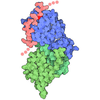
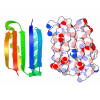
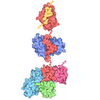
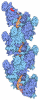
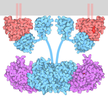
- Assembly
| Deposited unit | 
|
|---|---|
| 1 |
|
-Components
| #1: Protein | Mass: 44562.270 Da / Num. of mol.: 1 Source method: isolated from a genetically manipulated source Source: (gene. exp.) Homo sapiens (human) / Gene: FBXO22 / Cell line (production host): High Five / Production host:  Trichoplusia ni (cabbage looper) / References: UniProt: Q8NEZ5 Trichoplusia ni (cabbage looper) / References: UniProt: Q8NEZ5 | ||||||
|---|---|---|---|---|---|---|---|
| #2: Protein | Mass: 13839.761 Da / Num. of mol.: 2 / Fragment: BTB domain (UNP residues 7-128) Source method: isolated from a genetically manipulated source Source: (gene. exp.) Homo sapiens (human) / Gene: BACH1 / Production host:   Escherichia coli BL21 (bacteria) / References: UniProt: O14867 Escherichia coli BL21 (bacteria) / References: UniProt: O14867#3: Protein | | Mass: 18082.326 Da / Num. of mol.: 1 Source method: isolated from a genetically manipulated source Source: (gene. exp.) Homo sapiens (human) / Gene: SKP1 / Production host: Trichoplusia ni (cabbage looper) / References: UniProt: P63208#4: Protein | | Mass: 88501.945 Da / Num. of mol.: 1 Source method: isolated from a genetically manipulated source Source: (gene. exp.) Homo sapiens (human) / Gene: CUL1 / Production host: Escherichia coli BL21 (bacteria) / References: UniProt: Q13616Has protein modification | N | |
-Experimental details
-Experiment
| Experiment | Method: ELECTRON MICROSCOPY |
|---|---|
| EM experiment | Aggregation state: PARTICLE / 3D reconstruction method: single particle reconstruction |
- Sample preparation
| Component | Name: FBXO22-BACH1BTB / Type: COMPLEX / Entity ID: #1-#2 / Source: MULTIPLE SOURCES |
|---|---|
| Source (natural) | Organism: Homo sapiens (human) |
| Source (recombinant) | Organism: Trichoplusia ni (cabbage looper) |
| Buffer solution | pH: 7.5 |
| Specimen | Embedding applied: NO / Shadowing applied: NO / Staining applied: NO / Vitrification applied: YES |
| Vitrification | Instrument: FEI VITROBOT MARK IV / Cryogen name: ETHANE |
- Electron microscopy imaging
| Experimental equipment |  Model: Titan Krios / Image courtesy: FEI Company |
|---|---|
| Microscopy | Model: TFS KRIOS |
| Electron gun | Electron source:  FIELD EMISSION GUN / Accelerating voltage: 300 kV / Illumination mode: FLOOD BEAM FIELD EMISSION GUN / Accelerating voltage: 300 kV / Illumination mode: FLOOD BEAM |
| Electron lens | Mode: BRIGHT FIELD / Nominal defocus max: 3500 nm / Nominal defocus min: 800 nm / Alignment procedure: COMA FREE |
| Specimen holder | Cryogen: NITROGEN / Specimen holder model: FEI TITAN KRIOS AUTOGRID HOLDER |
| Image recording | Electron dose: 59 e/Å2 / Film or detector model: GATAN K3 BIOQUANTUM (6k x 4k) |
- Processing
| EM software |
| ||||||||||||||||||
|---|---|---|---|---|---|---|---|---|---|---|---|---|---|---|---|---|---|---|---|
| CTF correction | Type: PHASE FLIPPING AND AMPLITUDE CORRECTION | ||||||||||||||||||
| 3D reconstruction | Resolution: 3.9 Å / Resolution method: FSC 0.143 CUT-OFF / Num. of particles: 413523 / Algorithm: BACK PROJECTION / Symmetry type: POINT |
