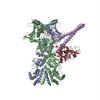
Movie
Movie Controller


+ Open data

- Basic information
| Entry | Database: PDB / ID: 8ffw | ||||||
|---|---|---|---|---|---|---|---|
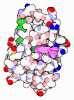
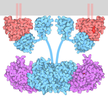
| Title | Cryo-EM structure of the GR-Hsp90-FKBP51 complex | ||||||
 Components Components |
| ||||||
 Keywords Keywords | CHAPERONE / steroid hormone receptor / ligand binding / ATP binding / protein folding | ||||||
| Function / homology |  Function and homology information Function and homology informationRegulation of NPAS4 gene transcription / motor neuron apoptotic process / nuclear glucocorticoid receptor activity / microglia differentiation / neuroinflammatory response / PTK6 Expression / steroid hormone binding / astrocyte differentiation / motor behavior / Modulation of host responses by IFN-stimulated genes ...Regulation of NPAS4 gene transcription / motor neuron apoptotic process / nuclear glucocorticoid receptor activity / microglia differentiation / neuroinflammatory response / PTK6 Expression / steroid hormone binding / astrocyte differentiation / motor behavior / Modulation of host responses by IFN-stimulated genes / cellular response to dexamethasone stimulus / cellular response to glucocorticoid stimulus / sperm plasma membrane / sperm mitochondrial sheath / sulfonylurea receptor binding / CTP binding / response to follicle-stimulating hormone / Scavenging by Class F Receptors / positive regulation of protein polymerization / vRNP Assembly / UTP binding / dATP binding / mitochondrial transport / cellular response to steroid hormone stimulus / negative regulation of striated muscle cell apoptotic process / HSP90-CDC37 chaperone complex / AP-3 adaptor complex binding / telomerase holoenzyme complex assembly / chaperone-mediated autophagy / Respiratory syncytial virus genome replication / Rho GDP-dissociation inhibitor binding / FK506 binding / Drug-mediated inhibition of ERBB2 signaling / Resistance of ERBB2 KD mutants to trastuzumab / Resistance of ERBB2 KD mutants to sapitinib / Resistance of ERBB2 KD mutants to tesevatinib / Resistance of ERBB2 KD mutants to neratinib / Resistance of ERBB2 KD mutants to osimertinib / Resistance of ERBB2 KD mutants to afatinib / Resistance of ERBB2 KD mutants to AEE788 / Resistance of ERBB2 KD mutants to lapatinib / Drug resistance in ERBB2 TMD/JMD mutants / Uptake and function of diphtheria toxin / positive regulation of cell size / dendritic growth cone / TPR domain binding / protein import into mitochondrial matrix / PIWI-interacting RNA (piRNA) biogenesis / response to dietary excess / response to caloric restriction / Assembly and release of respiratory syncytial virus (RSV) virions / non-chaperonin molecular chaperone ATPase / nuclear receptor-mediated steroid hormone signaling pathway / Sema3A PAK dependent Axon repulsion / response to salt stress / regulation of protein ubiquitination / estrogen response element binding / response to unfolded protein / HSF1-dependent transactivation / cellular response to transforming growth factor beta stimulus / cardiac muscle cell apoptotic process / regulation of protein-containing complex assembly / FOXO-mediated transcription of oxidative stress, metabolic and neuronal genes / Attenuation phase / protein folding chaperone complex / HSF1 activation / enzyme-substrate adaptor activity / chaperone-mediated protein complex assembly / axonal growth cone / neurofibrillary tangle assembly / regulation of postsynaptic membrane neurotransmitter receptor levels / telomere maintenance via telomerase / positive regulation of lamellipodium assembly / RHOBTB2 GTPase cycle / core promoter sequence-specific DNA binding / Dengue virus activates/modulates innate and adaptive immune responses / steroid binding / nitric oxide metabolic process / response to isolation stress / MECP2 regulates neuronal receptors and channels / protein unfolding / positive regulation of defense response to virus by host / Signaling by ERBB2 / skeletal muscle contraction / eNOS activation / positive regulation of telomere maintenance via telomerase / Tetrahydrobiopterin (BH4) synthesis, recycling, salvage and regulation / heat shock protein binding / endocytic vesicle lumen / response to cold / DNA polymerase binding / positive regulation of cardiac muscle contraction / Loss of Nlp from mitotic centrosomes / Loss of proteins required for interphase microtubule organization from the centrosome / Recruitment of mitotic centrosome proteins and complexes / cellular response to platelet-derived growth factor stimulus / lysosomal lumen / Recruitment of NuMA to mitotic centrosomes / ESR-mediated signaling / Anchoring of the basal body to the plasma membrane Similarity search - Function | ||||||
| Biological species |  Homo sapiens (human) Homo sapiens (human) | ||||||
| Method | ELECTRON MICROSCOPY / single particle reconstruction / cryo EM / Resolution: 3.23 Å | ||||||
 Authors Authors | Noddings, C.M. / Agard, D.A. | ||||||
| Funding support |  United States, 1items United States, 1items
| ||||||
 Citation Citation | Journal: Nat Struct Mol Biol / Year: 2023 Title: Cryo-EM reveals how Hsp90 and FKBP immunophilins co-regulate the glucocorticoid receptor. Authors: Chari M Noddings / Jill L Johnson / David A Agard / Abstract: Hsp90 is an essential molecular chaperone responsible for the folding and activation of hundreds of 'client' proteins, including the glucocorticoid receptor (GR). Previously, we revealed that Hsp70 ...Hsp90 is an essential molecular chaperone responsible for the folding and activation of hundreds of 'client' proteins, including the glucocorticoid receptor (GR). Previously, we revealed that Hsp70 and Hsp90 remodel the conformation of GR to regulate ligand binding, aided by co-chaperones. In vivo, the co-chaperones FKBP51 and FKBP52 antagonistically regulate GR activity, but a molecular understanding is lacking. Here we present a 3.01 Å cryogenic electron microscopy structure of the human GR:Hsp90:FKBP52 complex, revealing how FKBP52 integrates into the GR chaperone cycle and directly binds to the active client, potentiating GR activity in vitro and in vivo. We also present a 3.23 Å cryogenic electron microscopy structure of the human GR:Hsp90:FKBP51 complex, revealing how FKBP51 competes with FKBP52 for GR:Hsp90 binding and demonstrating how FKBP51 can act as a potent antagonist to FKBP52. Altogether, we demonstrate how FKBP51 and FKBP52 integrate into the GR chaperone cycle to advance GR to the next stage of maturation. | ||||||
| History |
|
- Structure visualization
| Structure viewer | Molecule: MolmilJmol/JSmol |
|---|
- Downloads & links
-Download
| PDBx/mmCIF format | 8ffw.cif.gz | 734.1 KB | Display | PDBx/mmCIF format |
|---|---|---|---|---|
| PDB format | pdb8ffw.ent.gz | 605.1 KB | Display | PDB format |
| PDBx/mmJSON format | 8ffw.json.gz | Tree view | PDBx/mmJSON format | |
| Others |  Other downloads Other downloads |
-Validation report
| Arichive directory | https://data.pdbj.org/pub/pdb/validation_reports/ff/8ffwftp://data.pdbj.org/pub/pdb/validation_reports/ff/8ffw | HTTPS FTP |
|---|
-Related structure data
| Related structure data |  29069MC 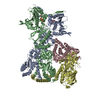 8ffvC M: map data used to model this data C: citing same article ( |
|---|---|
| Similar structure data |

-Links
 PDBj
PDBj

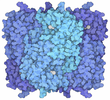
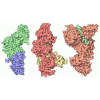
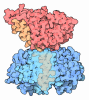
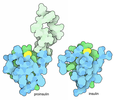

- Assembly
| Deposited unit | 
|
|---|---|
| 1 |
|
-Components
-Protein , 3 types, 4 molecules ABCD
| #1: Protein | Mass: 84650.531 Da / Num. of mol.: 2 Source method: isolated from a genetically manipulated source Source: (gene. exp.) Homo sapiens (human) / Gene: HSP90AA1, HSP90A, HSPC1, HSPCA / Production host:   Escherichia coli BL21(DE3) (bacteria) Escherichia coli BL21(DE3) (bacteria)References: UniProt: P07900, non-chaperonin molecular chaperone ATPase #2: Protein | | Mass: 41198.973 Da / Num. of mol.: 1 / Mutation: F602S Source method: isolated from a genetically manipulated source Source: (gene. exp.) Homo sapiens (human) / Gene: NR3C1, GRL / Production host: Escherichia coli BL21(DE3) (bacteria) / References: UniProt: P04150#3: Protein | | Mass: 51158.992 Da / Num. of mol.: 1 Source method: isolated from a genetically manipulated source Source: (gene. exp.) Homo sapiens (human) / Gene: FKBP5, AIG6, FKBP51 / Production host: Escherichia coli BL21(DE3) (bacteria) / References: UniProt: Q13451, peptidylprolyl isomerase |
|---|
-Non-polymers , 3 types, 5 molecules 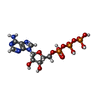


| #4: Chemical | 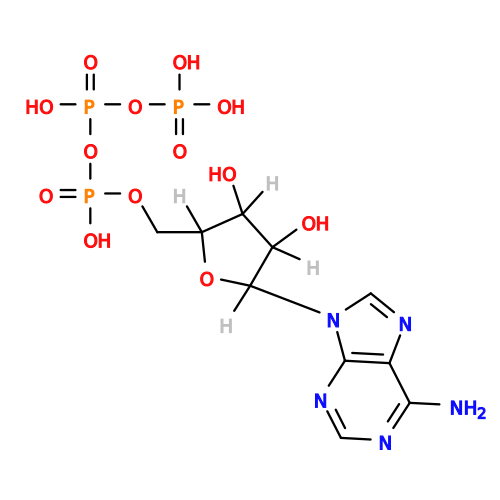 Mass: 507.181 Da / Num. of mol.: 2 / Source method: obtained synthetically / Formula: C10H16N5O13P3 / Feature type: SUBJECT OF INVESTIGATION / Comment: ATP, energy-carrying molecule*YM Mass: 507.181 Da / Num. of mol.: 2 / Source method: obtained synthetically / Formula: C10H16N5O13P3 / Feature type: SUBJECT OF INVESTIGATION / Comment: ATP, energy-carrying molecule*YM#5: Chemical |  Mass: 24.305 Da / Num. of mol.: 2 / Source method: obtained synthetically / Formula: Mg / Feature type: SUBJECT OF INVESTIGATION Mass: 24.305 Da / Num. of mol.: 2 / Source method: obtained synthetically / Formula: Mg / Feature type: SUBJECT OF INVESTIGATION#6: Chemical | ChemComp-DEX / |  Mass: 392.461 Da / Num. of mol.: 1 / Source method: obtained synthetically / Formula: C22H29FO5 / Feature type: SUBJECT OF INVESTIGATION / Comment: medication, antibiotic*YM Mass: 392.461 Da / Num. of mol.: 1 / Source method: obtained synthetically / Formula: C22H29FO5 / Feature type: SUBJECT OF INVESTIGATION / Comment: medication, antibiotic*YM |
|---|
-Details
| Has ligand of interest | Y |
|---|
-Experimental details
-Experiment
| Experiment | Method: ELECTRON MICROSCOPY |
|---|---|
| EM experiment | Aggregation state: PARTICLE / 3D reconstruction method: single particle reconstruction |
- Sample preparation
| Component | Name: Complex of the Glucocorticoid Receptor ligand binding domain, Hsp90 alpha dimer, and the co-chaperone FKBP51 Type: COMPLEX / Entity ID: #1-#3 / Source: RECOMBINANT |
|---|---|
| Molecular weight | Value: 0.3065 MDa / Experimental value: NO |
| Source (natural) | Organism: Homo sapiens (human) |
| Source (recombinant) | Organism: Escherichia coli BL21(DE3) (bacteria) |
| Buffer solution | pH: 7.5 |
| Specimen | Embedding applied: NO / Shadowing applied: NO / Staining applied: NO / Vitrification applied: YES |
| Specimen support | Grid material: COPPER / Grid mesh size: 400 divisions/in. / Grid type: Quantifoil R1.2/1.3 |
| Vitrification | Instrument: FEI VITROBOT MARK IV / Cryogen name: ETHANE / Humidity: 100 % / Chamber temperature: 283 K |
- Electron microscopy imaging
| Experimental equipment |  Model: Titan Krios / Image courtesy: FEI Company | |||||||||||||||||||||
|---|---|---|---|---|---|---|---|---|---|---|---|---|---|---|---|---|---|---|---|---|---|---|
| Microscopy | Model: FEI TITAN KRIOS | |||||||||||||||||||||
| Electron gun | Electron source:  FIELD EMISSION GUN / Accelerating voltage: 300 kV / Illumination mode: FLOOD BEAM FIELD EMISSION GUN / Accelerating voltage: 300 kV / Illumination mode: FLOOD BEAM | |||||||||||||||||||||
| Electron lens | Mode: BRIGHT FIELD / Nominal magnification: 105000 X / Nominal defocus max: 2000 nm / Nominal defocus min: 800 nm / Cs: 2.7 mm / Alignment procedure: COMA FREE | |||||||||||||||||||||
| Specimen holder | Cryogen: NITROGEN / Specimen holder model: FEI TITAN KRIOS AUTOGRID HOLDER | |||||||||||||||||||||
| Image recording |
| |||||||||||||||||||||
| EM imaging optics | Energyfilter name: GIF Bioquantum / Energyfilter slit width: 20 eV |
- Processing
| EM software |
| ||||||||||||||||||||||||||||||||
|---|---|---|---|---|---|---|---|---|---|---|---|---|---|---|---|---|---|---|---|---|---|---|---|---|---|---|---|---|---|---|---|---|---|
| CTF correction | Type: PHASE FLIPPING AND AMPLITUDE CORRECTION | ||||||||||||||||||||||||||||||||
| 3D reconstruction | Resolution: 3.23 Å / Resolution method: FSC 0.143 CUT-OFF / Num. of particles: 171778 / Symmetry type: POINT | ||||||||||||||||||||||||||||||||
| Atomic model building | 3D fitting-ID: 1 / Source name: PDB / Type: experimental model
|