 Movie
Movie Controller


+ Open data

- Basic information
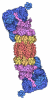
| Entry | Database: PDB / ID: 7z87 | ||||||
|---|---|---|---|---|---|---|---|
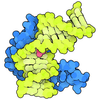
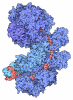
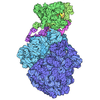
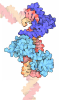
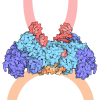
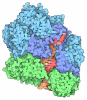
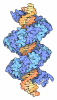
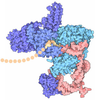
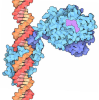
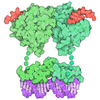
| Title | DNA-PK in the active state | ||||||
 Components Components |
| ||||||
 Keywords Keywords | DNA BINDING PROTEIN / DNA-dependent protein kinase | ||||||
| Function / homology |  Function and homology information Function and homology informationpositive regulation of platelet formation / Ku70:Ku80 complex / negative regulation of t-circle formation / DNA-dependent protein kinase activity / DNA end binding / small-subunit processome assembly / positive regulation of lymphocyte differentiation / histone H2AXS139 kinase activity / DNA-dependent protein kinase-DNA ligase 4 complex / immunoglobulin V(D)J recombination ...positive regulation of platelet formation / Ku70:Ku80 complex / negative regulation of t-circle formation / DNA-dependent protein kinase activity / DNA end binding / small-subunit processome assembly / positive regulation of lymphocyte differentiation / histone H2AXS139 kinase activity / DNA-dependent protein kinase-DNA ligase 4 complex / immunoglobulin V(D)J recombination / nonhomologous end joining complex / cellular response to X-ray / regulation of epithelial cell proliferation / regulation of smooth muscle cell proliferation / double-strand break repair via classical nonhomologous end joining / double-strand break repair via alternative nonhomologous end joining / Cytosolic sensors of pathogen-associated DNA / nuclear telomere cap complex / telomere capping / IRF3-mediated induction of type I IFN / regulation of hematopoietic stem cell differentiation / cellular hyperosmotic salinity response / U3 snoRNA binding / regulation of telomere maintenance / recombinational repair / maturation of 5.8S rRNA / protein localization to chromosome, telomeric region / positive regulation of double-strand break repair via nonhomologous end joining / negative regulation of cGAS/STING signaling pathway / 2-LTR circle formation / peptidyl-threonine phosphorylation / telomeric repeat DNA binding / negative regulation of protein phosphorylation / DNA 3'-5' helicase / 5'-deoxyribose-5-phosphate lyase activity / 3'-5' DNA helicase activity / ATP-dependent activity, acting on DNA / telomere maintenance via telomerase / mitotic G1 DNA damage checkpoint signaling / positive regulation of erythrocyte differentiation / activation of innate immune response / telomere maintenance / cyclin binding / DNA helicase activity / protein modification process / DNA-(apurinic or apyrimidinic site) lyase / class I DNA-(apurinic or apyrimidinic site) endonuclease activity / site of DNA damage / positive regulation of translation / intrinsic apoptotic signaling pathway in response to DNA damage / cellular response to gamma radiation / small-subunit processome / Nonhomologous End-Joining (NHEJ) / protein-DNA complex / peptidyl-serine phosphorylation / double-strand break repair via nonhomologous end joining / regulation of circadian rhythm / enzyme activator activity / double-strand break repair / cellular response to insulin stimulus / rhythmic process / transcription regulator complex / E3 ubiquitin ligases ubiquitinate target proteins / scaffold protein binding / double-stranded DNA binding / DNA recombination / secretory granule lumen / ficolin-1-rich granule lumen / damaged DNA binding / RNA polymerase II-specific DNA-binding transcription factor binding / protein kinase activity / protein phosphorylation / chromosome, telomeric region / non-specific serine/threonine protein kinase / transcription cis-regulatory region binding / ribonucleoprotein complex / protein domain specific binding / innate immune response / protein serine kinase activity / negative regulation of DNA-templated transcription / ubiquitin protein ligase binding / protein serine/threonine kinase activity / negative regulation of apoptotic process / Neutrophil degranulation / DNA damage response / nucleolus / positive regulation of DNA-templated transcription / protein-containing complex binding / chromatin / enzyme binding / positive regulation of transcription by RNA polymerase II / ATP hydrolysis activity / protein-containing complex / DNA binding / DNA-templated transcription / RNA binding / extracellular region / nucleoplasm / ATP binding / membrane Similarity search - Function | ||||||
| Biological species |  Homo sapiens (human) Homo sapiens (human) | ||||||
| Method | ELECTRON MICROSCOPY / single particle reconstruction / cryo EM / Resolution: 2.91 Å | ||||||
 Authors Authors | Liang, S. / Blundell, T.L. | ||||||
| Funding support |  United Kingdom, 1items United Kingdom, 1items
| ||||||
 Citation Citation | Journal: Nat Struct Mol Biol / Year: 2023 Title: Human DNA-dependent protein kinase activation mechanism. Authors: Shikang Liang / Tom L Blundell / Abstract: DNA-dependent protein kinase (DNA-PK), a multicomponent complex including the DNA-PK catalytic subunit and Ku70/80 heterodimer together with DNA, is central to human DNA damage response and repair. ...DNA-dependent protein kinase (DNA-PK), a multicomponent complex including the DNA-PK catalytic subunit and Ku70/80 heterodimer together with DNA, is central to human DNA damage response and repair. Using a DNA-PK-selective inhibitor (M3814), we identified from one dataset two cryo-EM structures of the human DNA-PK complex in different states, the intermediate state and the active state. Here we show that activation of the kinase is regulated through conformational changes caused by the binding ligand and the string region (residues 802-846) of the DNA-PK catalytic subunit, particularly the helix-hairpin-helix motif (residues 816-836) that interacts with DNA. These observations demonstrate the regulatory role of the ligand and explain why DNA-PK is DNA dependent. Cooperation and coordination among binding partners, disordered flexible regions and mechanically flexible HEAT repeats modulate the activation of the kinase. Together with previous findings, these results provide a better molecular understanding of DNA-PK catalysis. | ||||||
| History |
|
- Structure visualization
| Structure viewer | Molecule: MolmilJmol/JSmol |
|---|
- Downloads & links
-Download
| PDBx/mmCIF format | 7z87.cif.gz | 895.1 KB | Display | PDBx/mmCIF format |
|---|---|---|---|---|
| PDB format | pdb7z87.ent.gz | 713.9 KB | Display | PDB format |
| PDBx/mmJSON format | 7z87.json.gz | Tree view | PDBx/mmJSON format | |
| Others |  Other downloads Other downloads |
-Validation report
| Arichive directory | https://data.pdbj.org/pub/pdb/validation_reports/z8/7z87ftp://data.pdbj.org/pub/pdb/validation_reports/z8/7z87 | HTTPS FTP |
|---|
-Related structure data
| Related structure data |  14545MC  7z88C M: map data used to model this data C: citing same article ( |
|---|---|
| Similar structure data |

-Links
 PDBj
PDBj



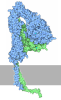
- Assembly
| Deposited unit | 
|
|---|---|
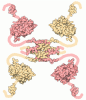
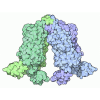
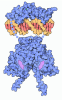
| 1 |
|
-Components
-Protein , 1 types, 1 molecules A
| #1: Protein | Mass: 469673.219 Da / Num. of mol.: 1 / Source method: isolated from a natural source / Source: (natural) Homo sapiens (human)References: UniProt: P78527, non-specific serine/threonine protein kinase |
|---|
-X-ray repair cross-complementing protein ... , 2 types, 2 molecules BC
| #2: Protein | Mass: 69945.039 Da / Num. of mol.: 1 Source method: isolated from a genetically manipulated source Source: (gene. exp.) Homo sapiens (human) / Gene: XRCC6, G22P1 / Production host:   Spodoptera frugiperda (fall armyworm) Spodoptera frugiperda (fall armyworm)References: UniProt: P12956, Hydrolases; Acting on acid anhydrides; Acting on acid anhydrides to facilitate cellular and subcellular movement, Lyases; Carbon-oxygen lyases; Other carbon-oxygen lyases |
|---|---|
| #3: Protein | Mass: 82812.438 Da / Num. of mol.: 1 Source method: isolated from a genetically manipulated source Source: (gene. exp.) Homo sapiens (human) / Gene: XRCC5, G22P2 / Production host: Spodoptera frugiperda (fall armyworm)References: UniProt: P13010, Hydrolases; Acting on acid anhydrides; Acting on acid anhydrides to facilitate cellular and subcellular movement |
-DNA chain , 2 types, 2 molecules DE
| #4: DNA chain | Mass: 7900.079 Da / Num. of mol.: 1 / Source method: obtained synthetically / Source: (synth.) Homo sapiens (human) |
|---|---|
| #5: DNA chain | Mass: 8078.203 Da / Num. of mol.: 1 / Source method: obtained synthetically / Source: (synth.) Homo sapiens (human) |
-Non-polymers , 2 types, 195 molecules 
| #6: Chemical | ChemComp-1IX / (~{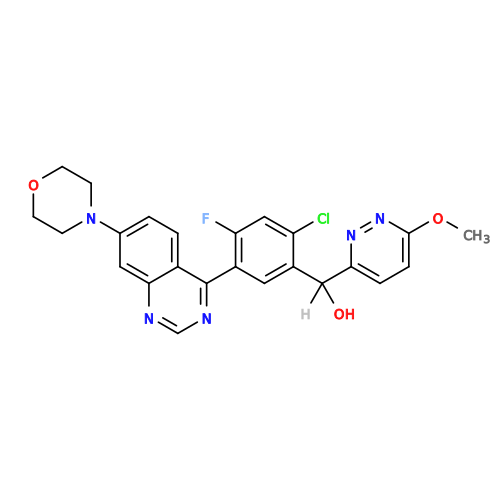 Mass: 481.907 Da / Num. of mol.: 1 / Source method: obtained synthetically / Formula: C24H21ClFN5O3 / Feature type: SUBJECT OF INVESTIGATION Mass: 481.907 Da / Num. of mol.: 1 / Source method: obtained synthetically / Formula: C24H21ClFN5O3 / Feature type: SUBJECT OF INVESTIGATION |
|---|---|
| #7: Water | ChemComp-HOH / Mass: 18.015 Da / Num. of mol.: 194 / Source method: isolated from a natural source / Formula: H2O |
-Details
| Has ligand of interest | Y |
|---|
-Experimental details
-Experiment
| Experiment | Method: ELECTRON MICROSCOPY |
|---|---|
| EM experiment | Aggregation state: PARTICLE / 3D reconstruction method: single particle reconstruction |
- Sample preparation
| Component | Name: Human DNA-dependent protein kinase / Type: COMPLEX / Entity ID: #1-#5 / Source: NATURAL |
|---|---|
| Source (natural) | Organism: Homo sapiens (human) |
| Buffer solution | pH: 7.6 |
| Specimen | Embedding applied: NO / Shadowing applied: NO / Staining applied: NO / Vitrification applied: YES |
| Vitrification | Cryogen name: ETHANE |
- Electron microscopy imaging
| Experimental equipment |  Model: Titan Krios / Image courtesy: FEI Company |
|---|---|
| Microscopy | Model: FEI TITAN KRIOS |
| Electron gun | Electron source:  FIELD EMISSION GUN / Accelerating voltage: 300 kV / Illumination mode: FLOOD BEAM FIELD EMISSION GUN / Accelerating voltage: 300 kV / Illumination mode: FLOOD BEAM |
| Electron lens | Mode: BRIGHT FIELD / Nominal defocus max: 2300 nm / Nominal defocus min: 1100 nm |
| Image recording | Electron dose: 47.22 e/Å2 / Film or detector model: GATAN K3 BIOQUANTUM (6k x 4k) |
- Processing
| CTF correction | Type: PHASE FLIPPING AND AMPLITUDE CORRECTION |
|---|---|
| 3D reconstruction | Resolution: 2.91 Å / Resolution method: FSC 0.143 CUT-OFF / Num. of particles: 275300 / Symmetry type: POINT |
