 Movie
Movie Controller

[English] 日本語
 Yorodumi
- PDB-7sac: S-(+)-ketamine bound GluN1a-GluN2B NMDA receptors at 3.69 Angstro... -
+ Open data

- Basic information
| Entry | Database: PDB / ID: 7sac | |||||||||||||||||||||||||||
|---|---|---|---|---|---|---|---|---|---|---|---|---|---|---|---|---|---|---|---|---|---|---|---|---|---|---|---|---|
| Title | S-(+)-ketamine bound GluN1a-GluN2B NMDA receptors at 3.69 Angstrom resolution | |||||||||||||||||||||||||||
 Components Components | (Glutamate receptor ionotropic, NMDA ...) x 2 | |||||||||||||||||||||||||||
 Keywords Keywords | TRANSPORT PROTEIN / Ligand-gated ion channel / ionotropic glutamate receptor / synaptic protein / voltage-gate ion channel | |||||||||||||||||||||||||||
| Function / homology |  Function and homology information Function and homology informationcellular response to corticosterone stimulus / cellular response to magnesium starvation / sensory organ development / cellular response to curcumin / regulation of cAMP/PKA signal transduction / auditory behavior / pons maturation / EPHB-mediated forward signaling / positive regulation of Schwann cell migration / Assembly and cell surface presentation of NMDA receptors ...cellular response to corticosterone stimulus / cellular response to magnesium starvation / sensory organ development / cellular response to curcumin / regulation of cAMP/PKA signal transduction / auditory behavior / pons maturation / EPHB-mediated forward signaling / positive regulation of Schwann cell migration / Assembly and cell surface presentation of NMDA receptors / regulation of cell communication / response to carbohydrate / fear response / sensitization / suckling behavior / olfactory learning / response to other organism / response to methylmercury / response to hydrogen sulfide / protein localization to postsynaptic membrane / dendritic branch / conditioned taste aversion / regulation of ARF protein signal transduction / transmitter-gated monoatomic ion channel activity / response to manganese ion / apical dendrite / response to glycoside / interleukin-1 receptor binding / cellular response to dsRNA / regulation of respiratory gaseous exchange / cellular response to lipid / propylene metabolic process / response to glycine / response to growth hormone / RAF/MAP kinase cascade / positive regulation of inhibitory postsynaptic potential / heterocyclic compound binding / neuromuscular process / neurotransmitter receptor complex / negative regulation of dendritic spine maintenance / response to amine / Synaptic adhesion-like molecules / NMDA glutamate receptor activity / regulation of monoatomic cation transmembrane transport / NMDA selective glutamate receptor complex / glutamate binding / voltage-gated monoatomic cation channel activity / regulation of axonogenesis / ligand-gated sodium channel activity / response to morphine / positive regulation of glutamate secretion / calcium ion transmembrane import into cytosol / regulation of synapse assembly / startle response / male mating behavior / positive regulation of reactive oxygen species biosynthetic process / protein heterotetramerization / regulation of dendrite morphogenesis / small molecule binding / glycine binding / receptor clustering / behavioral response to pain / parallel fiber to Purkinje cell synapse / behavioral fear response / positive regulation of calcium ion transport into cytosol / social behavior / regulation of neuronal synaptic plasticity / associative learning / regulation of postsynaptic membrane potential / action potential / regulation of MAPK cascade / response to electrical stimulus / extracellularly glutamate-gated ion channel activity / multicellular organismal response to stress / neuron development / positive regulation of dendritic spine maintenance / monoatomic cation transmembrane transport / detection of mechanical stimulus involved in sensory perception of pain / cellular response to glycine / response to magnesium ion / response to mechanical stimulus / Unblocking of NMDA receptors, glutamate binding and activation / glutamate receptor binding / monoatomic cation transport / prepulse inhibition / ligand-gated monoatomic ion channel activity / calcium ion homeostasis / long-term memory / phosphatase binding / adult locomotory behavior / postsynaptic density, intracellular component / synaptic cleft / response to fungicide / monoatomic cation channel activity / cellular response to manganese ion / glutamate-gated receptor activity / regulation of long-term synaptic depression / positive regulation of synaptic transmission, glutamatergic / sensory perception of pain / response to cytokine Similarity search - Function | |||||||||||||||||||||||||||
| Biological species |   Rattus norvegicus (Norway rat) Rattus norvegicus (Norway rat) | |||||||||||||||||||||||||||
| Method | ELECTRON MICROSCOPY / single particle reconstruction / cryo EM / Resolution: 3.69 Å | |||||||||||||||||||||||||||
 Authors Authors | Chou, T.-H. / Furukawa, H. | |||||||||||||||||||||||||||
| Funding support |  United States, 2items United States, 2items
| |||||||||||||||||||||||||||
 Citation Citation | Journal: Nat Struct Mol Biol / Year: 2022 Title: Structural insights into binding of therapeutic channel blockers in NMDA receptors. Authors: Tsung-Han Chou / Max Epstein / Kevin Michalski / Eve Fine / Philip C Biggin / Hiro Furukawa /  Abstract: Excitatory signaling mediated by N-methyl-D-aspartate receptor (NMDAR) is critical for brain development and function, as well as for neurological diseases and disorders. Channel blockers of NMDARs ...Excitatory signaling mediated by N-methyl-D-aspartate receptor (NMDAR) is critical for brain development and function, as well as for neurological diseases and disorders. Channel blockers of NMDARs are of medical interest owing to their potential for treating depression, Alzheimer's disease, and epilepsy. However, precise mechanisms underlying binding and channel blockade have remained limited owing to challenges in obtaining high-resolution structures at the binding site within the transmembrane domains. Here, we monitor the binding of three clinically important channel blockers: phencyclidine, ketamine, and memantine in GluN1-2B NMDARs at local resolutions of 2.5-3.5 Å around the binding site using single-particle electron cryo-microscopy, molecular dynamics simulations, and electrophysiology. The channel blockers form different extents of interactions with the pore-lining residues, which control mostly off-speeds but not on-speeds. Our comparative analyses of the three unique NMDAR channel blockers provide a blueprint for developing therapeutic compounds with minimal side effects. | |||||||||||||||||||||||||||
| History |
|
- Structure visualization
| Structure viewer | Molecule: MolmilJmol/JSmol |
|---|
- Downloads & links
-Download
| PDBx/mmCIF format | 7sac.cif.gz | 548.2 KB | Display | PDBx/mmCIF format |
|---|---|---|---|---|
| PDB format | pdb7sac.ent.gz | 433.6 KB | Display | PDB format |
| PDBx/mmJSON format | 7sac.json.gz | Tree view | PDBx/mmJSON format | |
| Others |  Other downloads Other downloads |
-Validation report
| Arichive directory | https://data.pdbj.org/pub/pdb/validation_reports/sa/7sacftp://data.pdbj.org/pub/pdb/validation_reports/sa/7sac | HTTPS FTP |
|---|
-Related structure data
| Related structure data |  24948MC 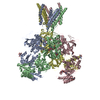 7saaC 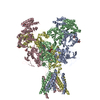 7sabC 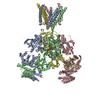 7sadC M: map data used to model this data C: citing same article ( |
|---|---|
| Similar structure data |

-Links
 PDBj
PDBj
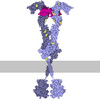
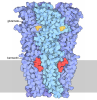
- Assembly
| Deposited unit | 
|
|---|---|
| 1 |
|
-Components
-Glutamate receptor ionotropic, NMDA ... , 2 types, 4 molecules ACBD
| #1: Protein | Mass: 95225.883 Da / Num. of mol.: 2 Source method: isolated from a genetically manipulated source Source: (gene. exp.) Rattus norvegicus (Norway rat) / Gene: Grin1, Nmdar1 / Production host:   Spodoptera frugiperda (fall armyworm) / References: UniProt: P35439 Spodoptera frugiperda (fall armyworm) / References: UniProt: P35439#2: Protein | Mass: 98888.945 Da / Num. of mol.: 2 Source method: isolated from a genetically manipulated source Source: (gene. exp.) Rattus norvegicus (Norway rat) / Gene: Grin2b / Production host: Spodoptera frugiperda (fall armyworm) / References: UniProt: Q00960 |
|---|
-Sugars , 2 types, 10 molecules 
| #3: Polysaccharide | Source method: isolated from a genetically manipulated source #4: Sugar | ChemComp-NAG / 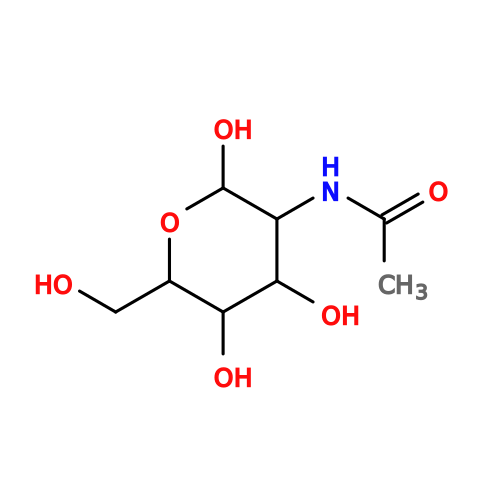 Type: D-saccharide, beta linking / Mass: 221.208 Da / Num. of mol.: 7 / Source method: obtained synthetically / Formula: C8H15NO6 Type: D-saccharide, beta linking / Mass: 221.208 Da / Num. of mol.: 7 / Source method: obtained synthetically / Formula: C8H15NO6 |
|---|
-Non-polymers , 3 types, 5 molecules 
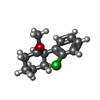
| #5: Chemical | 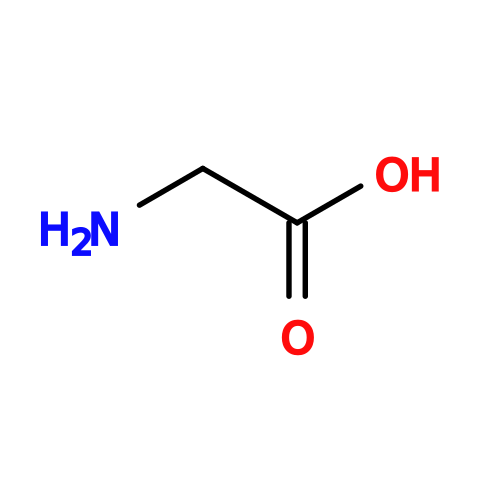 Type: peptide linking / Mass: 75.067 Da / Num. of mol.: 2 / Source method: obtained synthetically / Formula: C2H5NO2 / Feature type: SUBJECT OF INVESTIGATION Type: peptide linking / Mass: 75.067 Da / Num. of mol.: 2 / Source method: obtained synthetically / Formula: C2H5NO2 / Feature type: SUBJECT OF INVESTIGATION#6: Chemical | 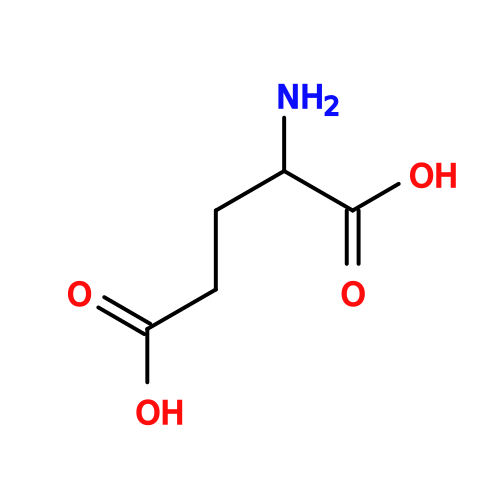 Type: L-peptide linking / Mass: 147.129 Da / Num. of mol.: 2 / Source method: obtained synthetically / Formula: C5H9NO4 / Feature type: SUBJECT OF INVESTIGATION Type: L-peptide linking / Mass: 147.129 Da / Num. of mol.: 2 / Source method: obtained synthetically / Formula: C5H9NO4 / Feature type: SUBJECT OF INVESTIGATION#7: Chemical | ChemComp-JC9 / ( |  Mass: 237.725 Da / Num. of mol.: 1 / Source method: obtained synthetically / Formula: C13H16ClNO / Feature type: SUBJECT OF INVESTIGATION / Comment: medication, antidepressant*YM Mass: 237.725 Da / Num. of mol.: 1 / Source method: obtained synthetically / Formula: C13H16ClNO / Feature type: SUBJECT OF INVESTIGATION / Comment: medication, antidepressant*YM |
|---|
-Details
| Has ligand of interest | Y |
|---|---|
| Has protein modification | Y |
-Experimental details
-Experiment
| Experiment | Method: ELECTRON MICROSCOPY |
|---|---|
| EM experiment | Aggregation state: PARTICLE / 3D reconstruction method: single particle reconstruction |
- Sample preparation
| Component | Name: Hetero-tetrameric GluN1a-GluN2B NMDA receptors / Type: COMPLEX / Entity ID: #1-#2 / Source: RECOMBINANT |
|---|---|
| Source (natural) | Organism: Rattus norvegicus (Norway rat) |
| Source (recombinant) | Organism: Spodoptera frugiperda (fall armyworm) |
| Buffer solution | pH: 7.5 |
| Specimen | Conc.: 4 mg/ml / Embedding applied: NO / Shadowing applied: NO / Staining applied: NO / Vitrification applied: YES |
| Vitrification | Instrument: FEI VITROBOT MARK IV / Cryogen name: ETHANE / Humidity: 85 % / Chamber temperature: 285 K |
- Electron microscopy imaging
| Experimental equipment |  Model: Titan Krios / Image courtesy: FEI Company |
|---|---|
| Microscopy | Model: FEI TITAN KRIOS |
| Electron gun | Electron source:  FIELD EMISSION GUN / Accelerating voltage: 300 kV / Illumination mode: FLOOD BEAM FIELD EMISSION GUN / Accelerating voltage: 300 kV / Illumination mode: FLOOD BEAM |
| Electron lens | Mode: BRIGHT FIELD |
| Image recording | Electron dose: 57.6 e/Å2 / Film or detector model: GATAN K3 BIOQUANTUM (6k x 4k) |
- Processing
| Software | Name: PHENIX / Version: 1.19.1_4122: / Classification: refinement | ||||||||||||||||||||||||
|---|---|---|---|---|---|---|---|---|---|---|---|---|---|---|---|---|---|---|---|---|---|---|---|---|---|
| EM software |
| ||||||||||||||||||||||||
| CTF correction | Type: NONE | ||||||||||||||||||||||||
| 3D reconstruction | Resolution: 3.69 Å / Resolution method: FSC 0.143 CUT-OFF / Num. of particles: 434625 / Symmetry type: POINT | ||||||||||||||||||||||||
| Refine LS restraints |
|
