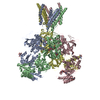
Movie
Movie Controller

[English] 日本語
 Yorodumi
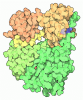
- EMDB-75121: SK5A-Matured apo state in complex with GluN1-GluN2B, full refinement -
+ Open data

- Basic information
| Entry |  | |||||||||
|---|---|---|---|---|---|---|---|---|---|---|
| Title | SK5A-Matured apo state in complex with GluN1-GluN2B, full refinement | |||||||||
 Map data Map data | SK5A-Matured apo state in complex with GluN1-GluN2B, full refinement | |||||||||
 Sample Sample |
| |||||||||
 Keywords Keywords | NMDAR / antibody / SIGNALING PROTEIN / SIGNALING PROTEIN-Immune System complex | |||||||||
| Function / homology |  Function and homology information Function and homology informationUnblocking of NMDA receptors, glutamate binding and activation / RAF/MAP kinase cascade / Synaptic adhesion-like molecules / Assembly and cell surface presentation of NMDA receptors / EPHB-mediated forward signaling / excitatory chemical synaptic transmission / Activated NTRK2 signals through FYN / ciliary transition zone / Synaptic adhesion-like molecules / Assembly and cell surface presentation of NMDA receptors ...Unblocking of NMDA receptors, glutamate binding and activation / RAF/MAP kinase cascade / Synaptic adhesion-like molecules / Assembly and cell surface presentation of NMDA receptors / EPHB-mediated forward signaling / excitatory chemical synaptic transmission / Activated NTRK2 signals through FYN / ciliary transition zone / Synaptic adhesion-like molecules / Assembly and cell surface presentation of NMDA receptors / negative regulation of dendritic spine maintenance / Neurexins and neuroligins / NMDA glutamate receptor activity / regulation of monoatomic cation transmembrane transport / NMDA selective glutamate receptor complex / glutamate binding / ligand-gated sodium channel activity / calcium ion transmembrane import into cytosol / protein heterotetramerization / glycine binding / glutamate receptor signaling pathway / Negative regulation of NMDA receptor-mediated neuronal transmission / Unblocking of NMDA receptors, glutamate binding and activation / regulation of neuronal synaptic plasticity / ciliary tip / Long-term potentiation / monoatomic cation transmembrane transport / ligand-gated monoatomic ion channel activity / MECP2 regulates neuronal receptors and channels / positive regulation of synaptic transmission, glutamatergic / EPHB-mediated forward signaling / glutamate-gated calcium ion channel activity / ionotropic glutamate receptor signaling pathway / ligand-gated monoatomic ion channel activity involved in regulation of presynaptic membrane potential / Ras activation upon Ca2+ influx through NMDA receptor / excitatory postsynaptic potential / positive regulation of excitatory postsynaptic potential / brain development / synaptic membrane / sodium ion transmembrane transport / synaptic transmission, glutamatergic / long-term synaptic potentiation / transmitter-gated monoatomic ion channel activity involved in regulation of postsynaptic membrane potential / regulation of synaptic plasticity / regulation of membrane potential / postsynaptic density membrane / calcium ion transmembrane transport / cilium / late endosome / amyloid-beta binding / RAF/MAP kinase cascade / signaling receptor activity / chemical synaptic transmission / response to ethanol / cytoskeleton / learning or memory / lysosome / postsynaptic membrane / postsynaptic density / neuron projection / synapse / dendrite / endoplasmic reticulum membrane / cell surface / zinc ion binding / metal ion binding / plasma membrane / cytoplasm Similarity search - Function | |||||||||
| Biological species |  Homo sapiens (human) / Homo sapiens (human) /   Mus musculus (house mouse) Mus musculus (house mouse) | |||||||||
| Method | single particle reconstruction / cryo EM / Resolution: 4.08 Å | |||||||||
 Authors Authors | Kleeman SO / Furukawa HF | |||||||||
| Funding support |  United States, 1 items United States, 1 items
| |||||||||
 Citation Citation | Journal: Nature / Year: 2026 Title: Ectopic NMDAR expression in cancer unmasks germline-encoded autoimmunity. Authors: Sam O Kleeman / Kevin Michalski / Xiang Zhao / Ruben Steigerwald / Miriam Ferrer / Llewelyn Levett / Ethan Ertel / Austin Schultz / Noriko Simorowski / Pamela Moody / Tse-Luen Wee / Cristina ...Authors: Sam O Kleeman / Kevin Michalski / Xiang Zhao / Ruben Steigerwald / Miriam Ferrer / Llewelyn Levett / Ethan Ertel / Austin Schultz / Noriko Simorowski / Pamela Moody / Tse-Luen Wee / Cristina Valente / Sharon Fox / Mateusz Makuch / Selina Thomsen / Ruby Harrison / Claire Regan / Jonathan Preall / Qing Gao / Dennis Thomas / Jill Habel / Rachel Rubino / Sarosh Irani / Hiro Furukawa / Tobias Janowitz /  Abstract: Autoimmunity and anti-cancer immunity lie on the same biological continuum, but their link remains obscure. The paraneoplastic neurological syndrome ANRE (anti-NMDA receptor (NMDAR) encephalitis) is ...Autoimmunity and anti-cancer immunity lie on the same biological continuum, but their link remains obscure. The paraneoplastic neurological syndrome ANRE (anti-NMDA receptor (NMDAR) encephalitis) is a paradigm for their connectivity, given that intratumoural NMDAR expression is correlated with the generation of anti-NMDAR antibodies. Here we verify ectopic expression of GluN1 and GluN2B NMDAR subunits in triple-negative breast cancer (TNBC) and model this using orthotopic TNBC tumours with inducible expression of GluN1-GluN2B NMDARs. We show that NMDAR expression is sufficient to induce the recruitment of B cells and their affinity maturation, consistent with an integrated adaptive immune response. Reconstruction of extended intratumoural B cell phylogenies and cryogenic electron microscopy structural analyses demonstrate that affinity-matured hypermutated and class-switched antibodies emerged from pre-existing germline-configuration lower-affinity anti-NMDAR antibodies. Distinct matured antibodies targeted specific epitopes and induced conformational rearrangements within the NMDAR amino-terminal domain, predictive of their functional effects, ranging from inhibition to potentiation. Passive transfer of an NMDAR-potentiating antibody caused autonomic dysregulation and lowered the seizure threshold in healthy female mice, recapitulating key diagnostic criteria of ANRE. We further identify a correlation between intratumoural NMDAR expression and anti-NMDAR antibody titres in patients with TNBC. Taken together, our data establish a direct connection between intratumoural NMDAR expression, antibody maturation and the onset of autoimmunity. These findings suggest that germline-encoded anti-NMDAR antibodies contribute to immune surveillance but can also trigger autoimmune disease after maturation, revealing a mechanistic trade-off between cancer immunity and neurotoxicity. | |||||||||
| History |
|
- Structure visualization
| Supplemental images |
|---|

- Downloads & links
-EMDB archive
| Map data | emd_75121.map.gz | 135.7 MB | EMDB map data format | |
|---|---|---|---|---|
| Header (meta data) | emd-75121-v30.xmlemd-75121.xml | 25.2 KB 25.2 KB | Display Display | EMDB header |
| Images |  emd_75121.png emd_75121.png | 69.6 KB | ||
| Filedesc metadata | emd-75121.cif.gz | 7.5 KB | ||
| Others | emd_75121_half_map_1.map.gzemd_75121_half_map_2.map.gz | 226.9 MB 226.9 MB | ||
| Archive directory |  https://data.pdbj.org/pub/emdb/structures/EMD-75121ftp://data.pdbj.org/pub/emdb/structures/EMD-75121 https://data.pdbj.org/pub/emdb/structures/EMD-75121ftp://data.pdbj.org/pub/emdb/structures/EMD-75121 | HTTPS FTP |
-Related structure data
| Related structure data |  10exMC  10enC  10evC  10eyC  10ezC  10fdC  10feC  10ffC  10flC  10fnC  10foC M: atomic model generated by this map C: citing same article ( |
|---|---|
| Similar structure data |


-Links
| EMDB pages | EMDB (EBI/PDBe) / EMDataResource |
|---|---|
| Related items in Molecule of the Month |

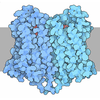
-Map
| File | Download / File: emd_75121.map.gz / Format: CCP4 / Size: 244.1 MB / Type: IMAGE STORED AS FLOATING POINT NUMBER (4 BYTES) | ||||||||||||||||||||||||||||||||||||
|---|---|---|---|---|---|---|---|---|---|---|---|---|---|---|---|---|---|---|---|---|---|---|---|---|---|---|---|---|---|---|---|---|---|---|---|---|---|
| Annotation | SK5A-Matured apo state in complex with GluN1-GluN2B, full refinement | ||||||||||||||||||||||||||||||||||||
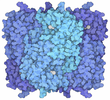
| Projections & slices | Image control
Images are generated by Spider. | ||||||||||||||||||||||||||||||||||||
| Voxel size | X=Y=Z: 1 Å | ||||||||||||||||||||||||||||||||||||
| Density |
| ||||||||||||||||||||||||||||||||||||
| Symmetry | Space group: 1 | ||||||||||||||||||||||||||||||||||||
| Details | EMDB XML:
|
 Z (Sec.)
 Y (Row.)
 X (Col.)


-Supplemental data
-Half map: Half Map A
| File | emd_75121_half_map_1.map | ||||||||||||
|---|---|---|---|---|---|---|---|---|---|---|---|---|---|
| Annotation | Half Map A | ||||||||||||
| Projections & Slices |
| ||||||||||||
| Density Histograms |


-Half map: Half Map B
| File | emd_75121_half_map_2.map | ||||||||||||
|---|---|---|---|---|---|---|---|---|---|---|---|---|---|
| Annotation | Half Map B | ||||||||||||
| Projections & Slices |
| ||||||||||||
| Density Histograms |


- Sample components
-Entire : SK3D IgG in complex with GluN1-GluN2B NMDAR protein
| Entire | Name: SK3D IgG in complex with GluN1-GluN2B NMDAR protein |
|---|---|
| Components |
|
-Supramolecule #1: SK3D IgG in complex with GluN1-GluN2B NMDAR protein
| Supramolecule | Name: SK3D IgG in complex with GluN1-GluN2B NMDAR protein / type: complex / ID: 1 / Parent: 0 / Macromolecule list: all |
|---|---|
| Source (natural) | Organism: Homo sapiens (human) |
-Macromolecule #1: Isoform 4 of Glutamate receptor ionotropic, NMDA 1
| Macromolecule | Name: Isoform 4 of Glutamate receptor ionotropic, NMDA 1 / type: protein_or_peptide / ID: 1 / Number of copies: 2 / Enantiomer: LEVO |
|---|---|
| Source (natural) | Organism: Homo sapiens (human) |
| Molecular weight | Theoretical: 91.827914 KDa |
| Recombinant expression | Organism:   Spodoptera frugiperda (fall armyworm) Spodoptera frugiperda (fall armyworm) |
| Sequence | String: KIVNIGAVLS TRKHEQMFRE AVNQANKRHG SWKIQLNATS VTHKPNAIQM ALSVCEDLIS SQVYAILVSH PPTPNDHFTP TPVSYTAGF YRIPVLGLTT RMSIYSDKSI HLSFLRTVPP YSHQSSVWFE MMRVYSWNHI ILLVSDDHEG RAAQKRLETL L EERESKAE ...String: KIVNIGAVLS TRKHEQMFRE AVNQANKRHG SWKIQLNATS VTHKPNAIQM ALSVCEDLIS SQVYAILVSH PPTPNDHFTP TPVSYTAGF YRIPVLGLTT RMSIYSDKSI HLSFLRTVPP YSHQSSVWFE MMRVYSWNHI ILLVSDDHEG RAAQKRLETL L EERESKAE KVLQFDPGTK NVTALLMEAR ELEARVIILS ASEDDAATVY RAAAMLNMTG SGYVWLVGER EISGNALRYA PD GIIGLQL INGKNESAHI SDAVGVVAQA VHELLEKENI TDPPRGCVGN TNIWKTGPLF KRVLMSSKYA DGVTGRVEFN EDG DRKFAN YSIMNLQNRK LVQVGIYNGT HVIPNDRKII WPGGETEKPR GYQMSTRLKI VTIHQEPFVY VKPTLSDGTC KEEF TVNGD PVKKVICTGP NDTSPGSPRH TVPQCCYGFC IDLLIKLART MNFTYEVHLV ADGKFGTQER VNNSNKKEWN GMMGE LLSG QADMIVAPLT INNERAQYIE FSKPFKYQGL TILVKKEIPR STLDSFMNPF QSTLWLLVGL SVHVVAVMLY LLDRFS PFG RFKVNSEEEE EDALTLSSAM WFSWGVLLNS GIGEGAPRSF SARILGMVWA GFAMIIVASY TANLAAFLVL DRPEERI TG INDPRLRNPS DKFIYATVKQ SSVDIYFRRQ VELSTMYRHM EKHNYESAAE AIQAVRDNKL HAFIWDSAVL EFEASQKC D LVTTGELFFR SGFGIGMRKD SPWKQNVSLS ILKSHENGFM EDLDKTWVRY QECDSRSNAP ATLTFENMAG VFMIVAGGI VAGIFLIFIE IAYKSRA UniProtKB: Glutamate receptor ionotropic, NMDA 1 |
-Macromolecule #2: Glutamate receptor ionotropic, NMDA 2B
| Macromolecule | Name: Glutamate receptor ionotropic, NMDA 2B / type: protein_or_peptide / ID: 2 / Number of copies: 2 / Enantiomer: LEVO |
|---|---|
| Source (natural) | Organism: Homo sapiens (human) |
| Molecular weight | Theoretical: 88.673234 KDa |
| Recombinant expression | Organism: Spodoptera frugiperda (fall armyworm) |
| Sequence | String: FHHLSVVPRV ELVAMNETDP KSIITRICDL MSDRKIQGVV FADDTDQEAI AQILDFISAQ TLTPILGIHG GSSMIMADKD ESSMFFQFG PSIEQQASVM LNIMEEYDWY IFSIVTTYFP GYQDFVNKIR STIENSFVGW ELEEVLLLDM SLDDGDSKIQ N QLKKLQSP ...String: FHHLSVVPRV ELVAMNETDP KSIITRICDL MSDRKIQGVV FADDTDQEAI AQILDFISAQ TLTPILGIHG GSSMIMADKD ESSMFFQFG PSIEQQASVM LNIMEEYDWY IFSIVTTYFP GYQDFVNKIR STIENSFVGW ELEEVLLLDM SLDDGDSKIQ N QLKKLQSP IILLYCTKEE ATYIFEVANS VGLTGYGYTW IVPSLVAGDT DTVPSEFPTG LISVSYDEWD YGLPARVRDG IA IITTAAS DMLSEHSFIP EPKSSCYNTH EKRIYQSNML NRYLINVTFE GRNLSFSEDG YQMHPKLVII LLNKERKWER VGK WKDKSL QMKYYVWPRM CPETEEQEDD HLSIVTLEEA PFVIVESVDP LSGTCMRNTV PCEKRIVTEN KTDEEPGYIK KCCK GFCID ILKKISKSVK FTYDLYLVTN GKHGKKINGT WNGMIGEVVM KRAYMAVGSL TINEERSEVV DFSVPFIETG ISVMV SRSN GTVSPSAFLE PFSADVWVMM FVMLLIVSAV AVFVFEYFSP VGYNRCLADG REPGGPSFTI GKAIWLLWGL VFNNSV PVQ NPKGTTSKIM VSVWAFFAVI FLASYTANLA AFMIQEEYVD QVSGLSDKKF QRPNDFSPPF RFGTVPNGST ERNIRNN YA EMHAYMGKFN QRGVDDALLS LKTGKLDAFI YDAAVLNYMA GRDEGCKLVT IGSGKVFAST GYGIAIQKDS GWKRQVDL A ILQLFGDGEM EELEALWLTG ICHNEKNEVM SSQLDIDNMA GVFYMLGAAM ALSLITFISE HLFYWQ UniProtKB: Glutamate receptor ionotropic, NMDA 2B |
-Macromolecule #3: Light chain
| Macromolecule | Name: Light chain / type: protein_or_peptide / ID: 3 / Number of copies: 2 / Enantiomer: LEVO |
|---|---|
| Source (natural) | Organism: Mus musculus (house mouse) |
| Molecular weight | Theoretical: 11.642848 KDa |
| Recombinant expression | Organism: Homo sapiens (human) |
| Sequence | String: DIQMTQSPSS LSASLGERVS LTCRASQDIG STLIWLQQEP DGTIKRLIYA TSSLDSGVPK RFSGSRSGSD YSLTISSLES EDFVDYYCL QYASSPYTFG GGTKLEIK |
-Macromolecule #4: Heavy chain
| Macromolecule | Name: Heavy chain / type: protein_or_peptide / ID: 4 / Number of copies: 2 / Enantiomer: LEVO |
|---|---|
| Source (natural) | Organism: Mus musculus (house mouse) |
| Molecular weight | Theoretical: 12.66998 KDa |
| Recombinant expression | Organism: Homo sapiens (human) |
| Sequence | String: EVQLQQSGAE LVKPGASVKL SCTASGFNIK DTYIHWVKQR PEQGLEWIGR IDPANGNTKY DPKFQGKATV TADTSSNAAY LHLSSLTSE DTAVYYCARS YDSFAYWGQG TLVTVSA |
-Experimental details
-Structure determination
| Method | cryo EM |
|---|---|
 Processing Processing | single particle reconstruction |
| Aggregation state | particle |
-Sample preparation
| Concentration | 5 mg/mL |
|---|---|
| Buffer | pH: 7.4 |
| Vitrification | Cryogen name: ETHANE / Instrument: FEI VITROBOT MARK IV |
- Electron microscopy
| Microscope | TFS KRIOS |
|---|---|
| Image recording | Film or detector model: GATAN K3 BIOCONTINUUM (6k x 4k) / Average electron dose: 71.7 e/Å2 |
| Electron beam | Acceleration voltage: 300 kV / Electron source:  FIELD EMISSION GUN FIELD EMISSION GUN |
| Electron optics | Illumination mode: FLOOD BEAM / Imaging mode: BRIGHT FIELD / Nominal defocus max: 2.2 µm / Nominal defocus min: 0.8 µm |
| Experimental equipment |  Model: Titan Krios / Image courtesy: FEI Company |