 Movie
Movie Controller


+ Open data

- Basic information
| Entry | Database: PDB / ID: 10fo | |||||||||||||||||||||
|---|---|---|---|---|---|---|---|---|---|---|---|---|---|---|---|---|---|---|---|---|---|---|
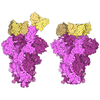
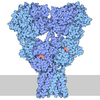
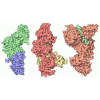
| Title | SK5B-Germline in complex with GluN1-GluN2B, full refinement | |||||||||||||||||||||
 Components Components |
| |||||||||||||||||||||
 Keywords Keywords | SIGNALING PROTEIN/Immune System / NMDAR / antibody / SIGNALING PROTEIN / SIGNALING PROTEIN-Immune System complex | |||||||||||||||||||||
| Function / homology |  Function and homology information Function and homology informationglycine-gated cation channel activity / excitatory chemical synaptic transmission / Activated NTRK2 signals through FYN / Synaptic adhesion-like molecules / ciliary transition zone / propylene metabolic process / response to glycine / neurotransmitter receptor complex / Assembly and cell surface presentation of NMDA receptors / Neurexins and neuroligins ...glycine-gated cation channel activity / excitatory chemical synaptic transmission / Activated NTRK2 signals through FYN / Synaptic adhesion-like molecules / ciliary transition zone / propylene metabolic process / response to glycine / neurotransmitter receptor complex / Assembly and cell surface presentation of NMDA receptors / Neurexins and neuroligins / negative regulation of dendritic spine maintenance / NMDA glutamate receptor activity / regulation of monoatomic cation transmembrane transport / NMDA selective glutamate receptor complex / glutamate binding / ligand-gated sodium channel activity / calcium ion transmembrane import into cytosol / positive regulation of reactive oxygen species biosynthetic process / protein heterotetramerization / glycine binding / glutamate receptor signaling pathway / ligand-gated monoatomic ion channel activity / Negative regulation of NMDA receptor-mediated neuronal transmission / Unblocking of NMDA receptors, glutamate binding and activation / positive regulation of calcium ion transport into cytosol / regulation of neuronal synaptic plasticity / Long-term potentiation / monoatomic cation transmembrane transport / ciliary tip / monoatomic cation transport / calcium ion homeostasis / MECP2 regulates neuronal receptors and channels / positive regulation of synaptic transmission, glutamatergic / EPHB-mediated forward signaling / glutamate-gated calcium ion channel activity / visual learning / synaptic cleft / ionotropic glutamate receptor signaling pathway / excitatory synapse / ligand-gated monoatomic ion channel activity involved in regulation of presynaptic membrane potential / excitatory postsynaptic potential / Ras activation upon Ca2+ influx through NMDA receptor / positive regulation of excitatory postsynaptic potential / brain development / sodium ion transmembrane transport / synaptic membrane / synaptic transmission, glutamatergic / long-term synaptic potentiation / transmitter-gated monoatomic ion channel activity involved in regulation of postsynaptic membrane potential / regulation of membrane potential / regulation of synaptic plasticity / postsynaptic density membrane / calcium ion transmembrane transport / terminal bouton / late endosome / cilium / synaptic vesicle / amyloid-beta binding / signaling receptor activity / RAF/MAP kinase cascade / chemical synaptic transmission / presynaptic membrane / calmodulin binding / cytoskeleton / dendritic spine / response to ethanol / learning or memory / lysosome / postsynaptic membrane / neuron projection / postsynaptic density / calcium ion binding / dendrite / endoplasmic reticulum membrane / synapse / protein-containing complex binding / cell surface / positive regulation of transcription by RNA polymerase II / zinc ion binding / plasma membrane / cytoplasm Similarity search - Function | |||||||||||||||||||||
| Biological species |  Homo sapiens (human) Homo sapiens (human)  Mus musculus (house mouse) Mus musculus (house mouse) | |||||||||||||||||||||
| Method | ELECTRON MICROSCOPY / single particle reconstruction / cryo EM / Resolution: 4.46 Å | |||||||||||||||||||||
 Authors Authors | Kleeman, S.O. / Furukawa, H.F. | |||||||||||||||||||||
| Funding support |  United States, 1items United States, 1items
| |||||||||||||||||||||
 Citation Citation | Journal: Nature / Year: 2026 Title: Ectopic NMDAR expression in cancer unmasks germline-encoded autoimmunity. Authors: Sam O Kleeman / Kevin Michalski / Xiang Zhao / Ruben Steigerwald / Miriam Ferrer / Llewelyn Levett / Ethan Ertel / Austin Schultz / Noriko Simorowski / Pamela Moody / Tse-Luen Wee / Cristina ...Authors: Sam O Kleeman / Kevin Michalski / Xiang Zhao / Ruben Steigerwald / Miriam Ferrer / Llewelyn Levett / Ethan Ertel / Austin Schultz / Noriko Simorowski / Pamela Moody / Tse-Luen Wee / Cristina Valente / Sharon Fox / Mateusz Makuch / Selina Thomsen / Ruby Harrison / Claire Regan / Jonathan Preall / Qing Gao / Dennis Thomas / Jill Habel / Rachel Rubino / Sarosh Irani / Hiro Furukawa / Tobias Janowitz /  Abstract: Autoimmunity and anti-cancer immunity lie on the same biological continuum, but their link remains obscure. The paraneoplastic neurological syndrome ANRE (anti-NMDA receptor (NMDAR) encephalitis) is ...Autoimmunity and anti-cancer immunity lie on the same biological continuum, but their link remains obscure. The paraneoplastic neurological syndrome ANRE (anti-NMDA receptor (NMDAR) encephalitis) is a paradigm for their connectivity, given that intratumoural NMDAR expression is correlated with the generation of anti-NMDAR antibodies. Here we verify ectopic expression of GluN1 and GluN2B NMDAR subunits in triple-negative breast cancer (TNBC) and model this using orthotopic TNBC tumours with inducible expression of GluN1-GluN2B NMDARs. We show that NMDAR expression is sufficient to induce the recruitment of B cells and their affinity maturation, consistent with an integrated adaptive immune response. Reconstruction of extended intratumoural B cell phylogenies and cryogenic electron microscopy structural analyses demonstrate that affinity-matured hypermutated and class-switched antibodies emerged from pre-existing germline-configuration lower-affinity anti-NMDAR antibodies. Distinct matured antibodies targeted specific epitopes and induced conformational rearrangements within the NMDAR amino-terminal domain, predictive of their functional effects, ranging from inhibition to potentiation. Passive transfer of an NMDAR-potentiating antibody caused autonomic dysregulation and lowered the seizure threshold in healthy female mice, recapitulating key diagnostic criteria of ANRE. We further identify a correlation between intratumoural NMDAR expression and anti-NMDAR antibody titres in patients with TNBC. Taken together, our data establish a direct connection between intratumoural NMDAR expression, antibody maturation and the onset of autoimmunity. These findings suggest that germline-encoded anti-NMDAR antibodies contribute to immune surveillance but can also trigger autoimmune disease after maturation, revealing a mechanistic trade-off between cancer immunity and neurotoxicity. | |||||||||||||||||||||
| History |
|
- Structure visualization
| Structure viewer | Molecule: MolmilJmol/JSmol |
|---|
- Downloads & links
-Download
| PDBx/mmCIF format | 10fo.cif.gz | 566.1 KB | Display | PDBx/mmCIF format |
|---|---|---|---|---|
| PDB format | pdb10fo.ent.gz | 449.2 KB | Display | PDB format |
| PDBx/mmJSON format | 10fo.json.gz | Tree view | PDBx/mmJSON format | |
| Others |  Other downloads Other downloads |
-Validation report
| Arichive directory | https://data.pdbj.org/pub/pdb/validation_reports/0f/10foftp://data.pdbj.org/pub/pdb/validation_reports/0f/10fo | HTTPS FTP |
|---|
-Related structure data
| Related structure data |  75138MC  10enC  10evC  10exC  10eyC  10ezC  10fdC  10feC  10ffC  10flC  10fnC M: map data used to model this data C: citing same article ( |
|---|---|
| Similar structure data |


-Links
 PDBj
PDBj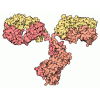

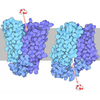
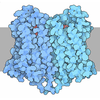
- Assembly
| Deposited unit | 
|
|---|---|
| 1 |
|
-Components
| #1: Protein | Mass: 94854.508 Da / Num. of mol.: 2 Source method: isolated from a genetically manipulated source Source: (gene. exp.) Homo sapiens (human) / Gene: GRIN1, NMDAR1 / Cell line (production host): Sf9 / Production host:   Spodoptera frugiperda (fall armyworm) / References: UniProt: Q05586 Spodoptera frugiperda (fall armyworm) / References: UniProt: Q05586#2: Protein | Mass: 92885.961 Da / Num. of mol.: 2 Source method: isolated from a genetically manipulated source Source: (gene. exp.) Homo sapiens (human) / Gene: GRIN2B, NMDAR2B / Cell line (production host): Sf9 / Production host: Spodoptera frugiperda (fall armyworm) / References: UniProt: Q13224#3: Antibody | | Mass: 12065.281 Da / Num. of mol.: 1 Source method: isolated from a genetically manipulated source Source: (gene. exp.) Mus musculus (house mouse) / Cell line (production host): Ric15 / Production host: Homo sapiens (human)#4: Antibody | | Mass: 13218.524 Da / Num. of mol.: 1 Source method: isolated from a genetically manipulated source Source: (gene. exp.) Mus musculus (house mouse) / Cell line (production host): Ric15 / Production host: Homo sapiens (human)Has protein modification | Y | |
|---|
-Experimental details
-Experiment
| Experiment | Method: ELECTRON MICROSCOPY |
|---|---|
| EM experiment | Aggregation state: PARTICLE / 3D reconstruction method: single particle reconstruction |
- Sample preparation
| Component | Name: SK5B-Germline IgG in complex with GluN1-GluN2B NMDAR protein Type: COMPLEX / Entity ID: all / Source: RECOMBINANT |
|---|---|
| Molecular weight | Experimental value: NO |
| Source (natural) | Organism: Homo sapiens (human) |
| Source (recombinant) | Organism: Homo sapiens (human) |
| Buffer solution | pH: 7.4 |
| Specimen | Conc.: 5 mg/ml / Embedding applied: NO / Shadowing applied: NO / Staining applied: NO / Vitrification applied: YES |
| Vitrification | Instrument: FEI VITROBOT MARK IV / Cryogen name: ETHANE |
- Electron microscopy imaging
| Experimental equipment |  Model: Titan Krios / Image courtesy: FEI Company |
|---|---|
| Microscopy | Model: TFS KRIOS |
| Electron gun | Electron source:  FIELD EMISSION GUN / Accelerating voltage: 300 kV / Illumination mode: FLOOD BEAM FIELD EMISSION GUN / Accelerating voltage: 300 kV / Illumination mode: FLOOD BEAM |
| Electron lens | Mode: BRIGHT FIELD / Nominal defocus max: 2200 nm / Nominal defocus min: 800 nm |
| Image recording | Electron dose: 71.7 e/Å2 / Film or detector model: GATAN K3 BIOCONTINUUM (6k x 4k) |
- Processing
| EM software |
| |||||||||
|---|---|---|---|---|---|---|---|---|---|---|
| CTF correction | Type: PHASE FLIPPING AND AMPLITUDE CORRECTION | |||||||||
| 3D reconstruction | Resolution: 4.46 Å / Resolution method: FSC 0.143 CUT-OFF / Num. of particles: 52452 / Symmetry type: POINT |
