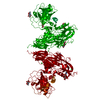
Movie
Movie Controller

[English] 日本語
 Yorodumi
- EMDB-74756: Structural insights into the exosite-mediated activation of Facto... -
+ Open data

- Basic information
| Entry |  | ||||||||||||||||||
|---|---|---|---|---|---|---|---|---|---|---|---|---|---|---|---|---|---|---|---|
| Title | Structural insights into the exosite-mediated activation of Factor IX by Factor XIa using cryoEM | ||||||||||||||||||
 Map data Map data | DeepEMhancer sharpened map - using Binary mask - used for model building | ||||||||||||||||||
 Sample Sample |
| ||||||||||||||||||
 Keywords Keywords | Coagulation / Intrinsic Pathway / Complex / Hemophilia / Factor IX / Factor XIa / BLOOD CLOTTING | ||||||||||||||||||
| Function / homology |  Function and homology information Function and homology informationDefective F9 secretion / coagulation factor IXa / Defective gamma-carboxylation of F9 / coagulation factor XIa / serine-type aminopeptidase activity / Defective F9 activation / positive regulation of fibrinolysis / Defective factor IX causes thrombophilia / Defective cofactor function of FVIIIa variant / Defective F9 variant does not activate FX ...Defective F9 secretion / coagulation factor IXa / Defective gamma-carboxylation of F9 / coagulation factor XIa / serine-type aminopeptidase activity / Defective F9 activation / positive regulation of fibrinolysis / Defective factor IX causes thrombophilia / Defective cofactor function of FVIIIa variant / Defective F9 variant does not activate FX / : / zymogen activation / plasminogen activation / Protein hydroxylation / Transport of gamma-carboxylated protein precursors from the endoplasmic reticulum to the Golgi apparatus / Gamma-carboxylation of protein precursors / Removal of aminoterminal propeptides from gamma-carboxylated proteins / : / serine-type peptidase activity / Golgi lumen / blood coagulation / heparin binding / endopeptidase activity / extracellular matrix / endoplasmic reticulum lumen / serine-type endopeptidase activity / calcium ion binding / proteolysis / : / extracellular exosome / extracellular region / membrane / metal ion binding / identical protein binding / plasma membrane Similarity search - Function | ||||||||||||||||||
| Biological species |  Homo sapiens (human) Homo sapiens (human) | ||||||||||||||||||
| Method | single particle reconstruction / cryo EM / Resolution: 3.7 Å | ||||||||||||||||||
 Authors Authors | Mohammed BM | ||||||||||||||||||
| Funding support |  United States, 5 items United States, 5 items
| ||||||||||||||||||
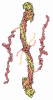
 Citation Citation | Journal: J Thromb Haemost / Year: 2026 Title: Structural insights into the exosite-mediated activation of Factor IX by Factor XIa using cryo-EM. Authors: Bassem M Mohammed / Samantha Deavila / Tristan Friet / Isabella Dattilio / Abstract: BACKGROUND: Factor XI (FXI) occupies a unique and clinically significant niche, bridging the tissue factor-driven and contact-driven coagulation pathways. Irrespective of the trigger, activated ...BACKGROUND: Factor XI (FXI) occupies a unique and clinically significant niche, bridging the tissue factor-driven and contact-driven coagulation pathways. Irrespective of the trigger, activated factor XI (FXIa) contributes to clotting by activating factor IX (FIX). Biochemical studies established that this reaction requires the membrane-binding FIX-Gla domain to engage an exosite on the FXIa Apple 3 (A3) domain, that only become available upon FXI activation. Structural data for FXIa, FIX, FIXaβ, and the FXIa:FIX complex are lacking; current understanding relies on zymogen FXI crystal structures and homology modeling of FXIa after kallikrein. OBJECTIVES: Elucidate the high-resolution structure of FXIa in functionally relevant conformation in complex with FIX. METHODS: We utilized cryogenic electron microscopy (cryo-EM) to determine the structures of human FXIa in complex with its full-length substrate, FIX, and activated product, FIXaβ. RESULTS: We report the first cryo-EM structures of FXIa in complex with its substrate, FIX, and activated FIX (FIXaβ). The structures capture a functionally relevant conformational change in the ...RESULTS: We report the first cryo-EM structures of FXIa in complex with its substrate, FIX, and activated FIX (FIXaβ). The structures capture a functionally relevant conformational change in the FXIa catalytic domain and reveals the first view of the entire FIX and FIXaβ. Critically, we visualize the FIX-Gla domain precisely docked to the FXIa-A3 exosite on both subunits of the FXIa dimer. We also define the first step of proteolysis, visualizing the FIX Arg145 inserted into the primary specificity pocket of FXIa. CONCLUSIONS: The structures define the full FXIa:FIX interface providing a structural template for understanding the sequential activation of FIX and for developing a new class of selective ...CONCLUSIONS: The structures define the full FXIa:FIX interface providing a structural template for understanding the sequential activation of FIX and for developing a new class of selective allosteric antithrombotic agents. | ||||||||||||||||||
| History |
|
- Structure visualization
| Supplemental images |
|---|

- Downloads & links
-EMDB archive
| Map data | emd_74756.map.gz | 211.5 MB | EMDB map data format | |
|---|---|---|---|---|
| Header (meta data) | emd-74756-v30.xmlemd-74756.xml | 38.1 KB 38.1 KB | Display Display | EMDB header |
| FSC (resolution estimation) | emd_74756_fsc.xml | 13.8 KB | Display | FSC data file |
| Images |  emd_74756.png emd_74756.png | 99.4 KB | ||
| Masks | emd_74756_msk_1.map | 274.6 MB | Mask map | |
| Filedesc metadata | emd-74756.cif.gz | 8.6 KB | ||
| Others | emd_74756_additional_1.map.gzemd_74756_additional_2.map.gzemd_74756_half_map_1.map.gzemd_74756_half_map_2.map.gz | 254.9 MB 137.1 MB 254.7 MB 254.7 MB | ||
| Archive directory |  https://data.pdbj.org/pub/emdb/structures/EMD-74756ftp://data.pdbj.org/pub/emdb/structures/EMD-74756 https://data.pdbj.org/pub/emdb/structures/EMD-74756ftp://data.pdbj.org/pub/emdb/structures/EMD-74756 | HTTPS FTP |
-Related structure data
| Related structure data |  9ztkMC  12bnC  9zqyC  9zubC  9zunC  9zvxC C: citing same article ( M: atomic model generated by this map |
|---|---|
| Similar structure data |


-Links
| EMDB pages | EMDB (EBI/PDBe) / EMDataResource |
|---|---|
| Related items in Molecule of the Month |
-Map
| File | Download / File: emd_74756.map.gz / Format: CCP4 / Size: 274.6 MB / Type: IMAGE STORED AS FLOATING POINT NUMBER (4 BYTES) | ||||||||||||||||||||||||||||||||||||
|---|---|---|---|---|---|---|---|---|---|---|---|---|---|---|---|---|---|---|---|---|---|---|---|---|---|---|---|---|---|---|---|---|---|---|---|---|---|
| Annotation | DeepEMhancer sharpened map - using Binary mask - used for model building | ||||||||||||||||||||||||||||||||||||
| Projections & slices | Image control
Images are generated by Spider. | ||||||||||||||||||||||||||||||||||||
| Voxel size | X=Y=Z: 0.928 Å | ||||||||||||||||||||||||||||||||||||
| Density |
| ||||||||||||||||||||||||||||||||||||
| Symmetry | Space group: 1 | ||||||||||||||||||||||||||||||||||||
| Details | EMDB XML:
|
 Z (Sec.)
 Y (Row.)
 X (Col.)


-Supplemental data
-Mask #1
| File | emd_74756_msk_1.map | ||||||||||||
|---|---|---|---|---|---|---|---|---|---|---|---|---|---|
| Projections & Slices |
| ||||||||||||
| Density Histograms |


-Additional map: DeepEMhanccer sharpened map - widetarget
| File | emd_74756_additional_1.map | ||||||||||||
|---|---|---|---|---|---|---|---|---|---|---|---|---|---|
| Annotation | DeepEMhanccer sharpened map - widetarget | ||||||||||||
| Projections & Slices |
| ||||||||||||
| Density Histograms |


-Additional map: Unsharpened local refined map for Class1 volume
| File | emd_74756_additional_2.map | ||||||||||||
|---|---|---|---|---|---|---|---|---|---|---|---|---|---|
| Annotation | Unsharpened local refined map for Class1 volume | ||||||||||||
| Projections & Slices |
| ||||||||||||
| Density Histograms |


-Half map: #2
| File | emd_74756_half_map_1.map | ||||||||||||
|---|---|---|---|---|---|---|---|---|---|---|---|---|---|
| Projections & Slices |
| ||||||||||||
| Density Histograms |


-Half map: #1
| File | emd_74756_half_map_2.map | ||||||||||||
|---|---|---|---|---|---|---|---|---|---|---|---|---|---|
| Projections & Slices |
| ||||||||||||
| Density Histograms |


- Sample components
-Entire : Complex of Factor XIa (FXIa) with Factor IX (FIX).
| Entire | Name: Complex of Factor XIa (FXIa) with Factor IX (FIX). |
|---|---|
| Components |
|
-Supramolecule #1: Complex of Factor XIa (FXIa) with Factor IX (FIX).
| Supramolecule | Name: Complex of Factor XIa (FXIa) with Factor IX (FIX). / type: complex / ID: 1 / Parent: 0 / Macromolecule list: #3 Details: FXIa is a dimer and binds 2 FIX molecules. Factor XIa used in this preparation is recombinant FXIa with a Ser557Ala mutation (mature protein numbering). recombinant protein is made as a ...Details: FXIa is a dimer and binds 2 FIX molecules. Factor XIa used in this preparation is recombinant FXIa with a Ser557Ala mutation (mature protein numbering). recombinant protein is made as a zymogen that is activated. The activation involve cleavage after residue Arg369 of FXI to give FXIa |
|---|---|
| Source (natural) | Organism: Homo sapiens (human) / Organ: liver / Tissue: Plasma |
| Molecular weight | Theoretical: 57 KDa |
-Supramolecule #2: Activated coagulation Factor XI (FXIa)
| Supramolecule | Name: Activated coagulation Factor XI (FXIa) / type: complex / ID: 2 / Parent: 1 / Macromolecule list: #1 Details: Made from recombinant FXI that was activated to give FXIa. Has a Ser557Ala mutation to render it catalytically dead. |
|---|---|
| Source (natural) | Organism: Homo sapiens (human) / Organ: liver / Tissue: Plasma |
-Supramolecule #3: Coagulation Factor IX (FIX)
| Supramolecule | Name: Coagulation Factor IX (FIX) / type: complex / ID: 3 / Parent: 1 / Macromolecule list: #3 / Details: Purified from human plasma |
|---|---|
| Source (natural) | Organism: Homo sapiens (human) / Organ: liver / Tissue: Plasma |
-Macromolecule #1: Coagulation factor XIa heavy chain
| Macromolecule | Name: Coagulation factor XIa heavy chain / type: protein_or_peptide / ID: 1 / Number of copies: 1 / Enantiomer: LEVO / EC number: coagulation factor XIa |
|---|---|
| Source (natural) | Organism: Homo sapiens (human) |
| Molecular weight | Theoretical: 41.262098 KDa |
| Recombinant expression | Organism: Homo sapiens (human) |
| Sequence | String: ECVTQLLKDT CFEGGDITTV FTPSAKYCQV VCTYHPRCLL FTFTAESPSE DPTRWFTCVL KDSVTETLPR VNRTAAISGY SFKQCSHQI SACNKDIYVD LDMKGINYNS SVAKSAQECQ ERCTDDVHCH FFTYATRQFP SLEHRNICLL KHTQTGTPTR I TKLDKVVS ...String: ECVTQLLKDT CFEGGDITTV FTPSAKYCQV VCTYHPRCLL FTFTAESPSE DPTRWFTCVL KDSVTETLPR VNRTAAISGY SFKQCSHQI SACNKDIYVD LDMKGINYNS SVAKSAQECQ ERCTDDVHCH FFTYATRQFP SLEHRNICLL KHTQTGTPTR I TKLDKVVS GFSLKSCALS NLACIRDIFP NTVFADSNID SVMAPDAFVC GRICTHHPGC LFFTFFSQEW PKESQRNLCL LK TSESGLP STRIKKSKAL SGFSLQSCRH SIPVFCHSSF YHDTDFLGEE LDIVAAKSHE ACQKLCTNAV RCQFFTYTPA QAS CNEGKG KCYLKLSSNG SPTKILHGRG GISGYTLRLC KMDNECTTKI KPR UniProtKB: Coagulation factor XI |
-Macromolecule #2: Coagulation factor XIa light chain
| Macromolecule | Name: Coagulation factor XIa light chain / type: protein_or_peptide / ID: 2 / Number of copies: 1 / Enantiomer: LEVO |
|---|---|
| Source (natural) | Organism: Homo sapiens (human) |
| Molecular weight | Theoretical: 26.686352 KDa |
| Recombinant expression | Organism: Homo sapiens (human) |
| Sequence | String: IVGGTASVRG EWPWQVTLHT TSPTQRHLCG GSIIGNQWIL TAAHCFYGVE SPKILRVYSG ILNQSEIKED TSFFGVQEII IHDQYKMAE SGYDIALLKL ETTVNYTDSQ RPICLPSKGD RNVIYTDCWV TGWGYRKLRD KIQNTLQKAK IPLVTNEECQ K RYRGHKIT ...String: IVGGTASVRG EWPWQVTLHT TSPTQRHLCG GSIIGNQWIL TAAHCFYGVE SPKILRVYSG ILNQSEIKED TSFFGVQEII IHDQYKMAE SGYDIALLKL ETTVNYTDSQ RPICLPSKGD RNVIYTDCWV TGWGYRKLRD KIQNTLQKAK IPLVTNEECQ K RYRGHKIT HKMICAGYRE GGKDACKGDA GGPLSCKHNE VWHLVGITSW GEGCAQRERP GVYTNVVEYV DWILEKTQ UniProtKB: Coagulation factor XI |
-Macromolecule #3: Coagulation factor IX
| Macromolecule | Name: Coagulation factor IX / type: protein_or_peptide / ID: 3 Details: CGU are Glu residues with post-translational modification adding a carboxyl group to the gamma carbon of Glu Number of copies: 1 / Enantiomer: LEVO / EC number: coagulation factor IXa |
|---|---|
| Source (natural) | Organism: Homo sapiens (human) / Tissue: plasma |
| Molecular weight | Theoretical: 47.158219 KDa |
| Sequence | String: YNSGKL(CGU)(CGU)FV QGNL(CGU)R(CGU)CM(CGU) (CGU)KCSF(CGU)(CGU)AR(CGU) VF(CGU)NT(CGU) RTT (CGU)FWKQYVDGD QCESNPCLNG GSCKDDINSY ECWCPFGFEG KNCELDVTCN IKNGRCEQFC KNSADNKVVC SCT EGYRLA ENQKSCEPAV ...String: YNSGKL(CGU)(CGU)FV QGNL(CGU)R(CGU)CM(CGU) (CGU)KCSF(CGU)(CGU)AR(CGU) VF(CGU)NT(CGU) RTT (CGU)FWKQYVDGD QCESNPCLNG GSCKDDINSY ECWCPFGFEG KNCELDVTCN IKNGRCEQFC KNSADNKVVC SCT EGYRLA ENQKSCEPAV PFPCGRVSVS QTSKLTRAET VFPDVDYVNS TEAETILDNI TQSTQSFNDF TRVVGGEDAK PGQF PWQVV LNGKVDAFCG GSIVNEKWIV TAAHCVETGV KITVVAGEHN IEETEHTEQK RNVIRIIPHH NYNAAINKYN HDIAL LELD EPLVLNSYVT PICIADKEYT NIFLKFGSGY VSGWGRVFHK GRSALVLQYL RVPLVDRATC LRSTKFTIYN NMFCAG FHE GGRDSCQGDS GGPHVTEVEG TSFLTGIISW GEECAMKGKY GIYTKVSRYV NWIKEKTKLT UniProtKB: Coagulation factor IX |
-Macromolecule #4: 2-acetamido-2-deoxy-beta-D-glucopyranose
| Macromolecule | Name: 2-acetamido-2-deoxy-beta-D-glucopyranose / type: ligand / ID: 4 / Number of copies: 4 / Formula: NAG |
|---|---|
| Molecular weight | Theoretical: 221.208 Da |
| Chemical component information | 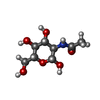 ChemComp-NAG: |
-Macromolecule #5: CALCIUM ION
| Macromolecule | Name: CALCIUM ION / type: ligand / ID: 5 / Number of copies: 7 / Formula: CA |
|---|---|
| Molecular weight | Theoretical: 40.078 Da |
-Experimental details
-Structure determination
| Method | cryo EM |
|---|---|
 Processing Processing | single particle reconstruction |
| Aggregation state | particle |
-Sample preparation #1
| Preparation ID | 1 | ||||||||||||
|---|---|---|---|---|---|---|---|---|---|---|---|---|---|
| Concentration | 0.1 mg/mL | ||||||||||||
| Buffer | pH: 7.4 Component:
| ||||||||||||
| Grid | Model: Quantifoil R1.2/1.3 / Support film - Film type ID: 1 / Support film - Material: CARBON / Support film - topology: HOLEY / Pretreatment - Type: GLOW DISCHARGE / Pretreatment - Time: 20 sec. / Pretreatment - Atmosphere: AIR | ||||||||||||
| Vitrification | Cryogen name: ETHANE / Chamber humidity: 95 % / Chamber temperature: 277.15 K / Instrument: FEI VITROBOT MARK IV |
-Sample preparation #2
| Preparation ID | 2 | ||||||||||||
|---|---|---|---|---|---|---|---|---|---|---|---|---|---|
| Concentration | 0.1 mg/mL | ||||||||||||
| Buffer | pH: 7.4 Component:
| ||||||||||||
| Grid | Model: Quantifoil R1.2/1.3 / Support film - Film type ID: 1 / Support film - Material: CARBON / Support film - topology: HOLEY / Pretreatment - Type: GLOW DISCHARGE / Pretreatment - Time: 20 sec. / Pretreatment - Atmosphere: AIR | ||||||||||||
| Vitrification | Cryogen name: ETHANE / Chamber humidity: 95 % / Chamber temperature: 277.15 K / Instrument: FEI VITROBOT MARK IV |
- Electron microscopy
| Microscope | TFS GLACIOS |
|---|---|
| Image recording | #0 - Image recording ID: 1 / #0 - Film or detector model: FEI FALCON IV (4k x 4k) / #0 - Digitization - Dimensions - Width: 4096 pixel / #0 - Digitization - Dimensions - Height: 4096 pixel / #0 - Number grids imaged: 1 / #0 - Number real images: 4662 / #0 - Average electron dose: 60.0 e/Å2 / #1 - Image recording ID: 2 / #1 - Film or detector model: FEI FALCON IV (4k x 4k) / #1 - Digitization - Dimensions - Width: 4096 pixel / #1 - Digitization - Dimensions - Height: 4096 pixel / #1 - Number grids imaged: 1 / #1 - Number real images: 1832 / #1 - Average electron dose: 57.2 e/Å2 / #1 - Details: 30 degree tilt / #2 - Image recording ID: 3 / #2 - Film or detector model: FEI FALCON IV (4k x 4k) / #2 - Digitization - Dimensions - Width: 4096 pixel / #2 - Digitization - Dimensions - Height: 4096 pixel / #2 - Number grids imaged: 1 / #2 - Number real images: 1297 / #2 - Average electron dose: 52.5 e/Å2 / #3 - Image recording ID: 4 / #3 - Film or detector model: FEI FALCON IV (4k x 4k) / #3 - Digitization - Dimensions - Width: 4096 pixel / #3 - Digitization - Dimensions - Height: 4096 pixel / #3 - Number grids imaged: 1 / #3 - Number real images: 817 / #3 - Average electron dose: 52.5 e/Å2 / #4 - Image recording ID: 5 / #4 - Film or detector model: FEI FALCON IV (4k x 4k) / #4 - Digitization - Dimensions - Width: 4096 pixel / #4 - Digitization - Dimensions - Height: 4096 pixel / #4 - Number grids imaged: 1 / #4 - Number real images: 2789 / #4 - Average electron dose: 50.0 e/Å2 |
| Electron beam | Acceleration voltage: 200 kV / Electron source:  FIELD EMISSION GUN FIELD EMISSION GUN |
| Electron optics | Illumination mode: FLOOD BEAM / Imaging mode: BRIGHT FIELD / Cs: 2.7 mm / Nominal defocus max: 2.4 µm / Nominal defocus min: 1.0 µm / Nominal magnification: 150000 |
| Sample stage | Cooling holder cryogen: NITROGEN |
+Image processing #1

+Image processing #2
-Atomic model buiding 1
| Initial model |
| |||||||||||||||
|---|---|---|---|---|---|---|---|---|---|---|---|---|---|---|---|---|
| Details | Combined Rigid fit, backbone trace, and ab-initio | |||||||||||||||
| Refinement | Space: REAL / Protocol: OTHER | |||||||||||||||
| Output model | PDB-9ztk: |