National Institutes of Health/National Institute of General Medical Sciences (NIH/NIGMS)
R01GM139034
米国
National Institutes of Health/National Institute of General Medical Sciences (NIH/NIGMS)
R35GM158090
米国
引用
ジャーナル: PLoS Pathog / 年: 2026 タイトル: Neutralization of SARS-CoV-2 by IgM-14 via engagement of two distinct spike epitopes. 著者: Yan Wang / Yanping Hu / Zhiqiang Ku / Jason Yeung / Jing Zou / Michael Woodson / Nikolai S Prokhorov / Ekaterina S Knyazhanskaya / Haiqing Zhao / Michael B Sherman / Zhiqiang An / Stephen F ...著者: Yan Wang / Yanping Hu / Zhiqiang Ku / Jason Yeung / Jing Zou / Michael Woodson / Nikolai S Prokhorov / Ekaterina S Knyazhanskaya / Haiqing Zhao / Michael B Sherman / Zhiqiang An / Stephen F Carroll / Pei-Yong Shi / Petr G Leiman / Xuping Xie / 要旨: Engineered immunoglobulin M (IgM) antibodies typically exhibit superior neutralization potency and avidity compared to their parental IgG counterparts, primarily due to multivalent binding to ...Engineered immunoglobulin M (IgM) antibodies typically exhibit superior neutralization potency and avidity compared to their parental IgG counterparts, primarily due to multivalent binding to repeated epitopes on a targeting antigen. In this study, we characterize the neutralization breadth and mechanism of action of IgM-14, a previously reported intranasally deliverable antibody targeting SARS-CoV-2. IgM-14 demonstrates remarkably potent antiviral activity against all pre-Omicron variants but significantly reduced efficacy against Omicron BA.1, and complete loss of activity against the later subvariant JN.1. Resistance selection identified two key mutations in the receptor-binding domain (RBD), G476D and F486P, which disrupt IgM-14 binding and confer strong resistance. Cryo-electron microscopy analysis uncovered two distinct Fab-RBD interfaces: a primary interface overlapping the angiotensin-converting enzyme 2 (ACE2)-binding region, and a unique secondary interface formed only when the RBD adopts the ACE2-inaccessible "down" conformation, involving a neighboring spike protomer. Site-directed mutagenesis and structural modeling revealed a critical role of this secondary site in IgM-14-mediated neutralization. Unlike IgG-14, structural modeling suggested that IgM-14 can simultaneously engage both interfaces in diverse modes, indicating a noncanonical avidity mechanism. Collectively, these findings highlight the structural and functional uniqueness of IgM-14 and offer valuable insights into the rational design of next-generation spike-targeted antibody therapeutics with enhanced breadth and potency.
 ムービー
ムービー コントローラー


 データを開く
 基本情報
基本情報
 マップデータ
 試料
試料 キーワード
キーワード 機能・相同性情報
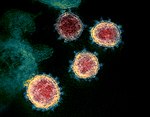 Severe acute respiratory syndrome coronavirus 2 (ウイルス) /
  Homo sapiens (ヒト)
 データ登録者
 米国, 2件
  引用
引用 構造の表示
構造の表示
 ダウンロードとリンク
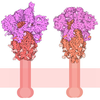
 emd_73306.png
 http://ftp.pdbj.org/pub/emdb/structures/EMD-73306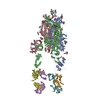


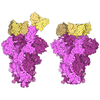
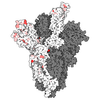
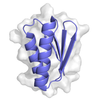
 Z (Sec.)
 Y (Row.)
 X (Col.)


 試料の構成要素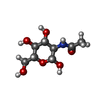
 解析
解析 電子顕微鏡法
 FIELD EMISSION GUN

