[日本語] English
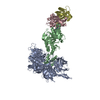
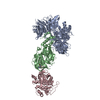
- EMDB-70791: Cryo-EM structure of the DDB1/CRBN-MRT-5702-G3BP2 ternary complex -

+
データを開く


IDまたはキーワード:

読み込み中...

-
基本情報

登録情報
データベース: EMDB / ID: EMD-70791
タイトルCryo-EM structure of the DDB1/CRBN-MRT-5702-G3BP2 ternary complex
マップデータ
試料
  • 複合体: DDB1/CRBN-MRT-5702-G3BP2 ternary complex
    • タンパク質・ペプチド: Protein cereblon
    • タンパク質・ペプチド: DNA damage-binding protein 1
    • タンパク質・ペプチド: Ras GTPase-activating protein-binding protein 2
  • リガンド: ZINC ION
  • リガンド: (1S,3S)-2-[(2-chlorophenyl)methanesulfonyl]-N-{[(4R)-3-(2,4-dioxo-1,3-diazinan-1-yl)imidazo[1,2-a]pyridin-7-yl]methyl}-1-methyl-1,2,3,4-tetrahydroisoquinoline-3-carboxamide
キーワードmolecular glue degrader / neo-substrate / cereblon / E3 ubiquitin ligase / LIGASE
機能・相同性
機能・相同性情報


negative regulation of monoatomic ion transmembrane transport / positive regulation by virus of viral protein levels in host cell / spindle assembly involved in female meiosis / epigenetic programming in the zygotic pronuclei / UV-damage excision repair / biological process involved in interaction with symbiont / limb development / regulation of mitotic cell cycle phase transition / WD40-repeat domain binding / Cul4A-RING E3 ubiquitin ligase complex ...negative regulation of monoatomic ion transmembrane transport / positive regulation by virus of viral protein levels in host cell / spindle assembly involved in female meiosis / epigenetic programming in the zygotic pronuclei / UV-damage excision repair / biological process involved in interaction with symbiont / limb development / regulation of mitotic cell cycle phase transition / WD40-repeat domain binding / Cul4A-RING E3 ubiquitin ligase complex / Cul4-RING E3 ubiquitin ligase complex / Cul4B-RING E3 ubiquitin ligase complex / ubiquitin ligase complex scaffold activity / negative regulation of reproductive process / negative regulation of developmental process / locomotory exploration behavior / viral release from host cell / cullin family protein binding / mRNA transport / ectopic germ cell programmed cell death / positive regulation of Wnt signaling pathway / positive regulation of viral genome replication / negative regulation of protein-containing complex assembly / proteasomal protein catabolic process / positive regulation of gluconeogenesis / stress granule assembly / nucleotide-excision repair / sperm end piece / molecular condensate scaffold activity / positive regulation of protein-containing complex assembly / Recognition of DNA damage by PCNA-containing replication complex / protein homooligomerization / regulation of circadian rhythm / DNA Damage Recognition in GG-NER / Dual Incision in GG-NER / Transcription-Coupled Nucleotide Excision Repair (TC-NER) / Formation of TC-NER Pre-Incision Complex / Wnt signaling pathway / Formation of Incision Complex in GG-NER / cytoplasmic stress granule / Dual incision in TC-NER / Gap-filling DNA repair synthesis and ligation in TC-NER / positive regulation of protein catabolic process / cellular response to UV / rhythmic process / site of double-strand break / sperm principal piece / Neddylation / sperm midpiece / Potential therapeutics for SARS / ubiquitin-dependent protein catabolic process / damaged DNA binding / transmembrane transporter binding / proteasome-mediated ubiquitin-dependent protein catabolic process / protein-macromolecule adaptor activity / chromosome, telomeric region / protein ubiquitination / innate immune response / DNA repair / mRNA binding / apoptotic process / DNA damage response / negative regulation of apoptotic process / protein-containing complex binding / nucleolus / perinuclear region of cytoplasm / SARS-CoV-2 activates/modulates innate and adaptive immune responses / protein-containing complex / : / DNA binding / RNA binding / extracellular exosome / nucleoplasm / membrane / metal ion binding / nucleus / cytoplasm / cytosol
類似検索 - 分子機能
G3BP2, RNA recognition motif / Ras GTPase-activating protein-binding protein / Nuclear transport factor 2, eukaryote / Nuclear transport factor 2 domain profile. / Nuclear transport factor 2 (NTF2) domain / Nuclear transport factor 2 domain / Yippee/Mis18/Cereblon / Yippee zinc-binding/DNA-binding /Mis18, centromere assembly / CULT domain / CULT domain profile. ...G3BP2, RNA recognition motif / Ras GTPase-activating protein-binding protein / Nuclear transport factor 2, eukaryote / Nuclear transport factor 2 domain profile. / Nuclear transport factor 2 (NTF2) domain / Nuclear transport factor 2 domain / Yippee/Mis18/Cereblon / Yippee zinc-binding/DNA-binding /Mis18, centromere assembly / CULT domain / CULT domain profile. / Lon N-terminal domain profile. / Lon protease, N-terminal domain / Lon protease, N-terminal domain superfamily / ATP-dependent protease La (LON) substrate-binding domain / Found in ATP-dependent protease La (LON) / : / RSE1/DDB1/CPSF1 second beta-propeller / Cleavage/polyadenylation specificity factor, A subunit, C-terminal / Cleavage/polyadenylation specificity factor, A subunit, N-terminal / : / CPSF A subunit region / RSE1/DDB1/CPSF1 first beta-propeller / PUA-like superfamily / NTF2-like domain superfamily / RNA recognition motif / RNA recognition motif / Eukaryotic RNA Recognition Motif (RRM) profile. / RNA recognition motif domain / RNA-binding domain superfamily / Nucleotide-binding alpha-beta plait domain superfamily / WD40-repeat-containing domain superfamily / WD40/YVTN repeat-like-containing domain superfamily
類似検索 - ドメイン・相同性
DNA damage-binding protein 1 / Protein cereblon / Ras GTPase-activating protein-binding protein 2
類似検索 - 構成要素
生物種Homo sapiens (ヒト)
手法単粒子再構成法 / クライオ電子顕微鏡法 / 解像度: 2.5 Å
データ登録者Quan C / Petzold G / Gainza P / Tsai J / Bunker RD / Wiedmer L / Donckele EJ
資金援助1件
OrganizationGrant number
Other private
引用ジャーナル: Nat Struct Mol Biol / : 2026
タイトル: Cereblon induces G3BP2 neosubstrate degradation using molecular surface mimicry.
著者: Stefano Annunziato / Chao Quan / Etienne J Donckele / Ilaria Lamberto / Richard D Bunker / Mary Zlotosch / Laura Schwander / Anastasia Murthy / Lars Wiedmer / Camille Staehly / Michelle ...著者: Stefano Annunziato / Chao Quan / Etienne J Donckele / Ilaria Lamberto / Richard D Bunker / Mary Zlotosch / Laura Schwander / Anastasia Murthy / Lars Wiedmer / Camille Staehly / Michelle Matysik / Samuel Gilberto / Despina Kapsitidou / Daric Wible / Gian Marco De Donatis / Peter Trenh / Rohitha SriRamaratnam / Vaik Strande / Raphael Lieberherr / David Lyon / Danielle Steiner / Joao Silva / Reinaldo Almeida / Elena Dolgikh / Bradley DeMarco / Jennifer Tsai / Amine Sadok / Vladislav Zarayskiy / Magnus Walter / Ralph Tiedt / Kevin J Lumb / Debora Bonenfant / Bernhard Fasching / John C Castle / Sharon A Townson / Pablo Gainza / Georg Petzold /
要旨: Molecular glue degraders (MGDs) are small-molecule compounds that divert E3 ligases to degrade nonnatural substrates called neosubstrates. Clinically effective MGDs bind cereblon (CRBN), a substrate ...Molecular glue degraders (MGDs) are small-molecule compounds that divert E3 ligases to degrade nonnatural substrates called neosubstrates. Clinically effective MGDs bind cereblon (CRBN), a substrate receptor of the Cullin 4-RING E3 ubiquitin ligase (CRL4), and recruit neosubstrates to an MGD-induced neosurface on the CRBN CULT domain through molecular mimicry of a natural CRBN degron. Here, we identify G3BP2 (Ras-GAP SH3 domain-binding protein 2), a neosubstrate that bypasses canonical interactions with CRBN by engaging an unconventional binding site on the CRBN LON domain. The ternary complex interface does not resemble known interactions with CRBN. Instead, CRBN leverages a preexisting protein-protein interaction (PPI) hotspot on the target protein by mimicking an endogenous binding partner of G3BP2. Our findings suggest that composite neosurfaces that mimic and stabilize the footprint of natural PPIs (in short, 'glueprints') could become a viable strategy for the rational expansion of the MGD target repertoire.
履歴
登録2025年5月23日-
ヘッダ(付随情報) 公開2026年1月28日-
マップ公開2026年1月28日-
更新2026年4月1日-
現状2026年4月1日処理サイト: RCSB / 状態: 公開

-
構造の表示

添付画像

ダウンロードとリンク

-
マップ

ファイルダウンロード / ファイル: emd_70791.map.gz / 形式: CCP4 / 大きさ: 824 MB / タイプ: IMAGE STORED AS FLOATING POINT NUMBER (4 BYTES)
投影像・断面図

画像のコントロール

大きさ
明度
コントラスト
その他
Z (Sec.)Y (Row.)X (Col.)
0.65 Å/pix.
x 600 pix.
= 392.4 Å
0.65 Å/pix.
x 600 pix.
= 392.4 Å
0.65 Å/pix.
x 600 pix.
= 392.4 Å

表面

投影像

断面 (1/3)

断面 (1/2)

断面 (2/3)

画像は Spider により作成

ボクセルのサイズX=Y=Z: 0.654 Å
密度
表面レベル登録者による: 0.044
最小 - 最大-0.27231437 - 0.4863657
平均 (標準偏差)-0.00018413516 (±0.005867048)
対称性空間群: 1
詳細

EMDB XML:

マップ形状
Axis orderXYZ
Origin000
サイズ600600600
Spacing600600600
セルA=B=C: 392.4 Å
α=β=γ: 90.0 °

-
添付データ

-
ハーフマップ: #2

ファイルemd_70791_half_map_1.map
投影像・断面図
ZYX

投影像

断面 (1/2)
密度ヒストグラム

-
ハーフマップ: #1

ファイルemd_70791_half_map_2.map
投影像・断面図
ZYX

投影像

断面 (1/2)
密度ヒストグラム

-
試料の構成要素

-
全体 : DDB1/CRBN-MRT-5702-G3BP2 ternary complex

全体名称: DDB1/CRBN-MRT-5702-G3BP2 ternary complex
要素
  • 複合体: DDB1/CRBN-MRT-5702-G3BP2 ternary complex
    • タンパク質・ペプチド: Protein cereblon
    • タンパク質・ペプチド: DNA damage-binding protein 1
    • タンパク質・ペプチド: Ras GTPase-activating protein-binding protein 2
  • リガンド: ZINC ION
  • リガンド: (1S,3S)-2-[(2-chlorophenyl)methanesulfonyl]-N-{[(4R)-3-(2,4-dioxo-1,3-diazinan-1-yl)imidazo[1,2-a]pyridin-7-yl]methyl}-1-methyl-1,2,3,4-tetrahydroisoquinoline-3-carboxamide

-
超分子 #1: DDB1/CRBN-MRT-5702-G3BP2 ternary complex

超分子名称: DDB1/CRBN-MRT-5702-G3BP2 ternary complex / タイプ: complex / ID: 1 / 親要素: 0 / 含まれる分子: #1-#3
由来(天然)生物種: Homo sapiens (ヒト)

-
分子 #1: Protein cereblon

分子名称: Protein cereblon / タイプ: protein_or_peptide / ID: 1 / コピー数: 1 / 光学異性体: LEVO
由来(天然)生物種: Homo sapiens (ヒト)
分子量理論値: 43.55409 KDa
組換発現生物種: Spodoptera frugiperda (ツマジロクサヨトウ)
配列文字列: INFDTSLPTS HTYLGADMEE FHGRTLHDDD SCQVIPVLPQ VMMILIPGQT LPLQLFHPQE VSMVRNLIQK DRTFAVLAYS NVQEREAQF GTTAEIYAYR EEQDFGIEIV KVKAIGRQRF KVLELRTQSD GIQQAKVQIL PECVLPSTMS AVQLESLNKC Q IFPSKPVS ...文字列:
INFDTSLPTS HTYLGADMEE FHGRTLHDDD SCQVIPVLPQ VMMILIPGQT LPLQLFHPQE VSMVRNLIQK DRTFAVLAYS NVQEREAQF GTTAEIYAYR EEQDFGIEIV KVKAIGRQRF KVLELRTQSD GIQQAKVQIL PECVLPSTMS AVQLESLNKC Q IFPSKPVS REDQCSYKWW QKYQKRKFHC ANLTSWPRWL YSLYDAETLM DRIKKQLREW DENLKDDSLP SNPIDFSYRV AA CLPIDDV LRIQLLKIGS AIQRLRCELD IMNKCTSLCC KQCQETEITT KNEIFSLSLC GPMAAYVNPH GYVHETLTVY KAC NLNLIG RPSTEHSWFP GYAWTVAQCK ICASHIGWKF TATKKDMSPQ KFWGLTRSAL LP

UniProtKB: Protein cereblon

-
分子 #2: DNA damage-binding protein 1

分子名称: DNA damage-binding protein 1 / タイプ: protein_or_peptide / ID: 2 / コピー数: 1 / 光学異性体: LEVO
由来(天然)生物種: Homo sapiens (ヒト)
分子量理論値: 127.097469 KDa
組換発現生物種: Spodoptera frugiperda (ツマジロクサヨトウ)
配列文字列: MSYNYVVTAQ KPTAVNGCVT GHFTSAEDLN LLIAKNTRLE IYVVTAEGLR PVKEVGMYGK IAVMELFRPK GESKDLLFIL TAKYNACIL EYKQSGESID IITRAHGNVQ DRIGRPSETG IIGIIDPECR MIGLRLYDGL FKVIPLDRDN KELKAFNIRL E ELHVIDVK ...文字列:
MSYNYVVTAQ KPTAVNGCVT GHFTSAEDLN LLIAKNTRLE IYVVTAEGLR PVKEVGMYGK IAVMELFRPK GESKDLLFIL TAKYNACIL EYKQSGESID IITRAHGNVQ DRIGRPSETG IIGIIDPECR MIGLRLYDGL FKVIPLDRDN KELKAFNIRL E ELHVIDVK FLYGCQAPTI CFVYQDPQGR HVKTYEVSLR EKEFNKGPWK QENVEAEASM VIAVPEPFGG AIIIGQESIT YH NGDKYLA IAPPIIKQST IVCHNRVDPN GSRYLLGDME GRLFMLLLEK EEQMDGTVTL KDLRVELLGE TSIAECLTYL DNG VVFVGS RLGDSQLVKL NVDSNEQGSY VVAMETFTNL GPIVDMCVVD LERQGQGQLV TCSGAFKEGS LRIIRNGIGI HEHA SIDLP GIKGLWPLRS DPNRETDDTL VLSFVGQTRV LMLNGEEVEE TELMGFVDDQ QTFFCGNVAH QQLIQITSAS VRLVS QEPK ALVSEWKEPQ AKNISVASCN SSQVVVAVGR ALYYLQIHPQ ELRQISHTEM EHEVACLDIT PLGDSNGLSP LCAIGL WTD ISARILKLPS FELLHKEMLG GEIIPRSILM TTFESSHYLL CALGDGALFY FGLNIETGLL SDRKKVTLGT QPTVLRT FR SLSTTNVFAC SDRPTVIYSS NHKLVFSNVN LKEVNYMCPL NSDGYPDSLA LANNSTLTIG TIDEIQKLHI RTVPLYES P RKICYQEVSQ CFGVLSSRIE VQDTSGGTTA LRPSASTQAL SSSVSSSKLF SSSTAPHETS FGEEVEVHNL LIIDQHTFE VLHAHQFLQN EYALSLVSCK LGKDPNTYFI VGTAMVYPEE AEPKQGRIVV FQYSDGKLQT VAEKEVKGAV YSMVEFNGKL LASINSTVR LYEWTTEKEL RTECNHYNNI MALYLKTKGD FILVGDLMRS VLLLAYKPME GNFEEIARDF NPNWMSAVEI L DDDNFLGA ENAFNLFVCQ KDSAATTDEE RQHLQEVGLF HLGEFVNVFC HGSLVMQNLG ETSTPTQGSV LFGTVNGMIG LV TSLSESW YNLLLDMQNR LNKVIKSVGK IEHSFWRSFH TERKTEPATG FIDGDLIESF LDISRPKMQE VVANLQYDDG SGM KREATA DDLIKVVEEL TRIH

UniProtKB: DNA damage-binding protein 1

-
分子 #3: Ras GTPase-activating protein-binding protein 2

分子名称: Ras GTPase-activating protein-binding protein 2 / タイプ: protein_or_peptide / ID: 3 / コピー数: 2 / 光学異性体: LEVO
由来(天然)生物種: Homo sapiens (ヒト)
分子量理論値: 54.19807 KDa
組換発現生物種: Escherichia coli (大腸菌)
配列文字列: MVMEKPSPLL VGREFVRQYY TLLNKAPEYL HRFYGRNSSY VHGGVDASGK PQEAVYGQND IHHKVLSLNF SECHTKIRHV DAHATLSDG VVVQVMGLLS NSGQPERKFM QTFVLAPEGS VPNKFYVHND MFRYEDEVFG DSEPELDEES EDEVEEEQEE R QPSPEPVQ ...文字列:
MVMEKPSPLL VGREFVRQYY TLLNKAPEYL HRFYGRNSSY VHGGVDASGK PQEAVYGQND IHHKVLSLNF SECHTKIRHV DAHATLSDG VVVQVMGLLS NSGQPERKFM QTFVLAPEGS VPNKFYVHND MFRYEDEVFG DSEPELDEES EDEVEEEQEE R QPSPEPVQ ENANSGYYEA HPVTNGIEEP LEESSHEPEP EPESETKTEE LKPQVEEKNL EELEEKSTTP PPAEPVSLPQ EP PKAFSWA SVTSKNLPPS GTVSSSGIPP HVKAPVSQPR VEAKPEVQSQ PPRVREQRPR ERPGFPPRGP RPGRGDMEQN DSD NRRIIR YPDSHQLFVG NLPHDIDENE LKEFFMSFGN VVELRINTKG VGGKLPNFGF VVFDDSEPVQ RILIAKPIMF RGEV RLNVE EKKTRAARER ETRGGGDDRR DIRRNDRGPG GPRGIVGGGM MRDRDGRGPP PRGGMAQKLG SGRGTGQMEG RFTGQ RR

UniProtKB: Ras GTPase-activating protein-binding protein 2

-
分子 #4: ZINC ION

分子名称: ZINC ION / タイプ: ligand / ID: 4 / コピー数: 1 / : ZN
分子量理論値: 65.409 Da

-
分子 #5: (1S,3S)-2-[(2-chlorophenyl)methanesulfonyl]-N-{[(4R)-3-(2,4-dioxo...

分子名称: (1S,3S)-2-[(2-chlorophenyl)methanesulfonyl]-N-{[(4R)-3-(2,4-dioxo-1,3-diazinan-1-yl)imidazo[1,2-a]pyridin-7-yl]methyl}-1-methyl-1,2,3,4-tetrahydroisoquinoline-3-carboxamide
タイプ: ligand / ID: 5 / コピー数: 1 / : A1CED
分子量理論値: 621.106 Da

-
実験情報

-
構造解析

手法クライオ電子顕微鏡法
解析単粒子再構成法
試料の集合状態particle

-
試料調製

緩衝液pH: 7.4
グリッドモデル: C-flat-1.2/1.3 / 材質: GOLD / メッシュ: 300 / 支持フィルム - 材質: CARBON / 支持フィルム - トポロジー: HOLEY / 前処理 - タイプ: GLOW DISCHARGE / 前処理 - 時間: 60 sec.
凍結凍結剤: ETHANE / チャンバー内湿度: 100 % / チャンバー内温度: 277 K / 装置: FEI VITROBOT MARK IV

-
電子顕微鏡法

顕微鏡TFS KRIOS
撮影フィルム・検出器のモデル: GATAN K3 BIOQUANTUM (6k x 4k)
平均電子線量: 50.5056 e/Å2
電子線加速電圧: 300 kV / 電子線源: FIELD EMISSION GUN
電子光学系C2レンズ絞り径: 50.0 µm / 照射モード: FLOOD BEAM / 撮影モード: BRIGHT FIELD / Cs: 2.7 mm / 最大 デフォーカス(公称値): 2.0 µm / 最小 デフォーカス(公称値): 0.3 µm / 倍率(公称値): 130000
試料ステージ試料ホルダーモデル: FEI TITAN KRIOS AUTOGRID HOLDER
ホルダー冷却材: NITROGEN
実験機器
モデル: Titan Krios / 画像提供: FEI Company

+
画像解析

CTF補正タイプ: NONE
初期モデルモデルのタイプ: PDB ENTRY
PDBモデル - PDB ID:

詳細: PDB ID 5DRV used as startup model for chains C and D
最終 再構成解像度のタイプ: BY AUTHOR / 解像度: 2.5 Å / 解像度の算出法: FSC 0.143 CUT-OFF / 使用した粒子像数: 565661
初期 角度割当タイプ: MAXIMUM LIKELIHOOD
最終 角度割当タイプ: MAXIMUM LIKELIHOOD

+
万見について

-
お知らせ

-
2022年2月9日: EMDBエントリの付随情報ファイルのフォーマットが新しくなりました

EMDBエントリの付随情報ファイルのフォーマットが新しくなりました

  • EMDBのヘッダファイルのバージョン3が、公式のフォーマットとなりました。
  • これまでは公式だったバージョン1.9は、アーカイブから削除されます。

関連情報:EMDBヘッダ

外部リンク:wwPDBはEMDBデータモデルのバージョン3へ移行します

-
2020年8月12日: 新型コロナ情報

新型コロナ情報

URL: https://pdbj.org/emnavi/covid19.php

新ページ: EM Navigatorに新型コロナウイルスの特設ページを開設しました。

関連情報:Covid-19情報 / 2020年3月5日: 新型コロナウイルスの構造データ

+
2020年3月5日: 新型コロナウイルスの構造データ

新型コロナウイルスの構造データ

関連情報:万見生物種 / 2020年8月12日: 新型コロナ情報

外部リンク:COVID-19特集ページ - PDBj / 今月の分子2020年2月:コロナウイルスプロテーアーゼ

+
2019年1月31日: EMDBのIDの桁数の変更

EMDBのIDの桁数の変更

  • EMDBエントリに付与されているアクセスコード(EMDB-ID)は4桁の数字(例、EMD-1234)でしたが、間もなく枯渇します。これまでの4桁のID番号は4桁のまま変更されませんが、4桁の数字を使い切った後に発行されるIDは5桁以上の数字(例、EMD-12345)になります。5桁のIDは2019年の春頃から発行される見通しです。
  • EM Navigator/万見では、接頭語「EMD-」は省略されています。

関連情報:Q: 「EMD」とは何ですか? / 万見/EM NavigatorにおけるID/アクセスコードの表記

外部リンク:EMDB Accession Codes are Changing Soon! / PDBjへお問い合わせ

+
2017年7月12日: PDB大規模アップデート

PDB大規模アップデート

  • 新バージョンのPDBx/mmCIF辞書形式に基づくデータがリリースされました。
  • 今回の更新はバージョン番号が4から5になる大規模なもので、全エントリデータの書き換えが行われる「Remediation」というアップデートに該当します。
  • このバージョンアップで、電子顕微鏡の実験手法に関する多くの項目の書式が改定されました(例:em_softwareなど)。
  • EM NavigatorとYorodumiでも、この改定に基づいた表示内容になります。

外部リンク:wwPDB Remediation / OneDepデータ基準に準拠した、より強化された内容のモデル構造ファイルが、PDBアーカイブで公開されました。

-
万見 (Yorodumi)

幾万の構造データを、幾万の視点から

  • 万見(Yorodumi)は、EMDB/PDB/SASBDBなどの構造データを閲覧するためのページです。
  • EM Navigatorの詳細ページの後継、Omokage検索のフロントエンドも兼ねています。

関連情報:EMDB / PDB / SASBDB / 3つのデータバンクの比較 / 万見検索 / 2016年8月31日: 新しいEM Navigatorと万見 / 万見文献 / Jmol/JSmol / 機能・相同性情報 / 新しいEM Navigatorと万見の変更点

他の情報も見る